Sunday, June 18, 2017

Sentimental Sunday: Happy Father's Day!

My dad, Frederick Henry Pape, my sister Mary, and me in a pool during a summer vacation trip to New Mexico in 1966.


© Amanda Pape - 2017 - click here to e-mail me.

Tuesday, June 13, 2017

Tombstone Tuesday: Lithuanian Radauskas Relatives, Rozalimas Cemetery

Some time ago, my Lithuanian third cousin Osvaldas Guokas sent me some photographs of tombstones with our family names on them from the cemetery in Rozalimas, Lithuania.  Here is one where I know how the people buried here are related to me:


Steponas Radauskas is my first cousin twice removed.  He is the son of my second great aunt Agota Guokaitė Radauskienė (Guokas Radauskas) (born in 1861, the older sister of my great-grandfather Charles Peter Guokas Sr.) and Ignatijus Radauskas (ABT 1853-1913).

Steponas was born February 14, 1899, in Gikoniai village in Lithuania, the tenth of the twelve children of Agota and Ignatijus.  Two of his older siblings, Leonas (Leo) Radauskas (1889-1973) and Anastazija Radauskas Polianski (1892-1978), and his younger sister Agota Radauskas Phillips Zaker (1902-1980), came to the United States.

On January 29, 1929, Steponas married Bronislava (Brone) Skačkauskaitė (1905-1961) in Šeduva, in the Radviliskis district municipality in Lithuania.  This is just 17.4 kilometers from Gikoniai.  You can also see from the map below that Rozalimas and Smilgiai are nearby.


The last name on the tombstone is Steponas' and Brone's son (sūnus in Lithuanian), Antanas, who was born about 1934 and died about 1935.


© Amanda Pape - 2017 - click here to e-mail me.

Sunday, June 11, 2017

Sentimental Sunday: Odin Frederick Pape, 2002-2017

Yesterday my brother Brian and his wife Paige lost their 15-year-old golden retriever, Odin Frederick, described by Brian as "'the best dog we ever owned' and whoever owned us."  He was a great companion in all their adventures and pretty lively (albeit slower) when I last saw him a few months ago.  Here are some pictures of him from the past:


Above:  Odin in May 2002, shortly after Brian and Paige got him.
Below:  Paige and Odin, May 2002.


My brother Brian captioned these two photos from June 11, 2002, as follows:
Above:  "Odin - I need a file and hacksaw."
Below:  "Odin - Which to chew first."


Above:  My son Eric with Odin on our visit to Texas in August, 2002.
Below:  Odin in early 2009


Above:  Brian with Odin on June 24, 2011.  Our family had all gone together to see "Late Nite Catechism" in Austin that evening - good times.
Below:  Brian with Odin at my parents' home in Austin on March 13, 2016.


Above:  My brother Mark with Odin on the right, and Odin's housemate Thorin on the left, at Thanksgiving at Brian and Paige's home in Austin, 2016.


© Amanda Pape - 2017 - click here to e-mail me.

Friday, June 9, 2017

Friday's Faces From the Past: Family of Agota Guokaitė and Ignacijus Radauskas, early 1913

My third cousin Osvaldas Guokas sent me another wonderful picture from Lithuania:


This is the family of my second great aunt, Agota Guokaitė (Guokas) Radauskienė (Radauskas, 1861-1942), the older sister of my great-grandfather Charles (Kazimieras) Guokas Sr. (1863-1939).  She and her family lived in Gikoniai village in Šiauliai County in Lithuania.  Gikoniai is a little south and west of the village of Čelkiai, where Agota and Kazimieras and many of their siblings were born.

Agota and her husband Ignacijus Radauskas (1858-1913) had at least twelve children (that we have found so far),  and at least seven of those lived to adulthood.  Three of those children moved to the United States.

In the photograph above, standing, from left, are Ignas Radauskas (Ignatijus Jr., born 1894), an unknown person who may be son Justinas Radauskas (born 1888), Anastazija (Anastasia) Radauskaitė Palijanskas (Polianski) (1892-1978), Kazimieras Radauskas (born 1886), Virginija Radauskaitė Palujanskas (born ABT 1897), and Steponas Radauskas (1899-1944).

Sitting from left, are an unknown person (who may be Agota's brother Antanas Guokas, Osvaldas' great-grandfather, who may be Agota's twin), Agota Guokienė Radauskienė, Agota Radauskaitė Filipavicius Zakarauskas (Agota Radauskas Phillips Zaker, 1902-1980), and Ignacijus Radauskas (Sr.)

Ignacijus Sr. died on June 5, 1913, so we know the picture was taken before then.  Son Leonas (Leo) Radauskas (1889-1973) is not in the photograph, because he was in Houston, Texas, in the 1910 Census, and in Houston city directories through 1913.

Anastazija went to the United States sometime between the time this photograph was taken and June 1, 1914, when she married Juozapas (Joseph Anthony) Palijanskas (Polianski), whose brother Petras married Virginija in this photo.  Later, around 1922, the youngest daughter, Agota, also went to the United States.  I have not been able to find her in any census or other document, but we are unsure about her married last name.

This photograph came from the private album of Aldona Radauskaitė Zigmantavičienė, the daughter of Steponas Radauskas. As Osvaldas says, "She saved it in perfect condition to our days."  Thank you Aldona!


© Amanda Pape - 2017 - click here to e-mail me.

Tuesday, June 6, 2017

Tombstone Tuesday: Lithuanian Palijanskas Relative, Smilgiai Cemetery

My Lithuanian third cousin Osvaldas Guokas went to the parish cemetery in Smilgiai on June 2 and took lots of pictures.  This one is for someone not directly related to me, but instead is the father-in-law of a distant relative.  That relative and her husband apparently paid for this grave marker:


photos above and below by Osvaldas Guokas, 2 June 2017


Describing the very top of the marker, Osvaldas said,

"On Lithuanian tombstones you can see
AA or A (cross) A
It means: Amžiną atilsį - Rest eternal."

The words "cia ilsisi" mean "here rests."

Osvaldas provided the translation for the rest of the marker.  He said the "text is in Lithuanian but in an interesting old style grammar."

Father Juozapas Palijanskas died 1902 May 22, was 55 years old;
Memory from son and daughter-in-law from America
Juozapas and Anastazija Palijanskas

Anastzija is Anastasia Radauskas Polianski (1892-1978), who immigrated to America about 1912-1914, and married Joseph Anthony Polianski (1890-1952) in Baltimore, Maryland, on June 1, 1914.  More about them in a future post.


© Amanda Pape - 2017 - click here to e-mail me.

Thursday, June 1, 2017

Treasure Chest Thursday: Happy Birthday to My Son Eric!


My son Eric and me in the summer of 1988.

© Amanda Pape - 2017 - click here to e-mail me.

Sunday, May 28, 2017

Military Monday: World War I Memorial, Spohn Park, Corpus Christi, Texas

Corpus Christi has a World War I memorial in Spohn Park in the downtown area.  This memorial was dedicated in 1931 for the 39 Nueces County men killed in that war. It was originally called "The Gold Star Tree Court of Honor," (with the slogan "Some deeds must not die; some names must not wither," according to newspaper clippings in a 1931-32 scrapbook in the Lillie Mussett (Mrs. Sam) Rankin Collection at the Corpus Christi Public Library.  (The scrapbook also contains articles with, in some cases, photographs, of all 39 men honored.)

The original memorial consisted of bronze medallions for each serviceman with a crepe myrtle tree planted adjacent to it. The medallions and trees line the Broadway Bluff Balustrade on either side of Lipan Street (which is just above the words "World War Memorial" in the photo below). About 2,500 people attended the original dedication in 1931.  Back then, they had no idea there would be a second World War.

Here's how the memorial looked about nine years ago:


Above:  World War Memorial Gold Star Court of Honor [8 October 2008, with Corpus Christi Cathedral in the background] / Terry Ross / CC BY-SA 2.0

Below:  "Heroes All" [8 October 2008] / Terry Ross / CC BY-SA 2.0


Just to the right in the first photo, not visible in it, is the sign pictured just above.  In the background, next to the balustrade, you can see one of the medallions on a small post.

In a June 1932 photo, the sign can be seen on the base of what is now the flagpole in the upper left corner of the first photograph in this post, at the top of the bluff.  In that 1932 photo, the sign was illuminated with incandescent bulbs; later, those bulbs were changed to neon.  It appears that might have happened and the sign might have been moved around April 2000 as part of a restoration project, but it's not clear to me if the sign is lit today.  It is about level with the large granite monument pictured below, which was added in 2001.  The concrete letters and star reading "World War Memorial Gold *star* Court" were added sometime between May 1941 and November 1944.


Above: p1400003 [World War Memorial Gold Star Court of Honor, 8 October 2008, cropped] 

Below: p1400004 [World War Memorial Gold Star Court of Honor, 8 October 2008, cropped] 


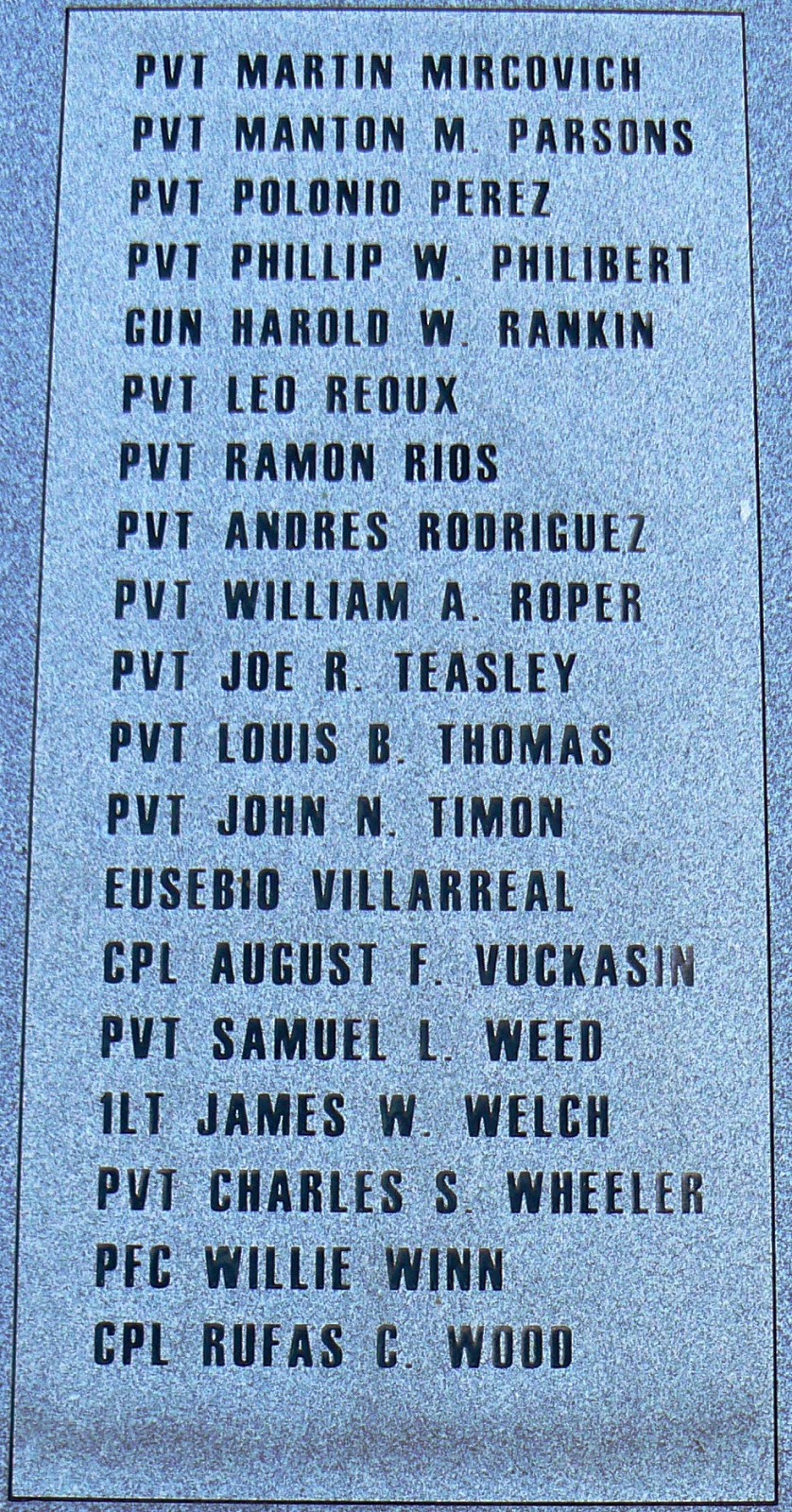
Following are photographs and transcriptions of the 39 names listed in two panels on the monument:


Pvt Juvencio Almaraz
Pvt Tomas Alvarado
Pvt Benjamin Birmingham
Pvt Albert Blair
Pvt Tranquelino Bosque
1Lt Morris F. Briggs
Wagoner James H. Cade
Pvt Fred Cruz
Pvt William Cunningham
Pvt Robert Gillett
Pvt Fernando Gonzalez
Seaman Ernest Gragg
Pvt Arthur Grant
Pvt Jesus Guzman
Pvt Ben Hastings
Pvt Otto Hercek
Pvt Samuel H. Ingle
Sgt Wilbur F. Lane
Pvt Joe Maupin
Cpt George McDonald


p1400007 [World War Memorial Gold Star Court of Honor, 8 October 2008, cropped] Terry Ross / CC BY-SA 2.0

Pvt Martin Mircovich
Pvt Manton M. Parsons
Pvt. Polonio Perez
Pvt Phillip W. Philibert
Gun Harold W, Rankin
Pvt Leo Reoux
Pvt Ramon Rios
Pvt Andres Rodriguez
Pvt William A. Roper
Pvt Joe R. Teasley
Pvt Louis B. Thomas
Pvt John N. Timon
Eusebio Villarreal
Cpl August F. Vuckasin
Pvt Samuel L. Weed
1Lt James W. Welch
Pvt Charles S. Wheeler
PFC Willie Winn
Cpt Rufas C. Wood


 p1400008 [World War Memorial Gold Star Court of Honor, 8 October 2008, cropped] / Terry Ross / CC BY-SA 2.0


Other parts of the 2001 monument include a brief history of Spohn Park, where the memorial is located, and of the Gold Star Court itself:


Above left:  p1400005 [World War Memorial Gold Star Court of Honor, 8 October 2008, cropped] 
Above right:  p1400006 [World War Memorial Gold Star Court of Honor, 8 October 2008, cropped] 

Below:  Medallion with tattered flag at Gold Star Court of Honor, Spohn Park, Upper Broadway and Lipan.  October 2010.  Kenneth L. Anthony Photographic Collection, Item 212-158. Special Collections and Archives, Mary and Jeff Bell Library, Texas A&M University-Corpus Christi.  Used with permission of Kenneth L. Anthony.  


The bronze plaques were originally installed closer to the ground.  In 1999, the medallions were raised and restored, as pictured above and below:


Above:  Medallion memorializing Eusebio Villareal [note his name was spelled incorrectly on both monuments], Gold Star Court of Honor, Spohn Park, Upper Broadway and Lipan.  October 2010.  Kenneth L. Anthony Photographic Collection, Item 212-159. Special Collections and Archives, Mary and Jeff Bell Library, Texas A&M University-Corpus Christi.  Used with permission of Kenneth L. Anthony. 


Below:  Medallion memorializing Pvt. Louis B. Thomas [Tamez], Gold Star Court of Honor, Spohn Park, Upper Broadway and Lipan.  October 2010. Kenneth L. Anthony Photographic Collection, Item 212-160. Special Collections and Archives, Mary and Jeff Bell Library, Texas A&M University-Corpus Christi.  Used with permission of Kenneth L. Anthony. 


Here is the text of the Texas Historical Marker dedicated in a ceremony on November 10, 2016, Veterans Day (with some additions in brackets):

Gold Star Court of Honor

The Corpus Christi Gold Star Court of Honor pays tribute to the mothers of the servicemen of Nueces County killed during World War I (1914-1918). Incorporated into the existing Spohn Park, part of the Broadway Bluff improvements completed in 1916, this court was the first of its kind in the state when dedicated on March 22, 1931.

The court was a project of the Daughters of the American Revolution (DAR), led by Mrs. Sam (Lillie) Rankin, regent of the Corpus Christi Chapter. The DAR was joined by the American Legion, as well as local civic, religious and business groups. The Gold Star Court was designed by Mrs. Frank [Eloise] de Garmo. Instrumental in establishing Courts of Honor in northeast cities, de Garmo envisioned the memorial as a living space to honor the fallen servicemen who made the ultimate sacrifice in the ‘War to End All Wars.’ The city planted crepe myrtle trees and built a gold star light, three feet in diameter, outlined with yellow and white lamps; in the center read the words, "Our 1917 World War Gold Star Heroes." The gold star was located at the northern point of the highest terraces, and at the opposite end, Nueces County officials placed a magnificent flagpole. On August 2, 1932, a British 5-inch field piece and a 3-inch caisson and limber were added to the site [later removed]. Later, large concrete letters reading "World War Memorial Gold Star Court" were placed in a semicircle.

In 1988, Broadway Bluff, Spohn Park, and the Gold Star Court were listed in the National Register of Historic Places. The site fell into disrepair until volunteers undertook a restoration project in 2000. A private, city, and county effort, the Gold Star Court — the first in Texas — honors Nueces County’s revered heroes and their mothers.


This post was done in honor of Memorial Day for The Honor Roll Project begun by Heather Wilkinson Rojo of Nutfield Genealogy.

© Amanda Pape - 2017 - click here to e-mail me.

Sunday, May 21, 2017

Sentimental Sunday: Sauliukas and Osvaldas, ABT 1975

My Lithuanian third cousin Osvaldas Guokas sent me another couple pictures that he said I could post in this blog. Here is what he had to say about them:


Cousins Sauliukas and Osvaldas, ABT 1975


"This is only one of a few photos with Saulius Tamulionis,  my cousin....The photo was done near Čelkiai, I think near the Tamuliuonis house, on the grange [farmstead] near Čelkiai.

Saulius is the son of Adelė Burkauskaitė Tamulionienė (who is the daughter of Marytė Guokaitė Burkauskienė).  Saulius Tamulionis died young, at 18 years old.  We know he was a very friendly and very smart boy.

I think that it is early spring 1975, the time of my first steps.  Stanislovas Tamulionis (the brother of Saulius) who did this photo shoot, loves all electronics and techniques, he purchased a camera, took the shots, and he did all the photochemical process himself.

Saulius is very nice Lithuanian man's name and comes from the Lithuanian word Saulė - the Sun in English. It's like son of the Sun.  And nobody called him Saulius, only the nickname Sauliukas (it is more shiny, more lovely).

They lived in the old big wooden Tamulionis family house near the road from Plaučiškiai to Žvirbloniai.  The Communists in Soviet times let Stanislovas Tamulionis and Adelė Burkauskaitė Tamulionė stay in this house, because it was not in the fields, but near the road.


Google map and satellite images locating the Lithuanian towns mentioned in this post


Two kilometers from this house to Žvirbloniai is the Galaliai grange where there is one family house. In this house lived Justinas Guokas and Alfonsa Remeikaitė Guokienė. But they had not owned it from the beginning. The Communists destroyed Justinas' house, that he constructed himself. And they forced them to move from their own house to the Galaliai grange.  I don't know who was the owner of this house before Justinas moved in, I just know that the Galaliai grange house was not Guokas property from the beginning.

At the time I was born in 1974, my father Vytautas Guokas and my mother Genovaitė Jurgaitytė Guokienė lived with Alfonsa Guokiene in this house in Galaliai in the neighborhood with the Tamulionis family. We lived in this house from the time of my parents' marriage and moved to the town of Pakruojis one year after my birth. So I spent a lot of time with my Tamulionis cousins in the first year of my life.

From my childhood I remember an old well in the Tamulionis house yard. It was old style, wooden, with old big hard wooden construction like in the photo below.

And I remember a big, brown, strong horse in the yard :) I dropped down from this horse together with my brother when I was about 7 years old and my brother Arūnas was about 3 years old." 


Senas šulinys [Old well] / VN (Virgis of Pakruojis, Lithuania) / CC BY 2.0

Thursday, May 18, 2017

Those Places Thursday: Smilgiai Belfry Story


May 2016 photo by Osvaldas Guokas, used with permission


My third cousin Osvaldas Guokas in Lithuania sent the picture (above) and story (below) about the belfry of St. George Catholic Church in Smilgiai, Lithuania:


The Smilgiai Church belfry was constructed at the end of the 19th century.
I believe that Kazimieras Guokas [my great-grandfather] possibly saw this building.
As I wrote in the past, it was the time of Russian occupation.  Russians banned Lithuanian writing, books, and schools; and it was forbidden to construct any new Catholic buildings.
It was impossible to construct the belfry in Smilgiai legally.
But there was a brave priest in Smilgiai.
At first, he told the citizens that he wanted to construct a well near the church. So they started digging the ground and laying a brick foundation. In the [nearby] village of Valiliškiai, he ordered all wooden frames from pine logs.

When all the preparatory jobs were done, the priest called all men from Smilgiai and Parish villages to come help. And they constructed the belfry during one night!

But after some time, a Russian administration controller came from Panevezys.  It was dangerous.
The priest told the local men, that they must throw earth and dirt on the wooden construction before the visit of the controller.  It looked like an old building after this treatment.

When the controller came to Smilgiai, the priest invited him for a rich dinner with alcohol drinks and roasted geese.

The controller did not recognize that the belfry was a new building, and everything ended very well.

In the future, this building was a very important place for the resistance. Priests hid here books in Lithuanian and other forbidden press [materials].

One very important historical person from Smilgiai was Mr. Antanas Bataitis from Valiliškiai. He illegally delivered Lithuanian books from Karaliaučius (Königsberg in German and Kaliningrad in Russian;  today, this city is still under Russian occupation).
The city Karaliaučius was under German Prussian control in those times. Lithuanians printed the books in this city.
Mr. Antanas Bataitis hid illegal books in the belfry and the priest financed this activity.
We have an unique word Knygnešys, in Lithuanian.  It means a person who delivers books illegally.  It is a very respectable epithet for a person in Lithuania.


© Amanda Pape - 2017 - click here to e-mail me.

Saturday, May 13, 2017

Sentimental Sunday: Happy Mother's Day!


My mother, Geraldine Margaret Guokas Pape, at a baby shower given by her mother-in-law and sisters-in-law in Chicago, Illinois, before I was born in 1957.


© Amanda Pape - 2017 - click here to e-mail me.