Showing posts with label Hanchette. Show all posts

Monday, September 9, 2013

Mystery Monday, Part 6: What Happened to H. Jay Hanchette? - continued

This is part 6 of my series on the mysterious disappearance of H. Jay Hanchette in 1891.  Parts 2, 3, 4, and 5 addressed the tragedies befalling Hanchette's  father, wife, brother-in-law, and son respectively.  Now it's time to revisit H. Jay's story.

News about his disappearance in May 1891 pretty much dried up by October of that year.  A Los Angeles newspaperman, Robert J. Farrell, claimed to have seen Hanchette in 1894 and 1897, but nothing came of those reports.  (Farrell committed suicide just a few weeks later in 1897.)

from the Omaha [NE} Morning World-Herald, August 25, 1897, page 2, via GenealogyBank.com

Charles Dwight Willard, a longtime associate of Hanchette and friend of his family, who took over as secretary of the Los Angeles Chamber of Commerce after Hanchette's disappearance, wrote A History of the Chamber of Commerce of Los Angeles, California: From Its Foundation, September, 1888, to the Year 1900 in 1899.  In it, Willard stated  (pages 187-188):

From that day [of his disappearance] to this, there has never been a clue to his whereabouts, nor has any adequate explanation ever been offered as to the cause of his disappearance.  Not the slightest suspicion of anything discreditable was ever attached to him, for he was a man of sterling character and correct habits.  His domestic relations were of the happiest.  Various individuals have since claimed to see Mr. Hanchette, but their testimony when sifted down has been found to be frivolous.  The theory now most generally accepted is that he was killed by thugs and his body destroyed.

However, privately Willard thought differently.  According to Suffering in the Land of Sunshine: A Los Angeles Illness Narrative by Emily Abel (Rutgers University Press, 2006), in a July 12, 1891, letter to his father, Willard said (page 49):

Hanchette had been "in secret a spend thrift and a fool about money matters."  Although not "exactly dishonest," he conducted his affairs in a "dishonorable" way.  "When he went away things were in a hopeless snarl with him and he had not the courage to come back and face them."

According to Donald Ray Culton's dissertation Charles Dwight Willard: Los Angeles City Booster and Professional Reformer, 1888-1914 (University of Southern California, via ProQuest, UMI Dissertations Publishing, 1971, pages 46-47), when Willard took over as Chamber of Commerce secretary after Hanchette's disappearance,

Minutes of the [chamber of commerce] directors' meetings taken by Hanchette were brief and careless; financial records were snarled; the bank account was overdrawn by $500; membership dues had not been collected; and ... two chamber employees ... had been spoiled hopelessly by the carefree attitude of the inefficient administrator.  Capping the problems was a debt amounting to approximately $2300.

In a June 15, 1899 article about Hanchette's son Earl murdering his wife, the Los Angeles Herald discussed the elder's disappearance on page 5:

Two theories concernlng the fate of Hanchette have had, and still have, adherents. The first is that he was murdered in Chicago for the purpose of robbery and his body sunk in the lake; the second, that the missing man carefully disguised himself, and, having dropped his identity and destroyed all traces by which he might be followed up, went to South America, foot loose and free, to recommence existence again under an assumed name. This theory is not an improbable one, as Hanchette's day dreams invariably took that form, and he would harp upon that sole subject with his intimates at any time.

I thought it interesting that an unnamed source - maybe Willard? - speculated the same thing in an article on page 6 in the same newspaper on June 12, 1891 (via Chronicling America):


copyright © Amanda Pape - 2013 - click here to e-mail me.

Monday, September 2, 2013

Mystery Monday / Tombstone Tuesday, part 5: H. Jay Hanchette's son Earl

This is part 5 of my series on the  mysterious disappearance of H. Jay Hanchette in 1891.  Tragedy continues to dog this family.  Besides his father, wife, and brother-in-law, Hanchette's youngest son Earl E. (1879-1899) was not immune from the seeming family curse.

Many newspapers in the western half of the county had stories similar to this one on page 1 of the Sacramento [CA] Daily Union on June 15, 1899 (via the California Digital Newspaper Collection):

Earl E. Hanchette was born in 1879 in California, the second son of Henry Jay Hanchette and his wife Emma Griffith.   According to a longer article on page 5 of the Los Angeles Herald that same date, he met  the former Georgia Elliott the previous summer in Los Angeles.  They eloped to San Francisco and married there in late August, 1898.  The 18-year-old Georgia had given birth just four weeks before she was murdered.  Hanchette said he did it because Georgia's mother wanted her daughter and grandchild to move back to Denver with her, and Hanchette did not want them to go.

Earl Hanchette apparently used chloroform on his wife before shooting her - I have to wonder if he got that from his uncle, Dr. Edgar M. Griffith, who was practicing medicine in Los Angeles at that time.  Hanchette shot himself in the stomach in a suicide attempt.  He was described as a "dudish masher," and

"The young man was always wayward, and grief over his ways of living may have hastened the death of his mother, Mrs. Emma J. Hanchette, for many years a highly respected public school principal in this city, whose demise occurred only a few months ago. He sought no employment. Remittances from his grandmother in San Francisco to himself and from his mother-in-law to his wife were wasted upon himself."

He'd apparently also resorted to forgery.

While Hanchette lingered in the hospital, the Los Angeles coroner and an undertaker squabbled over poor Georgia's body prior to the inquest.  Her body was shipped to Denver, and her child either sent there to live with its grandmother, or to Des Moines, Iowa, to live with its aunt, Georgia's sister, a Mrs. Meredith.  I don't know (yet) where Georgia is buried or what ultimately happened to her child.

Earl Hanchette died on June 17, 1899.  He is apparently buried at Angelus Rosedale Cemetery in Los Angeles, and shares a marker with his uncle Edgar Milton Griffith and his enabling grandmother, Aurelia Conant Griffith:

photo courtesy Don Lynch via FindAGrave.com


© Amanda Pape - 2013 - click here to e-mail me.

Monday, August 26, 2013

Mystery Monday, Part 4: H. Jay Hanchette's Brother-in-Law, Dr. Edgar M. Griffith

This is part 4 of my series on the mysterious disappearance of H. Jay Hanchette in 1891.  My research uncovered some - interesting - things about his brother-in-law, Dr. Edgar Milton Griffith.

According to the 1900 Census, Edgar Milton Griffith was born in September 1855 in California, the son of Milton Griffith, who had died by 1880, and of Aurelia Conant Griffith, a highly respected educator in San Francisco public schools. The 1860 and 1870 Censuses indicate he was born in 1858 or 1859, but by the 1880 Census, he is indicating that he is 25.  He may have aged himself in order to graduate at age 21 from the Medical College of the Pacific in 1876:

from the November 3, 1876, San Francisco Bulletin, page 2, via Archive of Americana

In 1878 and 1880, he was practicing in San Francisco, according to voter registration records, the city directory, and the 1880 Census.  According to an entry on his mother on pages 196-197 of Daniel Webster's The Bay of San Francisco: The Metropolis of the Pacific Coast and its Suburban Cities: A History (Chicago: Lewis Pub. Co., 1892, found in the HeritageQuest Online subscription database), Edgar was a "surgeon in the United States Army, then for three years surgeon in charge of St. John's Hospital, Shanghai, China," (not St. Paul's Hospital as indicated below) with that three years ended by January 1888, with his settling in Los Angeles:

from the January 15, 1888, Los Angeles Daily Herald, page 12, via Chronicling America

Dr. Griffith bounced between Los Angeles and San Francisco over the next few years.  His 1888 voter registration puts him in Los Angeles, as does entries in the Los Angeles city directories for 1888 and 1890.  However, his voter registrations for 1890, 1892, and 1896 put him back in San Francisco, as does an 1896 entry in the San Francisco city directory.

In between, though, in October 1894, the doctor gets some very negative publicity:

from the October 13, 1894,  Sacramento [CA] Record-Union, page 1, via Chronicling America

from the October 13, 1894, San Francisco Morning Call, Page 12, via Chronicling America
from the October 13, 1894, San Francisco Morning Call,
page 12, via Chronicling America

According to a story (excerpts above and left) in the October 13, 1894, San Francisco Morning Call, Edgar Griffith was married at one time and had a child, but I could find no record of these anywhere else but this newspaper.  (He was, however, listed as single in the 1880 Census, divorced on the 1900 Census, and widowed on 1910.)

Stories in this newspaper also indicated that the abandoned baby was adopted by the matron of the foundling home where she was taken, and named Phoebe Hearst Henderson.  Despite knowing her date of birth (October 1, 1894), I could find no further information about her, either.

As the story was picked up by other newspapers, such as in The Dalles, Oregon (below), it seemed to be embellished, turning Dr. Griffith into a monster.

from the October 15, 1894, The Dalles [OR} Daily Chronicle, page 1, via Chronicling America

from the October 15, 1894, Los Angeles Herald, Page 8, via Chronicling America

As can be seen from the story above, the Los Angeles newspaper sort of remembered H. Jay Hanchette (mistakenly referred to as Charles in this article) and Dr. Griffith's relationship to his sister, Hanchette's wife Emma.  More pain for her, especially since the story was apparently exaggerated.

Despite the accusations of addiction to morphine and cocaine, it came out in court that Griffith was actually tattooing the baby with gunpowder, apparently so it could be identified later, perhaps if the birth mother had second thoughts.  On October 23, Dr. Griffith was acquitted of the charges of cruelty, and there was no news of any further charges against him.

from the October 24, 1894, Los Angeles Herald, Page 2, via Chronicling America

Poor Dr. Griffith just couldn't seem to escape being involved in scandals, though.  Less than a year later, in May 1895, he treated the victim in the Jennie Matthews murder case in San Francisco.  A Mr. Winthrop was accused of poisoning her:


Both illustrations above, and the excerpts below, are from the May 20, 1895, San Francisco Call, page 5, via Chronicling America.

from the June 2, 1895, San Francisco Call, page 11,
via Chronicling America

Perhaps because of the baby branding case, the police were quick to suspect Dr. Griffith of being responsible for Jennie Matthews' death, even inadvertently. However, later testimony in the case, as reported in the June 2, 1895, San Francisco Call, showed that there was enough strychnine in her stomach to kill her.  However, there was not enough proof that Mr. Winthrop had given her the poison, and he was acquitted of her murder.

By 1897, Dr. Edgar M. Griffith has moved back to Los Angeles, based on listings in city directories and the 1900 and 1910 Censuses.

His name appears once more in the newspapers, in connection with the case of the wealthy Griffith Jenkins Griffith (no apparent relation) shooting his wife.  Apparently the two Griffiths were friends, and G. J. "spent the day at the residence of Dr. E..M. Griffith," according to a story in the September 7, 1903 Call (page 3, via Chronicling America., below):


from the March 19, 1904, San Francisco Call, page 16, via Chronicling America 

Edgar also provided an affadavit on Griffith's mental state at a hearing in June, 1904.  Although G. J. Griffith was acquitted of attempted murder due to "alcoholic insanity," he was convicted on a lesser charge of assault with a deadly weapon, and spent two years in prison.

Dr. Edgar Milton Griffith died on September 11, 1911, in Los Angeles, according to the Directory of Deceased American Physicians, 1804-1929 (Arthur Wayne Hafner, editor, Chicago: American Medical Association, 1993).

It's likely Dr. Griffith had nothing to do with the death of his sister, Emma Griffith Hanchette, during surgery in San Francisco in 1898.  He was living in Los Angeles at the time.  However, the private hospital where it happened was Lane Hospital, a successor to his medical school alma mater and precursor to Stanford Medical School.  


© Amanda Pape - 2013 - click here to e-mail me.

Monday, August 19, 2013

Mystery Monday, Part 3: H. Jay Hanchette's Wife Emma Griffith - and Her Brother

Harry Jay Hanchette married Emma A. Griffith in Marin County, California, on March 25, 1876.  He was 20 and she gave her age as 23 in the marriage record, but census records indicate she was actually 25 or 26.  She was born in Ohio, the daughter of Milton Griffith, who may have been related to H. Jay's mother Nancy Griffith, and of Aurelia Conant Griffith, a highly respected educator in San Francisco public schools.

According to an entry on Aurelia on pages 196-197 of Daniel Webster's The Bay of San Francisco: The Metropolis of the Pacific Coast and its Suburban Cities: A History (Chicago: Lewis Pub. Co., 1892, found in the HeritageQuest Online subscription database), Milton had gone west in 1853 (when Emma was age 4) to try his luck in the gold rush on the Klamath River.  The 1860 Census shows the family (now with Emma's brother Edgar Milton, ten years her junior) at Yreka Post Office, Humbug Township, Siskiyou County, California.  By 1863, they had settled in San Francisco.

It's not clear exactly when H. Jay moved to California, but he and Emma and their two children, Rex (born 1877) and Earl (born 1879) are living at 824 Lombard in San Francisco on the 1880 Census, with the widowed Aurelia and Edgar Milton, now a surgeon.  "Henry" is the proprietor of a stationery store.  He was at this address through at least October 16, 1886 (according to his voter registration in the California, Great Registers, 1866-1910, collection at FamilySearch.org), and by then edited the commercial columns of the San Francisco Examiner.

Two years later, his voter registration of March 17, 1888, indicates he is living in Los Angeles' Fourth Ward, and his September 22, 1890 voter registration gives an address of 425 South Broadway, an apartment building in that city.  Hanchette had been serving as the city editor for the Los Angeles Herald, but in late 1890, he became secretary of the Los Angeles Chamber of Commerce.

Meanwhile, Emma had followed her mother's footsteps and become a teacher (Zimena Conant in the article below is Emma Hanchette's grandmother):


from the Los Angeles Daily Herald, June 25, 1887,
page 10, via Chronicling America

A little over a month after arriving in Los Angeles from San Francisco, Emma had secured an assistant principalship at the Garey Street school:


from the Los Angeles Daily Herald, August 3, 1887,
page 9, via Chronicling America


And just a month later, a resignation resulted in her promotion to principal at the San Pedro Street school:
from the Los Angeles Daily Herald, September 16, 1887,
page 9, via Chronicling America


The following year, Emma was moved back to the Geary Street school, but this time as principal:

from the Los Angeles Daily Herald, September 12, 1888, page 1, via Chronicling America
The following spring, she was chosen as president of the primary section (the younger grades) for all schools in the Los Angeles district:

from the Los Angeles Daily Herald, March 20, 1889, page 3, via Chronicling America

In 1890, Emma became principal of the (then) new Ninth Street School, where she remained the rest of her life:

from the Los Angeles Herald, July 28, 1890, page 6, via Chronicling America

She continued to serve in other leadership rolls, such as on committees for the School Teachers' Alliance:

from the Los Angeles Herald, March 16, 1898, page 10, via Chronicling America

Sadly, though, just a little over six months after this committee appointment, Emma Hanchette was dead under mysterious circumstances:


from the Los Angeles Herald, September 27, 1898, page 5, via Chronicling America

A memorial to Emma Hanchette appeared in the Annual Report of the Board of Education and the Superintendent of City Schools of Los Angeles for 1897-1898:


What was Emma Hanchette's "last illness," and what kind of surgery was being performed from which her death was "an immediate result," at only age 49?  Could it have had anything to do with her surgeon brother in San Francisco?  Stay tuned for next week's report to see why I'm suspicious!


 © Amanda Pape - 2013 - click here to e-mail me.

Monday, August 12, 2013

Mystery ( & Military) Monday, Part 2: H. Jay Hanchette's Father, Capt. Hiram Solon Hanchette

This is part 2 of my series on the mysterious disappearance of H. Jay Hanchette in 1891.  One of the articles I found, from The Chicago Herald, May 19, 1891, page 3, via the Archive of Americana database, had this interesting paragraph at the end (at right):

Harry / Henry Jay Hanchette was the oldest child of Hiram Solon Hanchette / Hanchett and Nancy Jane Griffith, who married in Indiana.   H. Jay was born there in Sullivan County on August 16, 1856.  By 1860, the family was living in Dorr township, McHenry County, Illinois.  Here's a brief biography of Hiram Solon Hanchett, from page 638 of The Life and Times of Samuel Gorton* (Hiram was a descendent of Gorton through his mother):


According to A History of Woodstock 1852 - 2002, Sesquicentennial Edition, page 56, Hiram Hanchett was actually president of the town's Board of Trustees in 1862-63, not mayor. Other records show that he was at Camp Butler in Illinois in June, July, and September, 1863.  There are also a number of different versions of just how Hiram Hanchett died.  Here's one, found in the database Heritage Quest Online – Books, from the 1886 Report of the Adjutant General of the State of Illinois** by J. W. Vance, in the section on page 561 about the Sixteenth Cavalry:


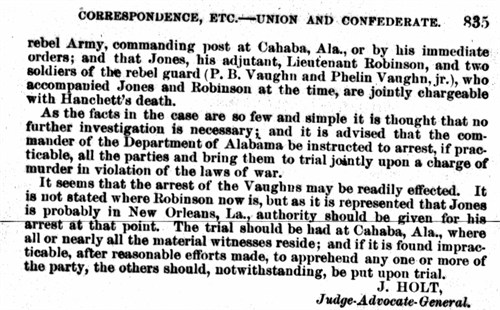
That account appears to have been taken verbatim from page 558 of The Patriotism of Illinois***, written by Thomas Mears Eddy in 1866.  Probably a more accurate account can be found in the 1899 Congressional Serial Set, on pages 117-120, 467, 794-795, 834-835, and 951 of Series 2, Volume 8, Part 1 (Prisoners of War and State, Etc.) in The War of the Rebellion: A Compilation of the Official Records of the Union and Confederate Armies****.

The image at left comes from an interpretive sign about Hiram S. Hanchett at Old Cahawba Archaelogical Park in Alabama.  There is a marker for Hanchett in the Civil War - era cemetery in the park (which has the remains of many of the former prisoners of the Confederate jail once there).  However, Hanchett is not buried there - his grave is unknown and unmarked.

A note on Ancestry.com on Hanchette in the "U.S., Civil War Soldier Records and Profiles, 1861-1865" database raises the possibility that a grave found in the 1970s, quite some distance from the 224 known graves, might be that of  Hiram Hanchett, and that DNA testing was a possibility.

H. Jay Hanchett was not quite nine years old when his father died.  His widow and children had moved to Chicago by 1870 and were living with his maternal grandparents on the Census that year.  His mother Nancy died at age 41, in 1877, when H. Jay was 21.

*Gorton, Adelos,. The life and times of Samuel Gorton : the founders and the founding of the Republic : a section of early United States history and a history of the colony of Providence and Rhode Island plantations in the Narragansett Indian country now the state of Rhode Island, 1592-1636-1677-1687 : with a genealogy of Samuel Gorton's descendants to the present time. Philadelphia: unknown, 1907.  Page 638, found on the Internet Archive.

Note that H. Jay is listed as Harris Joy in this book - most other references say his first name is Henry or Harry, and his middle name is Jay.  It's notable that the above-referenced book has separate entries for H. Jay's brother Charles and sister Minnie Estelle, who lived to adulthood, but there is no separate entry for H. Jay -  probably because of all the scandal that had accrued to his branch of the family by the time of the book's publication in 1907.

**Vance, J. W.  Report of the Adjutant General of the State of Illinois.  Springfield, IL: H.W. Rokker, state printer and binder, 1886.

***Eddy, Thomas Mears.  The Patriotism of Illinois:  A Record of the Civil and Military History of the State in the War for the Union, with a History of the Campaigns in which Illinois Soldiers Have Been Conspicuous, Sketches of Distinguished Officers, the Roll of the Illustrious Dead, Movements of the Sanitary and Christian Commissions, Volume 2.  Clarke & Company, 1866.

****Scott, Robert N., Lazelle, H. M., Davis, George B., Perry, Leslie J., Kirkley, Joseph W, et al.  The War of the Rebellion: a compilation of the official records of the Union and Confederate armies. 
Washington, DC: Government Printing Office, 1880-1901.

© Amanda Pape - 2013 - click here to e-mail me.

Monday, August 5, 2013

Mystery Monday: What Happened to H. Jay Hanchette?

The Dick Smith Library (where I work) serves as a Regional Historical Resources Depository for original and microfilmed records for a number of Texas counties, including Coleman.  Recently, another library transferred to us a fascinating Coleman County Sheriff's ledger from 1887 to 1892 that contained notices about stolen and stray animals, and wanted and missing persons.  This one caught my eye:
I used a variety of resources to try to find out what happened.  I searched old newspapers for "Hanchette" through subscription services Ancestry.com and GenealogyBank.com, my university's Archive of Americana database, and the free Chronicling America website sponsored by the Library of Congress and the National Endowment of the Humanities.  Most of my links below are to that source, so you can view articles in their entirety.

Henry/Harry Jay Hanchette, secretary of the Los Angeles Chamber of Commerce, left that city and had arrived in Chicago by March 31, 1891, to organize an exhibit of California fruit in the Windy City:
from The Chicago Herald, March 31, 1891, page 10, via Archive of Americana database

The exposition seemed to go well:


from the Los Angeles Herald, May 18, 1891, page 5, via Chronicling America


After the exposition closed in May, Hanchette was supposed to return home via train, but instead disappeared.  About the time the missing person notice went out, articles started appearing in Chicago, Los Angeles, and other newspapers:

from the Los Angeles Herald, May 18, 1891, page 5, via Chronicling America

from The Chicago Herald, May 18, 1891, page 3, via Archive of Americana database
from The Chicago Herald, May 19, 1891, page 3, via Archive of Americana database

from The Anaconda [MT] Standard, May 20, 1891, Page 7,
via Chronicling America


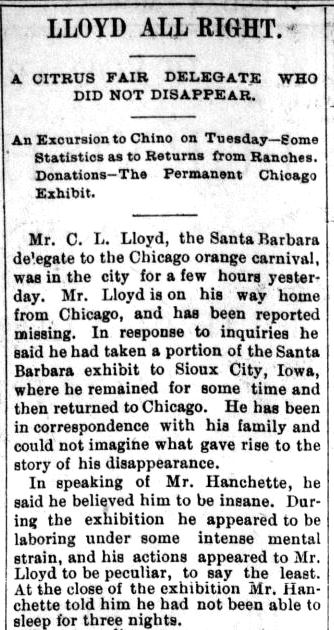
Over the next few months, this was followed by supposed sightings:  as a dead body pulled from Lake Michigan, a debauched man in Kalamazoo, Michigan, a demented man in Janesville, Wisconsin, an organ-seller in Flandreau, South Dakota, and as an insane man in Woodstock, Illinois, where Hanchette grew up.

There was also a lot of speculation:  that he'd sailed for South America, and that he'd been located with another woman - not his wife.  The latter rumor was apparently started by a detective Fred Smith, and rather vehemently denied by Hanchette's mother-in-law, Amelia Griffith.

from The Record-Union, Sacramento, CA, May 21, 1891, page 1, via Chronicling America


from the Los Angeles Herald, May 29, 1891, page 1, via Chronicling America

from The Dalles Weekly Chronicle (The Dalles, OR), June 12, 1891, page 1, via Chronicling America

from The Salt Lake Herald, Salt Lake City, Utah, June 14, 1891, page 14, via Chronicling America

from Riverside [CA] Independent Enterprise, August 15, 1891,
page 3,via GenealogyBank.com


from the Los Angeles Herald, August 20, 1891, Page 8,
via Chronicling America


A couple newspaper stories in the Los Angeles Herald on September 1 and September 2, 1891,  indicated Hanchette may have had a double.  His wife, Emma Griffith Hanchette, and his two sons, Rex and Earl, all thought they saw him in San Francisco while they were staying with Emma's parents, Dr. and Mrs. Edgar M. (Amelia Conant) Griffith.  Two other men who knew him thought they saw him there as well.

Later that month, Robert Farrell, who worked for the Los Angeles Herald when Hanchette was its city editor, claimed to have seen Hanchette, who identified himself variously as Hamilton, H. J. Mitchell, and John Blackman.   Farrell described what he saw in letters to the Herald on September 12 and September 25.

from Los Angeles Herald, September 26, 1891, Page 8,
via Chronicling America


from Arizona Republican (Phoenix), October 03, 1891, page 1, via Chronicling America
After this, things were quiet - for a while.  Come back next week for more of this story!

© Amanda Pape - 2013 - click here to e-mail me.