Showing posts with label Travel Tuesday. Show all posts

Tuesday, January 11, 2022

Travel Tuesday: Sandpiper Beach Resort, Pacific Beach, Washington

In my previous post, I mentioned some Christmas tree ornaments I got at the Sandpiper Beach Resort in Pacific Beach, Washington.  Here are some photos from some of my visits there.


Me and the offspring in the playground in the dunes next to the Pacific Ocean beach, New Years Eve/Day 1994-95, with one of the two main Sandpiper buildings in the background.


Sandpiper was discovered a bit by accident.  My family had been going to the Forks Motel jacuzzi suite and the Olympic National Park Second Beach area for short vacations twice a year in 1992, 1993, and 1994 (more about those trips in a future post).  We decided to take the long way home on on summer 1994 trip and explore the rest of the Olympic Peninsula.  That's when we discovered the Sandpiper on the southern Washington coast, where the beaches are wider and ideal for flying stunt kites.  Our first stay, in a suite with an ocean-view balcony and kitchen, was in mid-August 1994.

Best of all, no driving was allowed in a huge section of the beach in this area, making it very safe for kids - and very likely that any sand forts or castles you built - assuming they were above the high tide line - would still be there the next day.
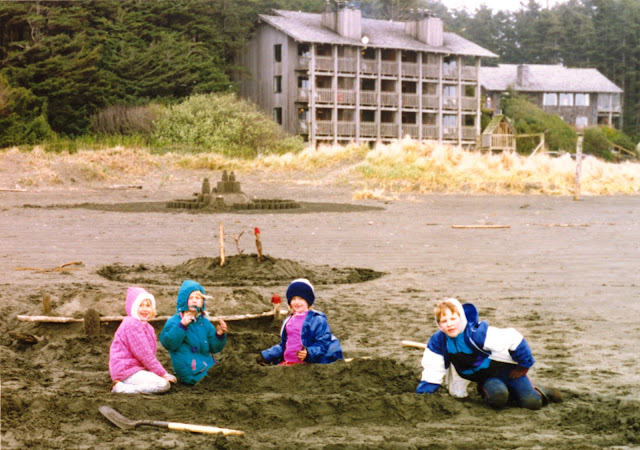

Above:  The offspring and some friends work on a sand fort on a New Years' Eve/Day visit in 1994-95.  You can see some of the Sandpiper buildings in the background.
Below:  Not sure if the offspring built this sand castle or not, but the photo shows some of the larger individual cabins that were also part of the resort.


We ended up visiting five times in 1995 - once for New Years' Eve and Day (the weather was cold, but nice), during spring break, and three times during the summer - some of those with relatives on my ex-husband's side.  Some of the trips qualified as business expenses for my ex (he was working on a consulting job in nearby Aberdeen), so we were able to stay in one of the two-bedroom-with-loft suites (11 or 12) on the top floor of the second main building (pictured below, a nice distance north of the other buildings).


Above:  the second building, nestled in a grove of spruce, a nice distance north of the other buildings.  Our favorite suites were 11 or 12, on the top floor, with lofts.
Below:  Sandpiper logo, which hasn't changed since the resort opened in 1973.


Besides building sand forts and castles, flying kites, and swimming (or in my case, wading, as the water was pretty cold for this Texas-bred girl), one could go beachcombing (sand dollars were prolific) or for long walks on the traffic-free beach (sometimes as far as Copalis Rock, three miles south).  Digging for razor clams and surf-fishing were popular with some guests.  
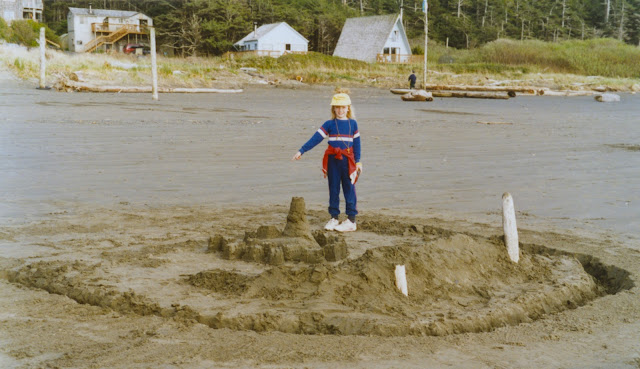


Above:  yet another sand fort, this one at either spring break or on one of our three summer visits in 1995.  More of the individual cabins of the resort, including an A-frame, are in the background.

Below:  The offspring in the garden area of the resort, summer 1995.


There was no television, but you could have a fire in the woodstove on a cold night, play board games or work puzzles, read, and watch (and photograph) storms and beautiful sunsets.  One of my favorite memories was waking up in the middle of the night on one visit (probably in the summer of 1995), looking out from the balcony - and seeing bioluminescence in the waves.  The blue-green light emitted by plankton on a new-moon night was mesmerizing - wish my photos of that had come out!


Above and below - sunsets in mid-August, 1994, and sometime in the summer of 1995.


I was sad to learn while researching for this blog post that the Sandpiper closed at the end of 2021.  The property has been sold to a developer who likely will tear down the existing cabins and four-story suite buildings, and put in something far less affordable for average folks.


© Amanda Pape - 2022 - e-mail me!

Tuesday, August 3, 2021

Happy Birthday to My Brother Mark!


My brother Mark at a roadside park in Texas, during a stop for a picnic lunch on our way to or from New Mexico in the summer of 1966.


© Amanda Pape - 2021 - e-mail me!

Tuesday, March 20, 2018

Travel Tuesday: Mabenka Restaurant, Chicago

So after spending a few hours at the Balzekas Museum of Lithuanian Culture on August 8, 2017, during our visit in Chicago - we were hungry!  I found a nearby restaurant whose online menu indicated it served some Lithuanian food.  Mabenka opened in 1992 and also serves Polish dishes.  The Polish immigrant founders, Joe and Janina Galica, made the name of the restaurant from the first letters of their children's names.


First came a basket of bread:  rye, pumpernickel, and a sweet white bread that I think had dates in it.


All the soups are homemade.  I don't think it's Lithuanian, but I ordered the red borscht - hot beet soup.  I wish the cold beet soup (šaltibarščiai in Lithuanian) had been in season!


My husband ordered the soup of the day, which was oxtail barley.  This is a common Eastern European recipe, but one we'd never had before (of course we shared everything).


I had to order the Lithuanian Combo Plate (liet. kombinacija)!  From the top left in the photo below, it contained:
  • a cepelinis (literally, a "zeppelin"), a potato dumpling stuffed with ground meat, and served with bacon bits and sour cream;
  • a Lithuanian sausage (perhaps a skilandis or kindziukas) with sauerkraut and horseradish; and
  • a slice of kugelis, a potato pudding baked and served with bacon bits and sour cream.


For dessert, we shared a blintz made with sweet farmer's cheese and topped with blueberries and whipped cream.  We were so full though that we ended up taking most of this with us.


© Amanda Pape - 2018 - click here to e-mail me.

Tuesday, March 13, 2018

Travel Tuesday: Balzekas Museum - Lithuanian Costumes

On our visit to the Balzekas Museum of Lithuanian Culture in Chicago back on August 8, 2017, we spent a lot of time in the Women's Guild Room, which featured Lithuanian folk arts, including examples of clothing and regional costumes.


Above:  Costume representing the Aukštaitija (Highlands) region, which is the area my ancestors are from.  It was purchased in 1930 in Kaunas, Lithuania and donated by Mrs. Joana Andriulus.

Below:  This costume was created by the famous folk artist Anastasija Tamošaitienė (born 1910) and belonged to Juzefa Daužvardienė (1904-1990), the Lithuanian General Honorary Consul in Chicago from 1971 to 1985, who was one of the sponsors of the museum.  Note the elaborate designs that were woven into the linen on the collar, cuffs, and sleeves of the blouse.  


Above and below:  Hand-woven aprons made with wool and linen yard made in Lithuania in the early and mid 1800s.  From the Cultural Treasure Collection of the Lithuanian University Club of Chicago.


More information on Lithuanian folk costumes is here:  http://folkcostume.blogspot.com/search?q=lithuania


© Amanda Pape - 2018 - click here to e-mail me.

Tuesday, March 6, 2018

Travel Tuesday: Balzekas Museum - Lithuanian Musical Instruments

One of the displays at the Balzekas Museum of Lithuanian Culture in Chicago was of this ensemble of figurines playing traditional musical instruments (from the private collection of Paulina Vaitaitis, D.D.S., 1920-2004):


I was curious about some of the instruments, so I started looking them up on the internet.  Below are two examples of the birbynė, a wind instrument originally used by shepherds.  The ones below are made of wood with a bell at the end of horn.


The kanklės is a Lithuanian plucked string instrument, like a zither.  As can be seen with the figurines, they come in a variety of sizes and shapes.


The skrabalai is a percussion instrument consisting of trapezoid-shaped wooden cowbells of various sizes arranged vertically in several rows.  The instrument is usually made of oak or ash and is played with two wooden sticks.


The skudučiai are panpipes made of wood, bark, or hollow stems.


© Amanda Pape - 2018 - click here to e-mail me.

Tuesday, February 27, 2018

Travel Tuesday: Textiles at the Balzekas Museum of Lithuanian Culture, Chicago

On our visit to the Balzekas Museum of Lithuanian Culture in Chicago back on August 8, 2017, we spent a lot of time in the Women's Guild Room, which featured Lithuanian folk arts, including traditional textiles.


Above and below:  Hand-loom-woven sashes (juostos) with traditional Lithuanian designs and patterns, from the private collection of Paulina Vaitaitis, D.D.S. (1920-2004).


© Amanda Pape - 2018 - click here to e-mail me.

Tuesday, February 20, 2018

Travel Tuesday: Lithuanian Chicago - The Balzekas Museum

I finally have time to write more about my week in Chicago, Illinois, in early August, 2017.  My husband and I took the train there and visited my son, but as he had to work most of the time we were there, we also did a genealogy grand tour.  For four days, we visited areas in and around Chicago related to my family - the northern suburbs of Wilmette and Evanston, the northern neighborhood of Rogers Park / West Ridge, and the southern neighborhoods where Lithuanian immigrants settled in the early 1900s.  As we were staying in the southern Lincoln Park area near my son's home, I also walked to a couple churches and drove by some other site in Old Town and other areas.  So, for the next few weeks, I'll be posting a lot about what I saw.

I'm going to start with what was actually our second full day in Chicago, Tuesday, August 8, when we drove down to the early Lithuanian neighborhoods.  To get oriented, our first stop was at the Balzekas Museum of Lithuanian Culture.


This museum is located in a former hospital at 6500 South Pulaski Road, a main thoroughfare in south Chicago.  It was founded in 1966 by Stanley Balzekas, Jr., in a different location, next to the former site of the family's automobile dealership in the Brighton Park neighborhood, where many Lithuanian immigrants lived.   In 1986, it moved to its present location.  The year 2016 was the 50th anniversary of the museum, as announced on attractive banners both inside and outside the building.


The museum has a number of permanent exhibits, my favorite being the Women’s Guild Room, which features Lithuanian folk arts: items made with amber, Christmas decorations and Easter eggs, dolls, and traditional Lithuanian costumes and textiles. I will have a number of pictures of these in future posts.  I would have liked to see the Children's Room, but it was not open the day we were there.


A semi-permanent exhibit on “No Home To Go To: The Story of Baltic Displaced Persons, 1944-1952” was on an upper floor of the museum.  The museum also offers genealogy research, special events and folk art classes, and an annual tour in Lithuania, as well as a gift shop.

© Amanda Pape - 2018 - click here to e-mail me.

Tuesday, December 16, 2014

Travel Tuesday: Advent Calendar of Christmas Memories

It's the annual Advent Calendar of Christmas Memories!  I've participated the past five years (2009 through 2013), and this year, the prompts and their sequence are the same as in 2013.  Due to some pressing needs to get some other projects done (like gift books for my parents made out of the previous years' blog posts), I'm going to link to the appropriate post from 2013 (which also links to older posts, when applicable) in the prompt title, and add a relevant photo.


The prompt for December 16 – Christmas Travel  

Christmas tree at Puerto Maya, Cozumel, Mexico, still up when we were there January 10, 2014

The Advent Calendar of Christmas Memories (ACCM) allows you to share your family’s holiday history twenty-four different ways during December! Learn more at http://adventcalendar.geneabloggers.com.

© Amanda Pape - 2014 - click here to e-mail me.

Tuesday, October 28, 2014

Travel Tuesday: Mom's Return from Europe, October 28, 1953

"New York, New York Passenger and Crew Lists, 1909, 1925-1957," index and images, FamilySearch (https://familysearch.org/pal:/MM9.3.1/TH-1971-33984-34033-88?cc=1923888 : accessed 28 Jul 2014), 8383 - vol 18330-18331, Oct 26, 1953 > image 1214 of 1418; citing NARA microfilm publication T715.  I blacked out passport numbers.

Mom's trip diary ends with the October 23 entry in Le Havre, France.  I did find her on a passenger list for her return voyage on the S.S. United States, though.  I believe the date of departure listed on this form is in error.  Earlier pages of this passenger list show the ship departing Le Havre on October 24, which would be more realistic.

Although she didn't write about it in her diary, I'm guessing it took about the same number of days (three) to drive from New York City back to Houston, Texas (via Oklahoma to drop off Joye Murphy), as it did to drive the opposite direction back in August, so Mom and Sylvia John would have arrived home on Halloween, October 31, 1953.


This is the 78th and last in a series of posts transcribing entries in my mother's 1953 Europe Trip journal.

© Amanda Pape - 2014 - click here to e-mail me.

Tuesday, October 21, 2014

Travel Tuesday: Mom's 1953 Europe Road Trip: At the Louvre

From Mom's Europe trip diary, in the "PLACES VISITED" section: 
October 21, Wednesday – Paris, France
Went to Louvre - saw Venus de Milo, the Mona Lisa, Winged Victory, and several more famous paintings.  After lunch at Rumplemayer's, went shopping again.  Bought some white gloves,*  exchanged Bobbie Nell's** Arpege for larger bottle, and bought Fred** some champagne.*  For dinner Joye** and Sylvia** treated me to champagne, because of my birthday.**  Managed to get most of my packing done, thank goodness.

* According to the "PURCHASES" section of the trip diary, my mother bought the white gloves at Fabrique de Ganto for 2900 francs, and the champagne at Gargantua for 1700 francs for both bottles.  She also purchased 8 hors d'oeuvre knives (for 2440 francs), a salad set (for 950 francs), and an hors d'oeuvre fork (for 300 francs), all at Jacques Franch.

** Bobbie Nell is my mother's step-first cousin, Bobbie Nell Brown.  Fred is my dad, Fred Pape, who Mom was dating at the time of this trip.  Joye and Sylvia are her traveling companions, her co-worker Sylvia John and Sylvia's friend Joye Murphy.  Mom's 25th birthday was two days before, on October 19.  

Paris - Carrousel and Louvre [2 August 1968, cropped] / Roger Wollstadt / CC BY-SA 2.0
Paris - Louvre - Winged Victory [11 May 1960, cropped]  / Roger Wollstadt / CC BY-SA 2.0

Mona Lisa, Louvre / Leonardo da Vinci [photo by Dcoetzee, 8 June 2011] / Public domain
The entrance to the Louvre might have looked something like the photo above in 1953.  L'Arc de Triomphe du Carrousel was built by Napoleon in 1806-1808, modeled after the Arch of Constantine in Rome. The bulldings of the Louvre (the part that had been the royal palace) are in the background. This was taken long before today's glass pyramid entrance was constructed.

The three most famous art works in the Louvre (at least back in the 1950s and 1960s) were the ones my mother saw.

One (of course) is da Vinci's Mona Lisa, pictured below.  The Winged Victory of Samothrace, pictured at left, was sculpted in Greece circa 190 B.C. 
Venus de Milo, Louvre [16 January 2009] / Sailko / GFDL, CC-BY-SA-3.0 or CC-BY-2.5
The Venus de Milo , pictured at left, was sculpted in Greece sometime between 130 and 100 B.C., and discovered in 1820 A. D.


This is the 75th in a series of posts transcribing entries in my mother's 1953 Europe Trip journal.


© Amanda Pape - 2014 - click here to e-mail me.

Tuesday, October 14, 2014

Travel Tuesday: Mom's 1953 Europe Road Trip - The Rain in Spain

From Mom's Europe trip diary, in the "PLACES VISITED" section: 
October 14, Wednesday – Road between Madrid and BeasainSpain
Left Madrid but had to come back to get gasoline.  On way out again, stopped (truck coming out on road) on real slippery road & car skidded.  Fortunately it came to a halt before anything was hit.  Drove through rain to Burgos where we lunched.  Then started on way to San Sebastian.  It got dark and we came across several flooded places along the road.  Got to a town called Beasain and could go no further because river was flooding across road.  Had to spend the night there.* 

 * According to the "HOTELS STOPPED AT" section of the trip diary, my mother and her friends stayed at the Hotel Orteaga in Beasain, Spain.


Vistas de la Catedral de Burgos [Views of the Cathedral of Burgos] / Camino del Cid (own work) / CC-BY-SA-3.0 or GFDL


Above is a photo of the Gothic Catedral de Santa María de Burgos, which dominates the view in Burgos.  It was built mostly in 1221-1230. Below is a possible route from Madrid to Beasain.  My research shows that Spain did experience greater-than-usual flooding in October 1953.


This is the 68th in a series of posts transcribing entries in my mother's 1953 Europe Trip journal.


© Amanda Pape - 2014 - click here to e-mail me.

Tuesday, October 7, 2014

Travel Tuesday: Mom's 1953 Europe Road Trip - A Long Day

From Mom's Europe trip diary, in the "PLACES VISITED" section: 
October 7, Wednesday – Road between Luchon, France, and San Sebastián, Spain
Got up early because we had a longer way to go.  After going over five mountain passes and stopping for lunch on roadside, we reached the French - Spanish border around 5:30.  Practically had to sign my life away at Spanish border -- we had to declare all currencies we had with us. (I didn't declare all French in case they talked to them.)  After several false starts we got on road to San Sebastian and found a very nice hotel* to spend a few nights.  Had to open trunk of car at Sp[anish] border.

* According to the "HOTELS STOPPED AT" section of the trip diary, my mother and her friends stayed at the Hotel des Londres in San Sebastián, Spain, pictured below.
EXTERIOR [Hotel Londres, San Sebastian, Spain, 14 June 2012] / Hotel Londres / CC BY-SA 2.0

Luchon (which has the proper name of  Bagnères-de-Luchon) is known as a spa town due to its thermal springs.  The Thermes Chambert, pictured below, is one such spa.  It was built in 1848 on the site of the ancient Roman thermal baths.
Bagnères-de-Luchon, Thermes [Chambert, 4 June 2010] / Père Igor (Own work) / GFDL or CC-BY-SA-3.0-2.5-2.0-1.0


Here is the map for this day's travel.  I imagine it took more than 7 hours in 1953:


This is the 61st in a series of posts transcribing entries in my mother's 1953 Europe Trip journal.


© Amanda Pape - 2014 - click here to e-mail me.

Tuesday, September 30, 2014

Travel Tuesday: Mom's 1953 Europe Road Trip - Rome, Day 2

From Mom's Europe trip diary, in the "PLACES VISITED" section: 
September 30, Wednesday – Rome
After breakfast went by North American College * and picked up ticket for audience with Pope.  We then went to Vatican City -- bought some stamps, saw the Sistine Chapel, and the Vatican Museums.  Only had about 1.5 hours so quickest trip on record.  Saw St. Peter's (very beautiful inside with many side altars and beautiful ceilings and domes).  Ate lunch at American Catholic Club. ** Came back to hotel and got ready to go to Castel Gandolfo (Pope's summer home).  Rode a city bus out there and saw the Pope.  He spoke in several different languages -- Italian, Spanish, French, English, and German -- but I couldn't understand English because of terrible loudspeaker system.  He gave us a Papal blessing which I hope blessed my crucifix. ***  Came back to Rome on a bus packed like a can of sardines.  Tight squeeze.  Went to opera and saw Cavilleria Rusticana and Pagliacci.  Opera better than Met in that thing weren't so perfect.  Both were wonderful.  The only sour note to me was people on stage were obviously looking at man on box on stage.  Music & voices were good.

* The Pontifical North American College is a Roman Catholic educational institution that opened in 1859 that trains priests, serves as a residence for American priests doing advanced studies in Rome, and (in 1953 and today) provides free tickets for papal audiences and other events.

** The American Catholic Club was originally established in July 1944 by the National Catholic Community Service to provide services for American and Allied soldiers.  It was located on the Via della Conciliazione, just three blocks from St. Peter's Square .

*** According to the Pontifical North American College, Mom's crucifix was blessed, along with any other religious articles she had with her that day.

Here are a couple of photos Mom took at St. Peter's, plus two others of sights she saw that day that were taken in 1961 and 1982 respectively:


St. Peter's Basilica from St. Peter's Square, Rome, Italy, 30 September 1953 / Geraldine Guokas Pape / CC BY-NC-ND 4.0
The obelisk in front of St. Peter's Basilica in the photo above is from Egypt (c. 2494 BC – 2345 BC) and was originally moved to Alexandria and then to the Circus of Nero in Rome in the first century AD.  It was moved to its present site in 1586.  Below is a close-up of the entry, with the statue of St. Peter to the left.
Entry to St. Peter's, Rome, Italy, 30 September 1953 / Geraldine Guokas Pape / CC BY-NC-ND 4.0

Rome - Pietà in St. Peter's [22 February 1961] / Roger Wollstadt / CC BY-SA 2.0
I'm sure Mom saw Michelangelo's Pietà, pictured above.  The Sistine Chapel ceiling probably looked a lot like it does in the photograph below from 1982, just before it was restored.
Vatican City 1982.03.18 [Sistine Chapel, before restoration] / Michael E. Johnston / CC BY-NC 2.0


This is the 54th in a series of posts transcribing entries in my mother's 1953 Europe Trip journal.


© Amanda Pape - 2014 - click here to e-mail me.

Tuesday, September 23, 2014

Travel Tuesday: Mom's 1953 Europe Road Trip - Into Italy

From Mom's Europe trip diary, in the "PLACES VISITED" section: 
September 23, Wednesday – Road between St. Moritz, Switzerland, and Milan, Italy
Left hotel on very foggy day.  Went though another pass and then drove across border into Italy.  After all our preparations to hide 10,000 lire notes, they didn't even ask about them.  Went to Lecco where we lunched - had spaghetti.  Then drove on to Milan where we found room to spend night.*  One of immediate things I noticed about Italy was loud horn blowing.  Also narrow streets.  People were not as prosperous as in Switzerland, understandably.
City of Lecco [25 December 2011] / ROFI44WIK (Own work) / CC-BY-SA-3.0

According to the "HOTELS STOPPED AT" section of the trip diary, my mother and her friends stayed at the Albergo Touring Hotel in Milan, Italy. 


At left is a map of today's route. The body of water to the left (with the city of Lecco at the bottom) is Lago di Como (Lake Como).  The photo below shows the city of Lecco and the marina on the lake.  Monte San Martino (mountain) looms over the city.  The building with the tall spire is the Basilica di San Nicolò (Cathedral of Saint Nicholas).

I'll have to ask Mom why they hid the Italian money.


This is the 47th in a series of posts transcribing entries in my mother's 1953 Europe Trip journal.


© Amanda Pape - 2014 - click here to e-mail me.