Showing posts with label Tombstone Tuesday. Show all posts

Tuesday, June 10, 2025

Chicago Catholic Cemetery Records

This is the third in a series of three posts about researching Lithuanians in the Chicago area, where many of them settled after immigrating to the United States. (Here is the first post, and here is the second post.)

Most Lithuanian Catholics in Chicago were buried in St. Casimir Catholic Cemetery, which was originally designated as a Lithuanian cemetery.  It opened in 1903, and burial cards from that year through about 1988 are available on FamilySearch.

You want to search the Illinois, Archdiocese of Chicago, Cemetery Records, 1864-1989 collection on FamilySearch, here:  https://www.familysearch.org/en/search/collection/1503083 

My recommendation is to start with just the surname.  This is because first names were sometimes Anglicized for St. Casimir, particularly in later years, but more often, especially in earlier years, the Lithuanian first name was used.  Plus, if you enter only the last name, you'll pull up others with the same last name (or similar spellings) that may be related.
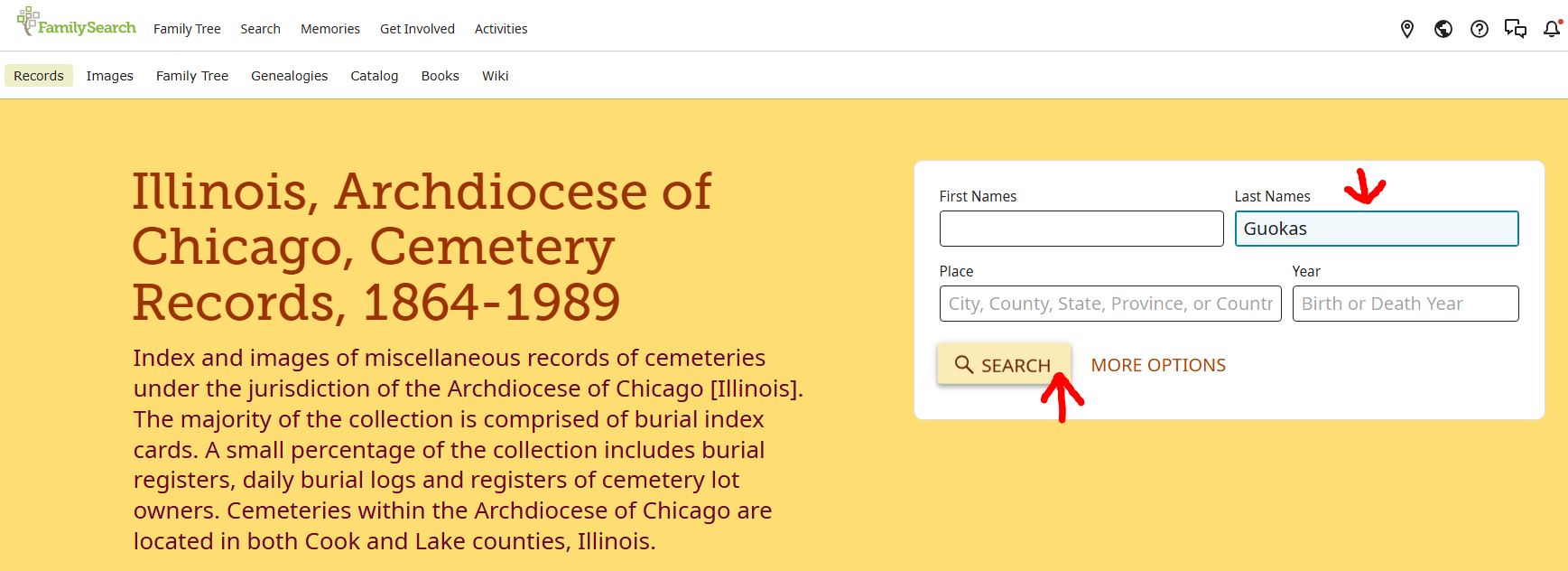


Above is a picture of the home page for this collection.  I entered Guokas for the last name, and clicked the Search button.  Below is an image of the first part of the results.


There were 38 results in all, some of which were "sounds like" (and Soundex) spellings that were pretty far off.  But the exact matches appear first, and I was looking for Juozapas (Joseph) Guokas, my second cousin thrice removed.  When you find a person you're looking for (or are interested in), I recommend clicking on the icon that looks like a piece of paper, and clicking on that for the record details.  Below is an image of the record details for Juozapas Guokas.


Some things to pay attention to in the record pictured above:

- the top arrow on the right points to the name of the cemetery (here, it is St. Casimir, but some Lithuanian immigrants were buried in other Catholic cemeteries);

- the bottom arrow on the left points to a "Copy Citation" button, which you'll want to do to properly source and document this information in Geni and other genealogy sites; and

- the "View Original Document" button just under the image of the card.  That opens the image to provide a larger view, like in the image below.


Some things to pay attention to in the record pictured above:

- the location (grave, lot, block, and/or section numbers) for the grave;

- the home address for the deceased - which might be helpful for finding the family on a census or in a directory;

- the internment date, which may also help you locate an obituary; and

- the age and the burial permit number (which might also be recorded on a death certificate), both of which can help you make sure you have the right person, especially with more common Lithuanian surnames.

I also want to point out the arrow at the far right, which appears when you hover near it - you can click that to look at the next burial card for St. Casimir.  I strongly encourage doing that, because these are supposed to be in alphabetical order, and you may encounter another family member.  But before you do, make a note of the grave location.

Clicking the next image button brought up a burial card for Kazimieras Guokas, who is buried in the same block and lot as Juozapas, which strongly indicates a relationship.  Kazimieras (Charles) Guokas is Juozapas' son.


Clicking on the Next Image arrow on the page with Kazimieras' burial card brought up that of Petronella (Sukys) Guokas, who is his mother and the wife of Juozapas.  Note in the image below that she is also buried in the same lot and block, and that she was living in Ohio at the time of her death, at age 70 and nearly 20 years after her husband's death.  Besides being an indicator of where to look for a civil death record and an obituary, it's also a hint that another family member was probably also living in Youngstown or at least nearby in Ohio. 


Finally, don't forget to also scroll forward.  Doing so from Juozapas' burial card brought up that of Julijonas Guokas, who is the son of Juozapas and Petronella, and the brother of Kazimieras, and buried in the same lot and block.


In the image above, also note that there is more than one way to maneuver through these images.  Besides the Next Image and Previous Image (pictured, in the middle) buttons, you can also enter an image number in the box at upper left, or click on a different image in the scroll bar at the bottom.

In the case of Petronella, she is listed in this record under the male Lithuanian form of the surname Guokas.  But you'll also want to scroll backwards and forwards enough (or do a separate search) for the female Lithuanian forms of surnames.  Use https://gen.wooyd.org/lt_surnames/ to help you find those.

--------

You'll also want to use the Archdiocese of Chicago Catholic Cemeteries "Locate a Loved One" web page, at https://www.catholiccemeterieschicago.org/locate-a-loved-one/ - an image is below.  This tool is particularly helpful if you have someone buried after the end date for the burial cards (which is 1988 for St. Casimir, and anywhere from 1986 to 1988 for other cemeteries).  Sometimes there are name spelling differences between the cards and these official records, which will also show up here.


You'll need to fill out your first and last name, an e-mail address, and check at least the second box (an agreement that you won't use the information provided "for any commercial purposes or financial gain").  Then click the Request button, and check your e-mail, which will look something like the one pictured below.


You'll need to click the "Locate Your Loved Ones" button in this e-mail to access the system.  You'll get a search page like the one below.


I suggest entering just the last name, and leaving the default to search all cemeteries.  This system won't bring up alternate spellings, but you can enter as few as two letters in the last name field (and in that case, I'd suggest adding at least a first initial and/or selecting a cemetery, because I got 12,612 results when I entered just Gu for the last name).  It will bring up everything that starts with the letters you entered.

Before we get to the results, I want to point out the timer at the upper right.  When you get down somewhere around five minutes or less, a window will pop up, like the one below, offering to extend your time, and you'll get 15 more minutes if you click yes.  I'm not sure how many times this window will pop up, though.


Below are the results for my search on Guokas.  There are only seven, and they are all buried at St. Casimir.  I clicked on the view button for my relative Juozapas.


Below is the top part of the page that will next appear.  On the left is the information that was also on the burial card, but there's also a link to view the grave location on Google Maps, and another link to bring up a QR code that will also take you to the location on Google Maps.  And just to be sure, the location is also shown on a Google map on the right.


In the image above, I also marked the buttons you can click to have this information e-mailed to you (and the web page updates to indicate the email was sent), and a button to download a PDF of the information.  Below is an example of the e-mail sent.


Note that the e-mail also includes a link to view the location on Google Maps.  Below is an image of what the PDF looked like (click on it to view it larger).  You get a section map on the left, a cemetery map on the upper right, the burial record information, and a QR code to view the location on Google Maps.


Note in the image above that I highlighted something that differs from the information on the burial card.  This record indicates Juozapas is buried in Section (not Block) 9.  

Going back to the record page for Juozapas, if you scroll down the page, you can also access the cemetery map, and download a PDF (which, for this cemetery, is high quality).


Scroll even further down the page, and you'll also find a section map you can download.  Unfortunately, for Section 9 at least, this image is a poor quality PNG image and not especially readable.  Perhaps they will be updated someday.


And here is a link to the FindAGrave memorial for Juozapas Guokas, which includes an image of the tombstone, which he shares with his wife and the two sons who predeceased him.  The engraving is in Lithuanian:  https://www.findagrave.com/memorial/188095962/joseph-guokas


© Amanda Pape - 2025 - e-mail me!

Tuesday, October 22, 2024

Success in a Remote Cemetery in Oklahoma

On the way home from visiting my late husband's first cousin in Oklahoma City last Friday, I went almost to the state of Oklahoma's eastern border with Arkansas, in search of the Vaughn Memorial Cemetery in Le Flore County, near the community of Gilmore, which is east of Poteau and north of Monroe.

As I wrote in an earlier post, I found my husband's great-grandfather, John L. Gresham, listed in a 1937 inventory for this cemetery.  I made a photo request through FindAGrave, but it hadn't been fulfilled in some time, which made me think that perhaps the grave marker didn't exist any more.

Well, it's there.  Here's a photo of the top of the marker, which has toppled from its base and now lies flat on the ground.  It reads:
J. L. Gresham
Born Feb. 1, 1855
Died Feb. 15, 1892


Above:  Photo of the top of the grave marker for J[ohn] L Gresham, showing the inscription.  Click on the image to view it larger.

Below:  The sign for the Vaughn Memorial Cemetery on Le Flore County Road N4780 (also known as the Gilmore Road), near Poteau, Oklahoma.  The red arrow points to the toppled grave marker for John L. Gresham (which I also marked for this photo by placing a water bottle on it.  Click on the image to view it larger.


Amazingly, between my GPS, a map on my phone, and notes about mileages and turns, I didn't get lost finding this (but I did learn that there are NO rest stops with restrooms on Interstate 50 between Oklahoma City and Sallisaw, near the Arkansas border).  My strategy upon arrival was to search near the cemetery sign pictured above, which was next to the road.  The older graves appeared to be in this area, and it made sense to me that burials would have started closer to the road.  This turned out to be a good strategy, because as you can see from the red arrow, John's grave WAS close to the front.

What I noticed first was the footstone, pictured below, which was propped up against the base of a toppled monument.  "J. L. G." - John L. Gresham - this had to be it!


Above:  Footstone for the grave of J[ohn] L G[resham], leaning against the base of a toppled monument

Below:  Looking over the base to the toppled monument.


I was amazed to see that the front of the monument was quite detailed!  (Click on the image below to enlarge.)  Although somewhat worn from the weather, there is clearly a flying dove carrying a banner that reads "At Rest" flying under an arched roof made by multiple columns leading into some sort of room with a tiled floor. At the bottom of the front of the monument, these words are engraved: "Resting in hope of a glorious resurrection."


Above:  the detailed front of the grave marker for John L. Gresham

Below:  Looking at the toppled monument from the top down - the inscription with the name and dates of birth and death is upside down at the bottom of the photograph.


I was thrilled to find this, and I've updated John L. Gresham's FindAGrave memorial with these images.  

I also visited the nearby Monroe Cemetery (just 3.4 miles due south), where my husband's great-great-grandmother Mary Malissa Hallmark Self is buried (along with one of her grandsons).  I did not find her husband, Vincent Garner Self Jr., there, nor did I find their daughter, John L. Gresham's wife (and my husband's great-grandmother) Lucinda "Lulu" Vina Self Gresham Young, in the Oak Hill (aka Kiowa City) Cemetery in the town of Kiowa in Pittsburgh County, 89.4 miles southwest.  It's possible they never had markers, the markers are long gone, or the newspaper accounts of their deaths were incorrect about the burial places.


© Amanda Pape - 2024 - e-mail me!

Tuesday, September 15, 2020

Tombstone Tuesday: Sayers Siblings


The David Sayers plot in Section E(B) at the Fairview Cemetery in Bastrop (photo above courtesy Gerry Beathard) has the graves for two more of the children of David and Inda Scott Sayers.  One of those children is the youngest, Sam Scott Sayers (1867-1935, photo below courtesy Gerry Beathard).  Sam served in the Texas General Land Office (GLO) in Austin from 1900 through 1935, and as its Chief Clerk from September 12, 1929 until his death.  Prior to his work with GLO, he was deputy county clerk in Bastrop County.


Below is a tribute to Sam Scott Sayers printed in the Report of the Commissioner
of the General Land Office 1934-36It notes that in his first 28 years as an abstract clerk, he compiled 28 volumes of "Abstracts of Texas Land Titles," which are the base for the GLO's land grant database today.


Below is Sam's death certificate.


"Texas Deaths, 1890-1976," database with images, FamilySearch (https://familysearch.org/ark:/61903/3:1:33S7-9B9H-SRHJ?cc=1983324&wc=9TH6-L29%3A263835801%2C267974101%2C268026101 : 22 July 2014), Death certificates > 1935 > Vol 062, certificates 030501-031000, Jun, Taylor-Wichita counties > image 174 of 527; State Registrar Office, Austin.


Buried next to Sam is his wife, Nora Buchanan "Dot" McLavy, 1877-1901.  Sadly she died less than two years after their marriage (on February 27, 1900, in Bastrop County).  They had no children and Sam never remarried.  He moved to Austin shortly after her death.  (Photo courtesy Gerry Beathard and used with his permission.)


Finally, on the other side of Sam is his sister (who outlived all her siblings), Jessie Alison Sayers (1859-1939), who never married nor had children.  More on this interesting woman in a future post.  (Photo courtesy Gerry Beathard and used with his permission.)


The plot map below shows where Sam, Dot, and Jessie are buried in the David Sayers fenced area, marked by the green box.  Their half-brother, Governor Joseph D. Sayers, and those in his fenced area (marked in purple below) were discussed in a previous post.


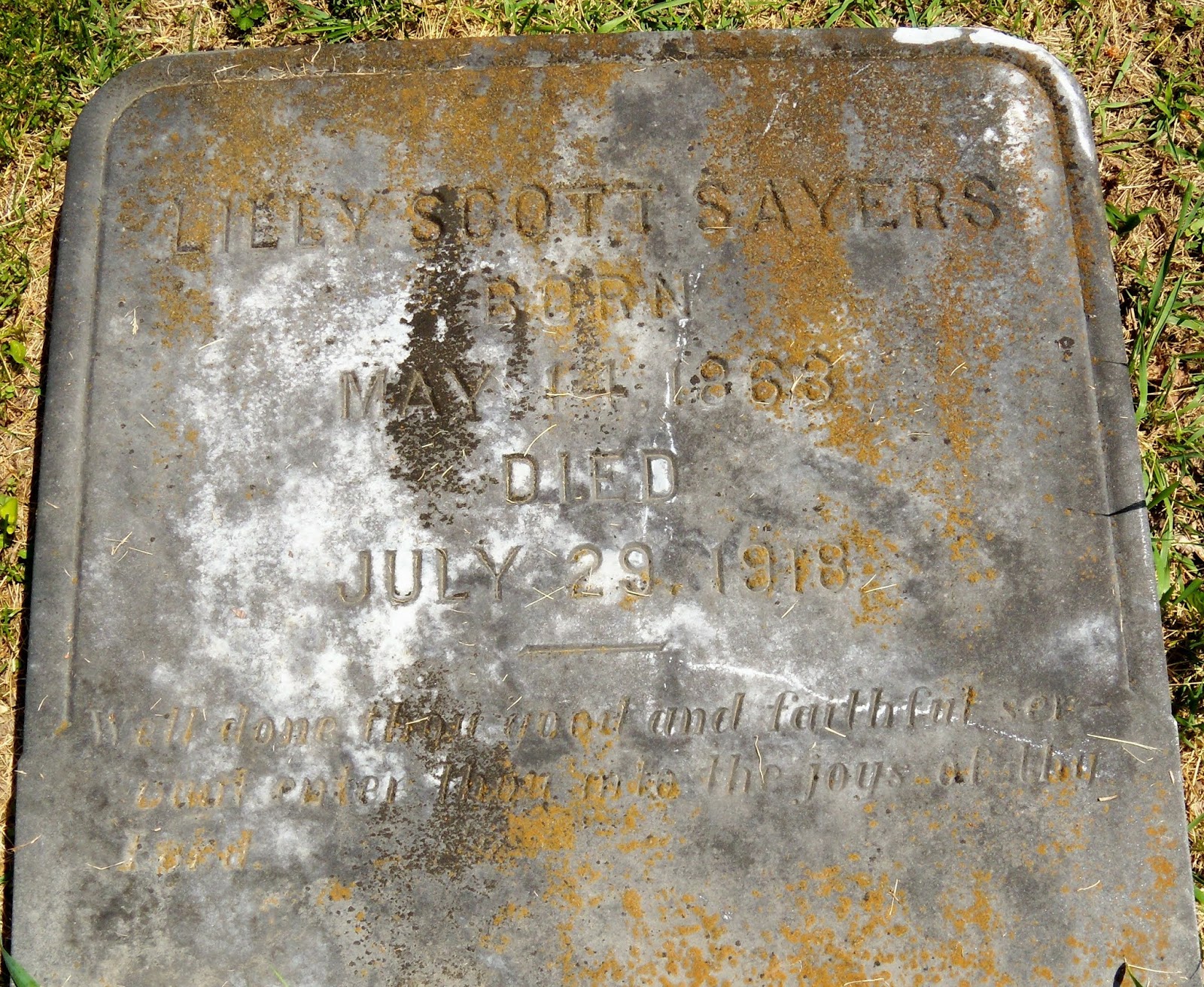
Two of the children of Dr. David Sayers and second wife Inda Scott Sayers are not buried in this plot.  One is son Thomas Green Sayers, buried in Houston and discussed in an earlier post.  The other is daughter Elizabeth ("Lizzie" or "Lilly") Scott Sayers Sayers, 1863-1918.  She attended the Colorado Institute in Bastrop, earning a certificate of proficiency in mathematics in 1879, and taught there in 1883.  She attended the Sam Houston Normal Institute (teacher training) in Huntsville in 1882 and 1886.  She taught in the primary department at Austin High School and at West Austin Public School from 1884 to 1890, along with her older sister Jessie.  In 1888, she taught grade 5 at West Austin. 

On October 20, 1890, in Bastrop County, Texas, she married her first cousin, widower Nicholas Albert Sayers (1845-1912) of Wythe County, Virginia.  However, in the 1900 and 1910 censuses, they are in Pulaski, Virginia.  After Nicholas' death in 1912, Lizzie apparently moved back to Texas and in with her sister Jessie in San Marcos.  She died there in 1918, but is buried next to her husband in the Oakwood Cemetery in Pulaski.  They had no children.  Here are their grave markers:


photos above and below courtesy Cindy Akers at FindAGrave.


Here is Lizzie's death certificate:


"Texas Deaths, 1890-1976," database with images, FamilySearch (https://familysearch.org/ark:/61903/3:1:33S7-9B9C-SV29?cc=1983324&wc=9THV-SP6%3A263835801%2C265476901%2C265538501 : 22 July 2014), Death certificates > 1918 > Vol 053-059, certificates 026285-029350, Jun-Jul, San Augustine-McLennan counties > image 2781 of 3385; State Registrar Office, Austin.


© Amanda Pape - 2020 - e-mail me!

Tuesday, September 8, 2020

Tombstone Tuesday: Texas Governor Joseph Draper Sayers, and His Brother


The most famous ancestor of my great uncle Philip Edgar Sayers Sr. is his (half-) uncle, Joseph Draper Sayers (1841-1929).  The photo above was provided by Hodson Sayers.

In his illustrious career, Joseph was Governor of Texas (1899-1903), a United States congressman (1885-99), Lieutenant Governor (1879-81), chairman of the Democratic state executive committee (1875-8), and a Texas state senator for then-District 26, representing Bastrop and Fayette counties (1873). 

After his service as governor, Joseph was chairman of the state Industrial Accident Board (now the Texas Workers' Compensation Commission) 1913-5, a regent of the University of Texas in Austin in 1916, a member of the Board of Legal Examiners 1922-6, and a member of the Board of Pardon Advisors from 1927 until his death on May 15, 1929.

Joseph was born born at Grenada, Mississippi, on September 23, 1841. the first child of Dr. David Sayers (1811-1886) and his first wife Mary Thomas Peete Sayers (1821-1847).  After moving to Bastrop with his father and younger brother William in December 1851, Joseph attended the nearby Bastrop Military Institute, and was its first graduate.  He joined the Confederate Army in 1861, reaching the rank of major in 1864 and serving on the staff of General Thomas Green (for whom his father named his first post-war son, Philip Sayers Sr.'s father, Thomas Green Sayers, 1865-1910).

After the war, Joseph studied law and was admitted to the bar in 1866.  He partnered with George Washington (Wash) Jones in Bastrop for ten years.  He was also an active Mason, serving as Grand Master of Masons in Texas June 1875 to June 1876.


Above:  Joseph Draper Sayers in July 1862.  Warner, Harry T. Texans and their state; a newspaper reference work, book, 1918; Houston. (https://texashistory.unt.edu/ark:/67531/metapth41332/m1/15/?q=Sayers: accessed September 7, 2020), University of North Texas Libraries, The Portal to Texas History, https://texashistory.unt.edu; crediting Amon Carter Museum.

Below:  an undated carte de vista of Joseph D. Sayers as a young man in Bastrop, Texas, probably between 1865 and 1873.   Part of the Prints and Photographs Collection of the Texas State Library and Archives Commission; public domain.  Cropped and enlarged here.


Above:  J. D. Sayers in 1892, during his service in the US House of Representatives.  From Daniell, Lewis E. Personnel of the Texas State Government: With Sketches of Representative Men of TexasMaverick Printing House, San Antonion, Texas, 1892, after page 180.  Same photo used in Murlin, Edgar Lewis. An Illustrated Congressional manual; the United States Red BookAlbany, J. B. Lyon, 1896, illustration after page 224.  Public domain, also found here.

Below:  The Governor Sayers plot at Fairview Cemetery, Bastrop, Texas, about June 2012.  Photo by and used with permission of Gerry Beathard. 


Governor Sayers is buried between his two wives, Ada Walton Sayers (1846-1871), who died three years after their marriage in 1868, and her sister, Orline "Lena" Walton Sayers (1851-1943), who he married in 1879.  Both marriages were childless.  Others buried in the fenced-in plot include the Walton sisters' mother, Maria L. Acee Walton (1825-1886) and their brother James F. Walton (1844-1884).


Above:  Tombstone of Joseph D. Sayers in Section E(B) in the historic Fairview Cemetery, Bastrop, Texas.
Below:  Texas historical marker on the gravesite.  Both photos by Curtis D. Craig of FindAGrave.


Above:  Former Texas Governor Joseph Draper Sayers (1841-1929) in 1920. Part of the Prints and Photographs Collection of the Texas State Library and Archives Commission; public domain.

Below:  Orline "Lena" Walton (Mrs. Joseph Draper) Sayers (1851-1943) in 1895. From Hinman, Ida. The Washington Sketch Book, Hartman & Cadick, Printers, 1895: Washington (D.C.), page 18-19. Public Domain, Also at https://commons.wikimedia.org/w/index.php?curid=61698079


Below are photos of Joseph and his younger full brother William Branch Sayers, who also served in the 13th State Legislature, as a House member representing the then-27th District (Gonzales, Caldwell, and Guadalupe counties).


Above:  Joseph Draper Sayers, representing the 26th Texas Senatorial District, and
Below:  William Branch Sayers, representing the 40th Texas House District.
Both as pictured in the Pictorial Monogram of the State Government of Texas 1873 (DeGolyer Library, SMU, Lawrence T. Jones III Collection), also on display on the ground floor elevator vestibule, east wall, of the Texas State Capitol in Austin, Texas.


William was also in the Texas House for the 14th Legislature, January 1874 to April 1876, when Hays County was also part of his district.  William was born February 22, 1843, in Canton, Mississippi, the second child of Dr. David Sayers and the last for his mother Mary Thomas Peete Sayers.  Like his brother, William attended the Bastrop Military Institute, served in the Confederate Army (in Terry's Texas Rangers), also attained the rank of major, and studied law after the Civil War.

William settled in Gonzales, and opened the banking firm Miller & Sayers with his law partner James Francis Miller in 1868.   He married Adele Lockhart in 1874.  They had two sons, James Draper Sayers Jr. (1875-1930), who attended the US Naval Academy and was married but childless, and William Branch Sayers Jr. (1876-1919), who had two sons who never married nor had children.  One of those sons likely left the following four photos found in an estate sale.

William Branch Sayers died on February 24, 1898, and is buried in the Masonic Cemetery in Gonzales, Texas, along with his wife, their two sons, and their sons' wives.


Above:  William Branch Sayers (1843-1898), taken at the studios of William H. Curtis in San Antonio, Texas, between 1892 and 1898.

Below:  Adele Lockart (Mrs. William Branch) Sayers (1853-1913), taken at the Clarence Curtis Deane studio at 306 Preston in Houston, Texas, between 1884 and 1888.  Her maternal uncles were Francis Richard LubbockGovernor of Texas, 1861-63, and Thomas Saltus Lubbock, for whom the Texas city and county were named


Above:  William Branch Sayers Jr. (1876-1919), while attending the Virginia Military Institute in Lexingon, Virginia.  He was a member of the Class of 1898 (although he did not graduate) and was manager of the gymnastics team there in 1896-97.

Below:  Henrietta "Etta" Reaves (Mrs. William B. Jr.) Sayers (1885-1968), in a photo taken at the Isaac Newton Rothwell studio at 107 W. Commerce Street in San Antonio, Texas, around 1896-1901.


Governor Sayers had a dormitory (pictured below) at Texas State College for Women (now Texas Woman's University) named for him, as he signed into law the legislation creating the college.  The three-story fireproof brick building with 92 rooms serving 202 students, opened in September 1928 and was demolished in 1982.  A family housing apartment building in the Lowry Woods student housing complex that opened in August 2005 is named Sayers Hall.


TSCW Sayers Hall, photograph, Date Unknown [but between 1928 and 1982]; (https://texashistory.unt.edu/ark:/67531/metapth21633/: accessed September 6, 2020), University of North Texas Libraries, The Portal to Texas History, https://texashistory.unt.edu; crediting Denton Public Library.


© Amanda Pape - 2020 - e-mail me!

Tuesday, September 1, 2020

Tombstone Tuesday: Dr. David Sayers Family Plot, Fairview Cemetery, Bastrop, Texas

The grandparents and some of the siblings of my great uncle Philip Edgar Sayers Sr. are buried in the historic Fairview Cemetery in Bastrop, Texas, in Section E(B).

Philip's grandfather was Dr. David Scott, 1811-1886, a physician born May 27, 1811, at Reed Island Creek in Wythe County, Virginia.  He graduated from the University of Pennsylvania medical school on March 26, 1835.  Late in 1840, he moved to Grenada, Mississippi, and married Mary Thomas Peete (1821-1847).  They had two sons, Joseph Draper Sayers (1841-1929) and William Branch Sayers (1843-1898) - more on them in future posts.

According to a source published in 1899, David and his two sons moved to Bastrop County, Texas, in December 1851, where he continued his practice of medicine.


Above:  Illustration of Dr. David Sayers, 21 January 1899, for the inauguration of his son Joseph Draper Sayers as Governor of Texas.  Cain, Thomas C. The Bastrop Advertiser (Bastrop, Tex.), Vol. 46, No. 46, Ed. 1 Saturday, January 21, 1899, newspaper, January 21, 1899; Bastrop, Texas. (https://texashistory.unt.edu/ark:/67531/metapth205431/m1/6/: accessed August 26, 2020), University of North Texas Libraries, The Portal to Texas History, https://texashistory.unt.edu; crediting Bastrop Public Library.


Below:  Obituary for Dr. David Sayers, July 10, 1886. Cain, Thomas C. The Bastrop Advertiser (Bastrop, Tex.), Vol. 29, No. 27, Ed. 1 Saturday, July 10, 1886, newspaper, July 10, 1886; Bastrop, Texas. (https://texashistory.unt.edu/ark:/67531/metapth204952/m1/2/: accessed August 26, 2020), University of North Texas Libraries, The Portal to Texas History, https://texashistory.unt.edu; crediting Bastrop Public Library.


Here is his grave marker at Fairview Cemetery - this photo is courtesy Gail Davis from FindAGrave.  The flag in the background is in the plot for his son, Texas Governor Joseph Draper Sayers.


Detail from Dr. Sayers' monument - this and all following cemetery and grave marker photos are by Gerry Beathard from FindAGrave and are used with his permission.


This side (pictured above) reads,

"In memory of Dr. David Sayers, born May 27, 1811 Died July 2, 1886
The afflicted poor never appealed to him. in vain."

The symbol above appears to be the keystone emblem signifying a Mark Master Mason.


This side (pictured above) includes the classic compass symbol of Freemasonry and the words, "His desires were regulated and his passions kept within due bounds with all mankind."  This is a Masonic teaching associated with the compass symbol.


This side (pictured above) has the words, "His conduct was in harmony with the principles of morality and virtue," and the Masonic square at the top, which symbolizes morality.


The final side (pictured above) has the words, "His life exemplified truth, and adorned humanity and his death illustrated the Christian's faith," and what I think is the Masonic 24-inch gauge symbol at the top.


Below is a picture of the David Sayers plot in the Bastrop Fairview Cemetery.  As you can see, there are a number of other graves within the gated, fenced-in area.


The cemetery is now operated by the City of Bastrop, which sent me a guide to the graves in this area of Section E(B) (pictured below, click on the image to make it larger).  The fence for the David Sayers plot is represented by the green box below.  The purple box outlines the fenced area of the Joseph Draper Sayers plot, which I'll discuss in a future post.


Dr. David Sayers' second wife. Indiana "Inda" Scott Sayers, 1828-1877, is buried next to him.  They married on February 8, 1854, in Bastrop County. and had four children who survived into adulthood:  Jessie Alison Sayers (1859–1939), Elizabeth ("Lizzie" or "Lilly") Scott Sayers Sayers (1863–1918; yes, she married a Sayers), Thomas Green Sayers (1865-1910, Phil Sayers' father), and Sam Scott Sayers (1867–1935).  More about Jessie, Elizabeth, and Sam in future posts.


Here is Inda's obituary:

Austin Weekly Statesman. (Austin, Tex.), Vol. 16, No. 27, Ed. 1 Thursday, May 26, 1887, newspaper, May 26, 1887; Austin, Texas. (https://texashistory.unt.edu/ark:/67531/metapth278075/m1/5/?q=sayers: accessed August 26, 2020), University of North Texas Libraries, The Portal to Texas History, https://texashistory.unt.edu.


On the other side of Dr. David Sayers' obelisk are four markers for four Sayers children who died young.  David Sayers, 1861-1865, was likely the doctor's and Inda's firstborn son.


Family stories said Thomas Green Sayers had a twin sister - that must have been Kate, also born in 1865:


It's not clear who the next two Mary Sayers belonged to.  Dr. David Sayers' first wife Mary died in 1847, and he did not marry Inda until 1854.  Perhaps he had another wife between Mary and Inda, with two daughters by her?  Or perhaps these are the children of some other unknown Sayers who came to Texas.


The other graves within the fence include David's and Inda's children Jessie Alison Sayers and Sam Scott Sayers, Sam's wife Dot McLavy Sayers (more on these three in future posts), Inda's sisters Mary Elizabeth Scott (1826-1880) and Martha Scott Fourshee, as well as three apparently unrelated persons:  stagecoach operator Constant K. Hall (1818-1873), his daughter Kate K. Hall (1845-1863), and his father-in-law James Leverich Hedenberg (1790-1862).  There's an empty spot next to Kate that could have the unmarked remains of her mother, Constant's wife, and James's daughter Margaret Matilda Hedenberg Hall (c.1816-26 Feb 1895).  And Dr. Sayers may have purchased his home from Constant (C. K.) Hall.


© Amanda Pape - 2020 - e-mail me!