Showing posts with label churches. Show all posts

Thursday, July 2, 2020

Those Places Thursday: St. Margaret Mary Catholic Parish, Rogers Park, Chicago

Here are some photos I took in August 2017 of some of the buildings of St. Margaret Mary Catholic Church in the Rogers Park neighborhood of Chicago - the ones my dad and his siblings would remember.  Click on photos to view them in larger format.


Above: the 1937-38 church, designed by Joseph William McCarthy.
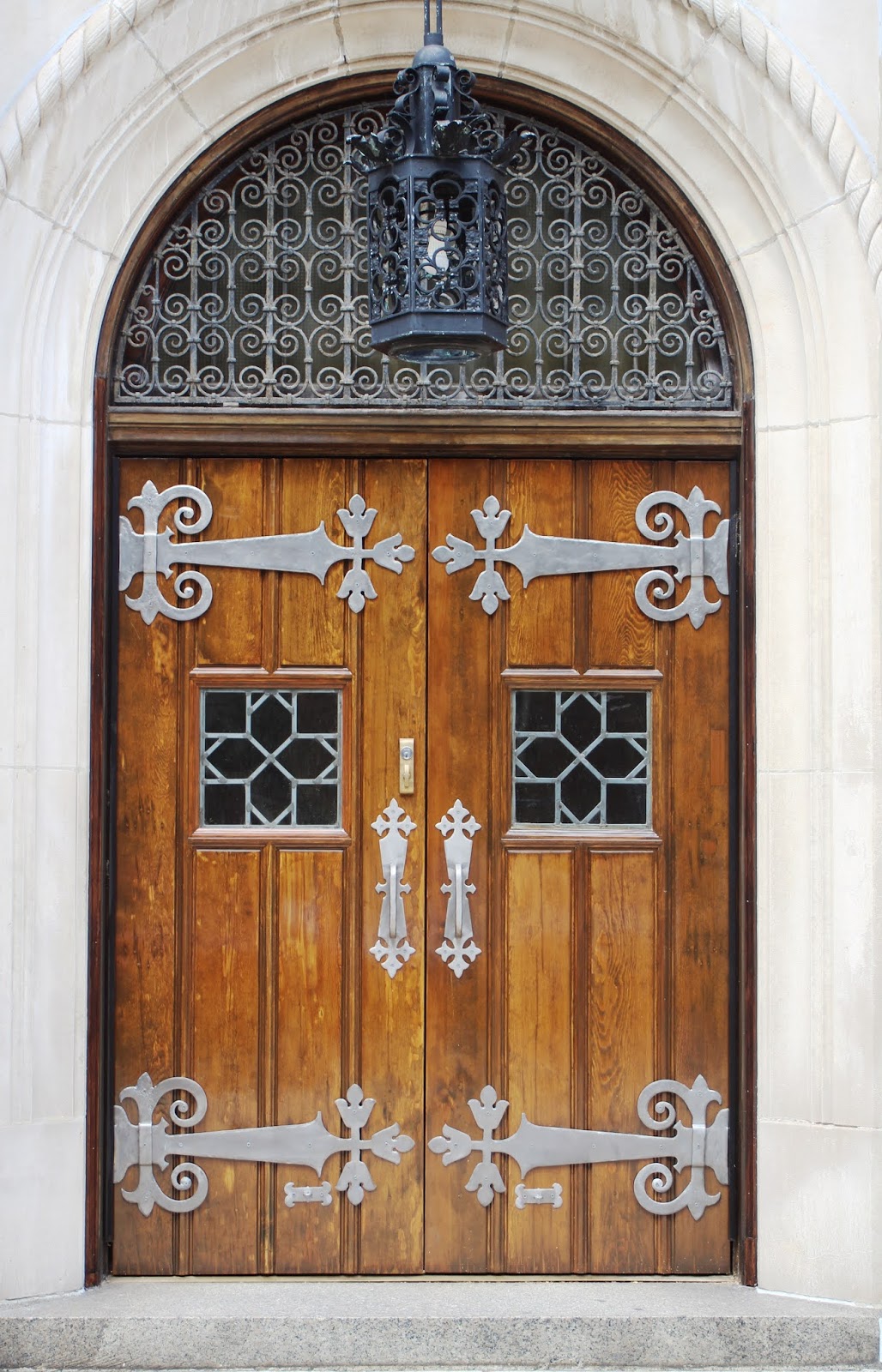
Below: front doors of the church. 


Above: detail of the rose window and the bell tower.
Below:  detail of the main front door.


Above:  detail of the light fixture above and columns around the front doors.
Below: detail of the cross above a side entrance, with a stained glass window behind it.


Above:  altar area of the church - the wood trusses of the roof are visible.
Below:  detail of the main altar.  The words just below the tabernacle are "Sanctus Santus Sanctus," Latin for "Holy Holy Holy."


Above:  detail of the crucifix above the main altar.  It was part of the original church the parish used for worship.  The words above it read "Introibo ad altare Dei," which is Latin for "I will go to the altar of God."

Below:  The rose window above the main entrance, and some of the stained glass windows and Stations of the Cross along the walls.


Above:  Statue of the church namesake, St. Margaret Mary Alacoque, in what was originally the priest's booth in one of the confessionals.

Below:  The 1948 rectory, designed by the architectural firm Barry and Kay.


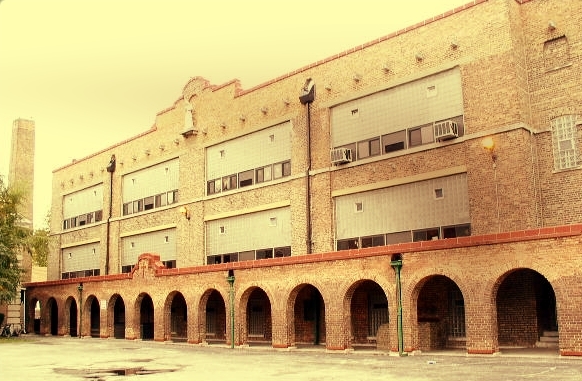
Above:  St. Margaret Mary School, Chicago [2007, cropped] / Kevin Dooley / CC BY 2.0.  Built in 1924 and also designed by Joseph W. McCarthy, it also served as the church until the 1937-38 building was completed.

Below:  Statue of St. Margaret Mary near the top of west side of the building.


Above:  Brickwork cross above a west side entrance to the school.  Note the medallion for Northside Catholic Academy - the school now serves as the middle school (grades 5-8) campus for the merged six parish schools in the area.

Below:  Front entrance to the old St. Margaret Mary Catholic School - now Northside Catholic Academy middle school campus.


Above:  Sign above the entrance door to the 1924 St. Margaret Mary Catholic School - "Sancta Margarita Maria - Georgius Cardinalis Mundelein Fundator," which is Latin for "Saint Margaret Mary - George Cardinal Mundeline Founder."


On February 6, 2020, it was announced that St. Margaret Mary would be consolidated with the nearby St. Henry Parish, St. Timothy Parish, and Blessed Alojzije Stepinac Croatian Catholic Mission (which is located in the 1905 St. Henry building), effective yesterday, July 1, 2020.  While St. Margaret Mary will be the headquarters, the new parish has a new name, Holy Child Jesus Parish.


© Amanda Pape - 2020 - e-mail me!

Sunday, June 28, 2020

Sentimental Sunday: St. Margaret Mary Window, October 1938

Yesterday I was contacted by Paul Murphy, an alumnus of St. Margaret Mary Catholic School in Chicago who'd read my post about the church and school.  He said,

Recently, one of my classmates sent us a copy of the 1938 parish bulletin which was then called "St. Margaret Mary Window." The parish address on page 1 is "7320 Ellwood Avenue."  Today, there is no Ellwood Avenue in Chicago. Also, I could not find it on a list of  Chicago street name changes since the 19th Century. Could [you] help us solve the mystery?

He sent me a copy of the newsletter.  Here's its header on page 1 - note the address, underlined in red.


I decided to first look at "Locations of Chicago Roman Catholic Churches, 1850-1990" by Jack Bochar, second edition (revised to 1997).  This is a GREAT tool to figure out what church your ancestors may have attended, especially if they were immigrants more likely to belong to a national (ethnic) parish, rather than a territorial parish.  Besides helpful maps (the H-1 below refers to the maps grid), this source usually gives a brief history of the locations of the parish.  I thought perhaps the parish office was located elsewhere.  Note that this document is available in a variety of places, but the copy maintained by the Chicago Archdiocese has fairly up-to-date annotations of changes since 1997.

Here is what it said about St. Margaret Mary (underlined in red):

 "--1921: Church at Chase Ave. between Barton (now Claremont) and Ellsood [sic] (now Oakley) Ave."


I went back to check another great tool, the online list of Chicago street name changes compiled in 1948.   In this guide, a hyphen preceding an entry indicates a former street name. Its new name follows it and the coordinates refer to the new name.


So Ellwood Street addresses between 6800N and 7599N became Oakley Street addresses, apparently sometime after October 16, 1938 (the date of the church newsletter) and 1948.

I was curious what exactly was at 7320 N. Oakley Avenue.  From Google Maps Street View, that address falls where the playground is today on the north side of the current school building.   My guess is that at one point the rectory/office was in that location, probably a house similar to the one next door at 7322 (which was built around 1919).  The address 7320 N. Oakley is actually a separate parcel in the assessor's records, not part of the main church-rectory-school parcel.  Here's the assessor's record for 7320 N. Oakley (photo is from August 5, 2008, the playground was built October 3, 2009, the house at 7322 is on the right):


Below is a map highlighting (in blue) the parcel from the CookViewer, a GIS application.  There's also a small skinny parcel just south of it.


Finally, I decided to check Sanborn maps for the area.  First, I used the awesome Sanborn Map locator on the Chicago In Maps website.  I looked at the Sanborn Maps for the Rogers Park area for 1937 (actually published in 1938) and that map updated in April 1951.

First is the 1937-38 Sanborn Map.  Yellow indicates a wood frame structure, red is brick, and green is an unspecified fireproof materials, often detailed in the image (click on it to make it larger).  You can see here that there is in fact a house (D stands for dwelling) at 7320 N. Oakley (formerly Ellwood). The school building (which also served as a church initially) was constructed in 1924 and the church in 1937 (although it was not completed until 1938).  The wood frame building between them may have been an early church hall or perhaps it was the first church, referred to in Bochar's book as existing in 1924.


Below is the Sanborn Map updated to April 1951.  The old rectory at 7320 N. Oakley is gone.  I would need to look at deed records, but my guess is that the church swapped the north 16 feet or so (on the left on this map) of the lot at 7320 N. Oakley for the 16-foot-wide alley between 7320 and the school.  This created an alley right next to 7320, as pictured on the CookViewer earlier in this post.

The wood frame building between the church and the school has been replaced by the present brick rectory, built in 1948.  Also by this point, the church had purchased the flats at 7325-7327 Claremont and turned it into the convent.


Here is the 1924 building permit for the school:


And here is the 1937 building permit for the church.  Note that the 1924 architect is J[oseph] W[illiam] McCarthy (1884-1965, later of McCarthy, Smith, and Eppig, in 1937), who designed 41 Catholic churches in the Chicago area, as well as schools, hospitals, and convents.


Finally, here is the 1948 building permit for the present-day rectory, designed by the firm Barry & Kay, which included architects Gerald Aloysius Barry (1894-1966) and his son Gerald Ward Barry (1924-2005), who also designed a number of Chicago Catholic churches and other facilities.


So far, I haven't been able to find the building permit for the original rectory at 7320 N. Oakley, the convent at 7325 N. Claremont, nor that wood frame building between the church and the school on the 1937-38 Sanborn Map.

I was pleased to find some references to my family in the church newsletter.  Here is an article my Uncle Bob (Paul Robert Pape Jr., 1926-2008) wrote about a Boy Scout trip:


And here is an article that indicates he was an end on the school's football team.  He would have been in seventh grade in the autumn of 1938:


© Amanda Pape - 2020 - e-mail me!

Sunday, December 30, 2018

Sentimental (Church Record) Sunday: St. Michael Catholic Church, Old Town, Chicago - Miscellaneous Exterior

While visiting my son in Chicago in August 2017, I was able to easily walk from the daylight basement apartment where we were staying in Lincoln Park to St. Michael Catholic Church in Old Town.  I made a couple trips there over the week we were visiting.  So far I have written about the exterior and some of its details, as well as a family connection at the rectory doors, the interior in general, the main altar (the High Altar of Angels), and the four other altars in or next to the sanctuary of the church.  I also wrote about the stained glass windows on the west side as well as those on the east side and in the narthex/vestibule area.  Last week I wrote about miscellaneous interior features.  Today's post is the final one on this church, about miscellaneous outdoor features.  Click on all photos to make them larger.


Just outside the front entrance is the third major statue of the church's namesake, St. Michael the Archangel (the other two statues are over the entrance door, and at the top of the main altar).  His foot rests on a defeated Lucifer.


The inscription on the base reads:  "St. Michael + Archangel assist us in our battles against the evils of the day. Our dead are not unknown soldiers. We know who they are and wither they seek to go.  Dedicated to the glory of God by St. Michael Post No. 201 Catholic War Veterans U.S.A. June 14, 1959"


Above and below:  More views of the statue of St. Michael outside the entrance.


The former church meeting hall, just east of the church entrance and constructed in 1899, was converted to six residential units in 1987.


Across from the church entrance is the current parish hall, which is the former convent, built in 1892.  It has some beautiful features like stone carvings...


...and leaded glass windows.


Finally, having nothing to do with the church but posted simply because it is located right outside the entrance and I thought it was pretty, particularly at sunset - "Genesis," a stainless steel sculpture by Jaci Willis, part of the Chicago Sculpture Exhibit.


© Amanda Pape - 2018 - click here to e-mail me.

Sunday, December 23, 2018

Sentimental (Church Record) Sunday: St. Michael, Old Town, Chicago - Interior: Miscellaneous

While visiting my son in Chicago in August 2017, I was able to easily walk from the daylight basement apartment where we were staying in Lincoln Park to St. Michael Catholic Church in Old Town.  I made a couple trips there over the week we were visiting.  So far I have written about the exterior and some of its details, as well as a family connection at the rectory doors, the interior in general, the main altar (the High Altar of Angels), and the four other altars in or next to the sanctuary of the church.  I also wrote about the stained glass windows on the west side as well as those on the east side and in the narthex/vestibule area.  This week I'm writing about miscellaneous interior features.  Click on all photos to make them larger.

Starting near the entrance to the church - there is a mosaic of St. Michael the Archangel on the floor.


Also near the vestibule are these wooden old-style confession booths.  The priest would center the door at the center, and penitents would go in each side door.  The priest could slide open a panel on each side where he could hear but not see the penitent, to hear his or her confession.  There are also a number of statues of saints in this area.  To the left of the confessional is Saint Catherine of Alexandria (note the Catherine wheel at her side); to the right is Saint Rose of Lima (usually pictured with the infant Jesus Christ).


Along both the east and west walls, interspersed between the stained glass windows, are the fourteen Stations of the Cross, seven on each side.  Below are stations four (Jesus meets his blessed mother [Mary]) and five (Simon assists Jesus to carry the cross) on the west wall.


And below is station nine, from the opposite (east) wall, Jesus falls the third time.


A little further up on the west wall, below the three windows portraying the Assumption of Mary, is a small, newer altar to Our Lady of Guadalupe.  


Moving up towards the sanctuary, two of the side altars there (St. Joseph and Sacred Heart) are partially surrounded by what I believe are sections of the original communion rail of the church.


Next to the Sacred Heart altar is a statue of the Infant Jesus of Prague.


I've seen similar statues, of the child Jesus with a crown, holding a globus cruciger in the left hand, and the right hand giving a blessing, in many churches, each one with different real clothing.  Here is the same statue in August 2009, with different clothing and a different globus.

santo niño / Via Tsuji / CC BY-NC-ND 2.0


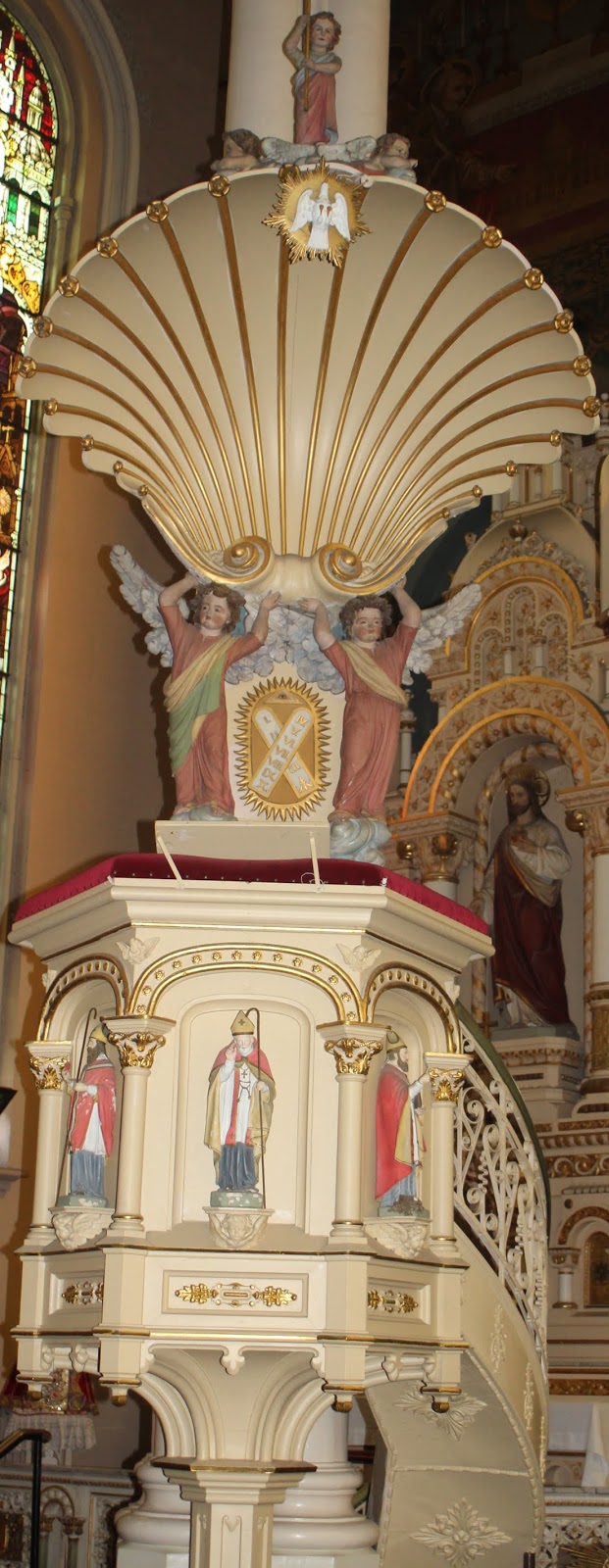
Finally, the church also has a large elevated pulpit near the front.  The crossed tablets below the shell with the Roman numerals one through ten symbolize the Ten Commandments.  A semi-spiral staircase, on the right in the photo below, leads up to it.  The dove at the top of the shell represents the Holy Spirit.


Various popes or bishops (based on their mitres and croisers) are portrayed around the pulpit, but I'm not sure who each is.  


One more post about St. Michael's Catholic Church in Old Town, Chicago, next week, to end up the year!


© Amanda Pape - 2018 - click here to e-mail me.