Sunday, June 29, 2014

Sentimental Sunday: Mom & Siblings at Littlefield Fountain in Austin, ABT 1941

Charles III, Jo Ann, and Geraldine Guokas at the Littlefield Fountain in Austin, Texas, ABT 1941
 I was pretty sure the photo above was taken in Austin, Texas, about 1941, because the clothing Charles and Jo Ann are wearing matches that in another photo taken in Austin about the same time.  I wasn't sure about the location, though, until I enlarged the detail in the upper part of the leftmost third of the picture:
Above:  Close-up of fountain detail from the left part of the 1941 photo at the top of this post
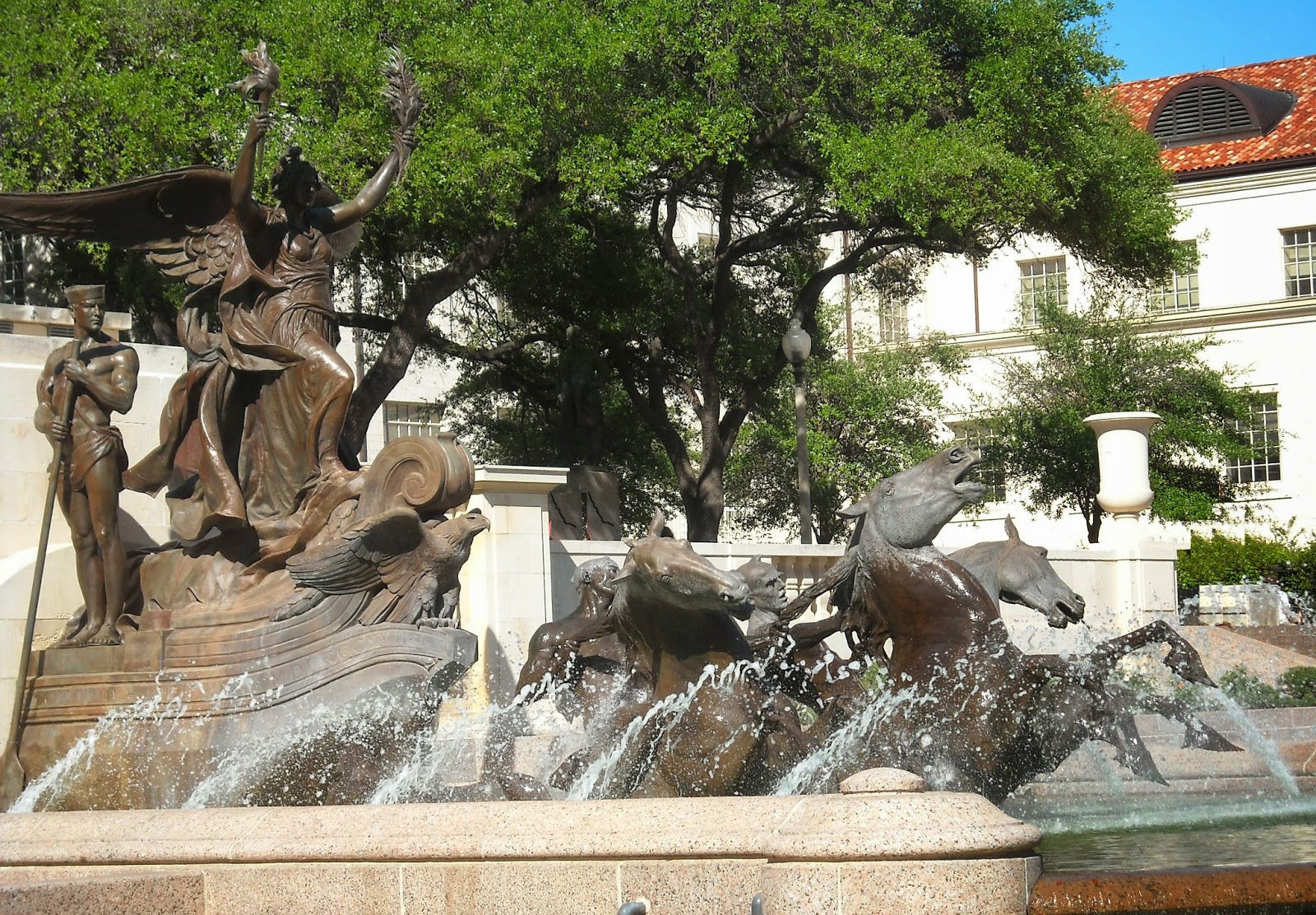
Below:  The Littlefield Fountain in March 2013

The Littlefield Memorial Fountain, located in the South Mall at the University of Texas at Austin, was designed by Italian sculptor Pompeo Coppini, who also designed the Alamo Cenotaph. Donated by Major George W. Littlefield, the World War I memorial fountain was commissioned in 1919, installed in 1932, and dedicated on April 29, 1933. It is comprised of three concentric pools on different levels with jets of water spraying on a bronze group featuring the personification of Columbia, the Spirit of Independence, returning from World War I on the bow of her warship, the Boat of America (which has an eagle on the prow). In her right hand is the Torch of Light and in her left is the Palm of Victory. She is flanked by two military figures--the Army to her left and the Navy to her right. To the front are three plunging, finned sea horses, symbolizing the ocean, with the two outer ones mounted by mermen, representing man's discipline.  The fountain is inscribed in Latin with Brevis a Natura nobis vita data est at memoria bene redditae vitae sempiterna. The translation reads, "Short life hath been given by Nature unto man; but the remembrance of a life laid down in a good cause endureth forever." Beneath this inscription is a memorial bronze plaque that lists all University of Texas students and alumni killed in World War I.

© Amanda Pape - 2014 - click here to e-mail me.

Friday, June 27, 2014

Friday's Faces From the Past: Cousin Beth, ABT 1971-2 and 1980


My 1C Beth, who shares the same birthday, at what I think is probably her high school graduation (left), and on her wedding day.

© Amanda Pape - 2014 - click here to e-mail me.

Thursday, June 26, 2014

Those Places Thursday: San Antonio's Historic Menger Hotel

The original part of the Menger Hotel, at the corner of Alamo Plaza and Blum in San Antonio.
The lower two stories were built in 1859; the third story was added in 1881.
Just four-plus days left (through July 1, 2014) to get early-bird discount registration fees for #FGS2014, the Federation of Genealogical Societies conference being held in San Antonio, Texas, August 27-30!  If you are still looking for a hotel, and don't mind being a little further from the Henry B. Gonzalez Convention Center, you might want to consider the historic Menger Hotel, next door to the Alamo.

The historical marker pictured at left pretty much tells the story of the hotel.  I took the pictures in this post on April 6, 2013, when I was at the hotel to make a presentation on blogging and family history for the International Society of Educational Biography conference.  I also picked up a self-guided tour brochure at the front desk with some of the other facts presented in the captions to the photos.  What I didn't get to see, but described in the brochure, was a network of tunnels under the building that once held wine cellars, meat lockers, and led to Menger's adjacent brewery.
The Victorian Lobby - the lobby of the 1859-1881 portion of the hotel was remodeled in 1909
The leaded skylight in the Victorian Lobby, added in 1909

The four-story, 125-room 1949/1950 addition to the Menger Hotel (at Alamo Plaza and Crockett) 
Entrance to the 1949/1950 addition (at Alamo Plaza and Crockett) and Main Lobby of the Menger Hotel
The Tropical Garden of the Menger Hotel, as viewed from the Main Lobby side
© Amanda Pape - 2014 - click here to e-mail me.

Wednesday, June 25, 2014

Wordless Wednesday: Dietz Kids, September 1963

Clockwise from left:  Ron, Shellie, Ruth, Rich, Regina, Rob, September 1963

© Amanda Pape - 2014 - click here to e-mail me.

Tuesday, June 24, 2014

Travel Tuesday: El Mercado in San Antonio, 1980, 2008, 2010, 2011

cousin Donna shopping at El Mercado, January 1980
One of my favorite places to visit the summer I lived in San Antonio - and a favorite place to take guests in subsequent years - was El Mercado, the Market Square, "the largest Mexican marketplace outside of Mexico."
Market Square (El Mercado), 7 August 2010 / David (Brokentaco) /  CC BY-2.0

This historic site (in existence since the 1820s) has over 100 shops and galleriesrestaurants and a food court, and (since 2012) the Educational and Cultural Arts Center of Texas A&M University - San Antonio (in what used to be the Museo Alameda), which features exhibitions of Latino arts.
Museo Alameda [now the Educational and Cultural Arts Center], 1 June 2012 / Karen / CC BY-NC-ND 2.0

Probably the biggest reason I'd travel from my work place of Mission San José to El Mercado was to eat great Mexican food at Mi Tierra Café, or buy goodies at its panaderia (bakery).  This awesome place, open 24 hours a day with year-round Christmas lights and decorations, has the BEST panes dulces (sweet breads - try the empanadas or cuernos de azucar) and Mexican candies (leche quemada is my favorite).
Mi Tierra Restaurant, San Antonio, 28 January 2008 / Mathieu PlourdeCC BY-2.0

For those of you going to San Antonio for the Federation of Genealogical Societies' 2014 Conference in late August, you can buy a one-day pass for VIA Transit and ride the Red (301) Circulator bus from the Henry B. Gonzalez Convention Center, site of #FGS2014 to Market Square and other sites of interest (like the Alamo).

© Amanda Pape - 2014 - click here to e-mail me.

Sunday, June 22, 2014

Sentimental Sunday: Pape Girls, Fall 1967

clockwise from left:  Terrie, Judy, Donna, Bobbie

© Amanda Pape - 2014 - click here to e-mail me.

Friday, June 20, 2014

Friday's Faces From the Past: Dietz Kids, ABT 1963-64


Shelly, Rob, Ruth, Rich, Ron, and Regina, probably late 1963 or early 1964.

© Amanda Pape - 2014 - click here to e-mail me.

Thursday, June 19, 2014

Those Places Thursday: San Antonio Missions National Historical Park, 1978 and 1997

I hope those of you going to San Antonio for the Federation of Genealogical Societies' 2014 Conference (#FGS2014) in late August plan to stay in San Antonio a few days more (either before or after the conference) so you can see some of the sites outside of the downtown area.  This week, I am writing about destinations to the north and to the south of downtown.

If you were to head south of the River Walk along the San Antonio River, you'd eventually reach the first of four sites in the San Antonio Missions National Historical Park.  Mission Nuestra Señora de la Purisima Concepción de Acuña, simply known as Mission Concepción, was dedicated in 1755, and is the oldest unrestored stone church in America.
Mission Concepcion at San Antonio, Texas, 27 June 2010 / Travis Witt / CC BY-SA-3.0
Next is Mission San José y San Miguel de Aguayo, or simply Mission San José, the "Queen of the Missions."  It was almost completely restored by the WPA (Works Projects Administration) in the 1930s.  Thus, it is the largest of the missions and gives the visitor an idea of how all the missions (including the Alamo) might have looked in the mid-1700s.
Mission San José at San Antonio, 27 June 2010 / Travis Witt / CC BY-SA-3.0
Further down the San Antonio River is Mission San Juan Capistrano, usually just called Mission San Juan.  It started in east Texas in 1761 and moved to this location in 1761.
Mission San Juan Capistrano facade at San Antonio, TX, 30 June 2011 / Travis K. Witt / CC BY-SA-3.0
Furthest south is Mission San Francisco de la Espada, or Mission Espada.  It is the oldest mission in the state, originally founded in east Texas in 1690 and moved here in 1731.
Mission Espada Chapel at San Antonio, TX, 30 June 2011 / Travis K. Witt / CC BY-SA-3.0

I'd suggest allowing at least an entire day to visit the missions.  All four are still active Catholic churches, and San José and San Juan offer bilingual mariachi Masses on Sundays. (Note that the church at Mission Espada is closed for preservation work until December 2014).

You might also want to visit the nearby Espada Aqueduct.  Built in 1745 as part of the irrigation system for the missions, it is the only remaining Spanish aqueduct in the United States.

I was privileged to work as a park ranger at Mission San José in the summer of 1978, when it was still part of the Texas Parks and Wildlife Department system.  I've written about and posted pictures of Mission San José before, but here are some additional photos from a visit by my family of origin that summer, and another visit with my offspring in the summer of 1997.
Dad and me at the former entrance to Mission San José, on the southwest corner of the complex, summer 1978.
The entrance has been moved to the southeast corner and this sign was removed sometime after August 1998.

Mark, me, Mom, Dad, Mary, and Brian, just outside the San José granary with its flying buttresses, summer 1978

Mark, Sister Jean Marie, Brian, Mom, Dad, and Mary at the entrance to the San José church, summer 1978

Mark, Mary, Dad, Mom, Brian, Nani, and Sister Jean Marie in front of the Rose Window, summer 1978

Eric and Diane in front of the Rose Window / Rosa's Window, summer 1997

 © Amanda Pape - 2014 - click here to e-mail me.

Wednesday, June 18, 2014

(Almost-) Wordless Wedding Wednesday: Wedding Wall

photo courtesy Heather Grandusky Odden
photo courtesy Marianne Streff Gustafson
I thought this was a really cute idea for a photo booth prop (and another great way to incorporate old family pictures in a wedding).  These are from the recent wedding of a first-cousin-once-removed. Hang wedding photos for couples related to the bride and groom (parents, grandparents, etc.) on a wall made of plywood and covered with wallpaper or an old sheet, along with some large frames surrounding openings in the wall.  When I first saw the top image, I thought the "photos" of 1C1Rs Heather and J.J. (and their spouses Kevin and Marianne respectively) above, were REAL!  Only J. J.'s hand on the frame gives it away!  The second photo has 1C1R Christy and her fiance Dave.  In the photo below, my 1C Marianne and her husband Bill make their pictures come a little TOO alive!
photo courtesy Marianne Streff Gustafson

© Amanda Pape - 2014 - click here to e-mail me.

Tuesday, June 17, 2014

Travel Tuesday: San Antonio's Brackenridge Park Area, 1944, 1978 and 1980

Japanese Tea Garden / Sunken Gardens Pagoda / Pavilion, Summer 1978


I hope those of you going to San Antonio for the Federation of Genealogical Societies' 2014 Conference (#FGS2014) in late August plan to stay in San Antonio a few days more (either before or after the conference) so you can see some of the sites outside of the downtown area.  This week, I'm going to write about destinations to the north and to the south of downtown.

If you were to head north of the River Walk along the San Antonio River, you'd eventually reach Brackenridge Park, which is near the river's spring-fed headwaters.  The 343-acre site has an interesting history and features New Deal era structures in its bridges over the river, picnic areas, and golf course, as well as tree-lined trails, playgrounds, and a miniature train that takes visitors on a 3.5 mile loop around the park.

Brackenridge Park is the site of a number of attractions, including
the San Antonio Zoo,
the Witte Museum, and
the Japanese Tea Garden.

Mom, Dad, me, and brother Mark along the San Antonio River in Brackenridge Park, summer 1978

Siblings Brian, Mark, and Mary at Brackenridge Park, summer 1978


I visited all of these sites as well as the park the summer I lived in San Antonio, but my favorite place by far was the Tea Garden.  It's one of the places I took my family when they came to see me that summer, and a place I took relatives visiting in Texas in subsequent years.  In those days (1978), it was known as the Sunken Gardens.

The site was originally a rock quarry.  Between July 1917 and May 1918, City Parks Commissioner Ray Lambert, with plans from his park engineer and no money, was able to construct the Garden. According to the city's website, he "used prison labor to shape the quarry into a complex that included walkways, stone arch bridges, an island and a Japanese pagoda....local residents donated bulbs to beautify the area. Exotic plants were provided by the City nursery and the City Public Service Company donated the lighting system. The pagoda was roofed with palm leaves from trees in City parks. When completed, Lambert had spent only $7,000."
Cousin Donna diverts the 60' waterfall at the Sunken Gardens, January 1980


"In 1926, at the City's invitation, Kimi Eizo Jingu, a local Japanese-American tea importer, moved to the garden and opened the Bamboo Room, where light lunches and tea were served....his family continued to operate the tea garden until 1942, when they were evicted due to anti-Japanese sentiment during World War II. A Chinese-American family operated the facility until the early 1960s....In 1984, the area was rededicated as the Japanese Tea Garden."

Unfortunately, after that, the Garden suffered some decline due to "the ravages of time and insufficient funds."  In 2004, the City and the San Antonio Parks Foundation began a multi-phase restoration. In 2014, according to the City, "The lower area, which includes the koi ponds and flower beds, will be closed beginning June 10 through the end of September. However, the upper level around the pagoda will remain open as will the Jingu House Café. The renovations include repairs to the ponds’ filtration system and re-lining of the ponds. Additionally, new lighting will be installed around the ponds and the pagoda."


Above and below - views of the Sunken Gardens, summer 1978


ETA:  I'm not completely sure, but I believe this photo of my mother and her two siblings was taken in the Sunken Garden area in 1944.  They are wearing the same clothes they had on in photographs taken at San Antonio's River Walk and Alamo.

Gerrie, Jo Ann, and Charles Guokas III at the Sunken Gardens in San Antonio, 1944


© Amanda Pape - 2014 - click here to e-mail me.