Friday, August 13, 2021

A Mother-in-Law's Early Memories, ABT 1917-1919

Jewel Moore Gresham, ABT 1932


Sometime before she died in 1994, my mother-in-law, Jewel Moore Gresham, either wrote down or dictated some memories.  Here are the earliest ones, from the years the family lived near Silver Creek northwest of Fort Worth, Texas, south of Azle and north of White Settlement:

I was born October 4, 1914 in a log cabin that was located on a creek by the name of "Live Oak"  [actually Silver Creek1].  This was part of a farm owned by Rufus B. Hagood.2  Mr. Hagood, with his wife,3 his two sons, Orval4  and ?,5 and a daughter, Annie B.,6 lived across the creek in the "big house."  

I think that Mabel,7 Audie,8 and I were the only ones born in the log cabin.  Papa9 and the Hagoods worked the land together.  I don't know what kind of arrangement they had.10  Mr. Hagood liked Papa.  He said he was the most honest man he had ever known. (Years later, when he came to see us in Oklahoma, he told me this).  He gave him the nickname "Square."  The Hagood boys were older than any of the children in our family.  Annie B. was about the same age as Mabel.

The log cabin had one big room with a fireplace which served as Mama11 and Papa's bedroom.  A shed room on the side was the kitchen.  It had a huge wood cookstove, table, chairs and a long bench.  (The table was still with us when I left home in 1939.)  There was a "safe" where the dishes and the leftover food was stored (this piece was still with us when I left home.)  Out the front door of the cabin was a deck, on the other side of the deck was a big bedroom where we slept.  

I don't have many vivid memories of our life at that point in time.  I do have memory of a Christmas morning.  I must have been small enough that I was still sleeping with Mama and Papa.  I remember waking up and Papa had built a fire in the fireplace and lit the lamp, and that is when I saw all the stockings filled with goodies and presents.  I guess we were poor, but when Christmas came around, Papa and Mama made it special, and we were happy.

Another memory was about the mirror in that old oak dresser we had.  It was low, and I could see myself in it.  I couldn't figure it out, and I wanted Ivis12 to take me to that other place.  Somehow, it looked like a better place.  The dresser was placed "catty-cornered" in the room.  So Ivis put a blindfold over my eyes, and after a few maneuvers, she told me I could take off the blindfold.  I guess that was my very first disappointment.  She had put me in the corner behind the dresser.

I don't know exactly how long we lived here, but judging from the events that were happening at the time, it must have been in 1917.  Orval Hagood had been drafted in the army.13 ... I remember going with Mama to see Mrs. Hagood.  We found her sitting at the kitchen table, and she was crying.

The Hagoods moved into Fort Worth, and we moved into the big house.  This house had two huge rooms.  The fireplaces, one in each room, were joined into one chimney.  A small shed room on the side was where I slept.  Also, a kitchen, pantry, and back porch.  There was a huge front porch that stretched across the entire house.  The house was evidently built on a slope, because there were a lot of steps leading up to the porch.

That is where I first saw and smelled a geranium.  Even now when I smell a geranium, I think of that porch.  Everyone was going to school14 except me.  

At some time, I had diphtheria.15  By that time, they had the vaccine, and I remember the doctor coming, and Papa gave me a nickel if I wouldn't cry when the doctor gave me the shot.  I just remember the one shot, so I guess it was pretty powerful stuff.  I had a lot of croup, and I guess a lot of "snotty noses."  Mama would make cough syrup out of mullein and horehound. ... At four, I knew what mullein looked like.  Now, I don't think I could recognize mullein growing in the wild.  I remember going down a path and I was singing, "horehound and mullein, horehound and mullein."  All of a sudden a huge dog rose out of the weeds and started barking at me.  I threw my bucket away, and went screaming towards the house.  Of course, Mama came running to see what was the matter.

One winter, one of the sows had a litter of pigs.  She wasn't a very good mother, so Papa took the little piglets into the house.  He made a nest on the hearth of the fireplace.  He left me with instructions to watch the piglets, and not let them run into the fire.  So I sat and watched and watched and watched, and then I decide things were not going so good, so I went to the porch and started screaming and jumping up and down.  Papa, in the meantime, had gone back to the barn.  When he heard me screaming, he jumped over all the fences and when he came into the room, he found all the piglets fast asleep.  "What was the trouble?" he said.  I said, "One of them wiggled his ear."

Behind the house was a hill.  I'm sure it wasn't too high, but to me, it seemed awful tall.  One summer day, for some reason, we all climbed to the top of the hill.  It was the first time I had ever seen the horizon.  It had a tremendous effect on me.  I did not know the world was so big.  It left an indelible imprint on my mind.  Even now, when I am on a mountain  top, I still get a diminished feeling, but fascinated by the vastness.

We had neighbors.  One family, a German family (Hallman), had many children.  We used to visit each other on Sunday.  Another family named Pierce had kids our age.  The Hagoods would come to visit with little Annie B.  Annie B. had a very lively imagination.  She was always seeing monsters in the weeds.  One day, I remember she had us in the outhouse, and she wouldn't let us out because she could see a monster's foot in the weeds.  I never did see that monster's foot, and I felt cheated.

It was at this time that Papa bought Mama a new Singer sewing machine -- the very machine sitting in the bedroom (that Ivis now has).  Mama made all our clothes.  She never had a pattern.  I don't know how she did it.

I guess it was in 1918 that the boll weevil ate up the cotton crop in Texas, and families began to migrate.  The Hallmans went to Nebraska, and the Pierces went to Oklahoma - Marlow.  He wrote back how great the crops were there.  I can't remember exactly when we moved.  Papa went ahead and took the horses, cows, pigs and plows in a boxcar.  I think he stayed in the boxcar with the animals.  Of course, it was only 150 miles from Fort Worth to Marlow, so the trip wasn't too long.  I remember being on a train.  I couldn't breathe, and Mama got some passenger to open the window so I could get some fresh air.  It must have been in late winter, because when we got to Marlow, there was snow on the ground.

The war was over November 11, 1918, so I am guessing that when we got to Marlow, it was in the early months of 1919.


A few months ago, I decided I wanted to try to locate the land the Moore family lived on from about 1909 to 1919.  My next post will be about where it is located and how I determined that.

NOTES  

1.  Live Oak was the name of their school, and the creek it was near.  The creek the cabin was on was Silver Creek.  This was in an area on the northwest side of Fort Worth in the area north of White Settlement and south of Azle - now about where Loop 820 circles the city.

2.  Rufus B[unyon] Hagood, 1854-1944. Hagood is pronounced Hay-good, and was spelled Haygood in the transcription of  Jewel's memories.


7.  Mabel is Jewel's older sister, Beulah Mabel "Mabel" Moore, 1910-1932

8.  Audie is Jewel's older sister, Audie Ruth Moore Cook, 1911-1969

9.  Papa is Jewel's father, Tandy Clayton "Clayton" Moore, 1878-1964

10.  According to page 84 of Heroic Lives of Ordinary People, by Tom Moore, his grandson, Clayton rented an 80-acre plot with a cabin, supposedly former slave quarters, from Hagood.

11.  Mama is Jewel's mother, Nancy "Nannie" Flora Jones Moore, 1882-1969

12.  Ivis is Jewel's oldest sister, Ivis Moore Mew, 1905-2004

13.  Orval Hagood served in the Army from July 3, 1918, to April 11, 1919.  His older brother Bun was not eligible to serve because by June 5, 1917, he was missing an eye.

14.  Jewel's older sisters, Ivis, Ruby (Clayton Moore Albillar, 1908-1967), Mabel, and Audie, and her big brother Thomas Gurth Moore (1902-1935) attended the Live Oak School, about two miles away.

15.  Jewel's oldest sister, Velma E. Moore (1903-1908), had died of diphtheria.  However, a diphtheria vaccine was not developed until 1926, so this is either a much later memory for Jewel, or she might have received the pertussis (whooping cough, vaccine developed in 1914) or smallpox vaccine.


© Amanda Pape - 2021 - e-mail me!

Tuesday, August 3, 2021

Happy Birthday to My Brother Mark!


My brother Mark at a roadside park in Texas, during a stop for a picnic lunch on our way to or from New Mexico in the summer of 1966.


© Amanda Pape - 2021 - e-mail me!

Saturday, July 3, 2021

Sibling Saturday: Happy Birthday to My Brother Brian!


My brother Brian at a roadside park in Texas, during a stop for a picnic lunch on our way to or from New Mexico in the summer of 1966.


© Amanda Pape - 2021 - e-mail me!

Sunday, June 20, 2021

Sentimental Sunday: Happy Father's Day to My Dad in Heaven!


This photo was taken on the driveway of our family home at 8015 Sharpview in Houston, Texas, sometime during or before October 1966.  From the top, left to right, Frederick Henry Pape (1929-2017) holding Mary, me, Brian, and Mark.


© Amanda Pape - 2021 - e-mail me!

Tuesday, June 1, 2021

Happy Birthday to My Son!

Eric in Fall 2012 when he taught math as a volunteer at St. Vincent K-8 School in Los Angeles, after graduating from New College of Florida with a double major in mathematics and history.


After his volunteer work, Eric earned a master's degree in applied financial mathematics from the University of Connecticut, and worked first for Charles Schwab in Chicago and McKinsey & Company in Boston.  He recently accepted a position as a data scientist with DataRobot and is currently working in Charlotte, North Carolina.  I'm so proud of him!


© Amanda Pape - 2021 - e-mail me!

Monday, May 24, 2021

Military Monday: Orange County, Indiana, War Memorial

In honor of the upcoming Memorial Day and for The Honor Roll Project, I decided to transcribe the Orange County, Indiana, War Memorial.


This memorial is located on the grounds of the Orange County, Indiana courthouse in the Paoli town square.  Across the top of the shorter stones on the left and right sides of the memorial, it reads, "Honor roll of the silent ones who fought for God and country".  There's a star at the top of the tall stone in middle, and at the bottom it says, "Orange County".

All photos below are cropped out of the photo above, and enhanced for readability.


1917  World War I  1918

Alvis Apple | William A. Beaty | Walter Benson | Roscoe Bledsoe | William S. Bowling | Warren Brock | Clarence Busick | Ross Carnes | Banks Claxton | Weaver Crecelius | Wesley Edwards | Gilbert Elliott | Everett M. Finkbiner | Oscar L. Ford | Carl Ferguson | Ernest E. Gakan | Harry Grigsby | Dora Hammond | Benjamin Holiday | Clyde Hooten | Ezra Jordon | Clarence A. Keith | Manoah J. Kirby | Ray Kemple | Homer D. King | John Arthur Lingle Jr. | George McDonald | Lacy Phillips | Claude Sears | Stallard Weeks | Clarence Wolfe


1941  World War II  1945

James Robert Akers | Elmer C. Allen | Lee Allen | Roy A. Baker | James Lee Belo | Jesse T. Bobbitt | Loren Bundy | Lawrence Noble Charles | Kenneth Clements | Robert Condra | David Daugherty | Lowell Doan | Irvin L. Eickelberger | Bryan Ellis | Paul Leroy Freeman | Harold Giles | William Goins | Arthur J. Grimes | Robert E. Hall | Frank Lev Hamer | Everett Hankins | Howard Hill | Charles S. Holland | Delmar Holland | Kenneth Howard | Willard G. Hunter | Phillip Jackson | Clois Leon Keifner | Esco King | Howard Kirby | James W. Kirby | Samuel R. Knox Jr. | Robert M. Lane | James Lindley | Howard Linthicum | Gilbert Martin | Clarence S. Moffatt | Durward Monyhan | Edwin V. Monroe | Bertie Thomas McCracken | Harry McDonald | James L. McFarland | Roscoe Nussear | Howard Payton | Carl Wayne Peters | Clyde Pinnick | Warren Allen Pruett | Charles Qualkinbush | Arthur Quinn | Kenneth M. Radcliffe | William Robert Radcliff | Cecil Iden Rhodes | William Roach | George O. Shinkle | Ray Smith | George Speer | Charles E. Stanfield | Carroll Trinkle | Francis M. Walls | William Walls | William Donald Walton | Ray R. Waynick | Earl M. Wilson | Earl V. Wilson | Johnnie Williams | Donald W. Wininger | Coy Lewis Wolfe | Carl Wayne Morris


Korean War

Dale Asher | Gene Bledsaw | Carl N. Estell | Gary Max Leonard | Jack D. McKiegher | Franklin D. Radcliff | John O. Walker | Jack E. Kellams | George Deel | Ray R. Pruett | Charles L. Wells | William A. Lynch


Viet Nam War

Arnold G. Abel | Mark J. Allstott | Charles E. Beals | J. Stephen Brown | John D. Cook | Ronald W. Hackney | Jack L. Sanders | Richard Wolfington Jr. | David Fox


© Amanda Pape - 2021 - e-mail me!

Sunday, May 23, 2021

"Apartment Building Split, Whirled, and Relocated" - But Where?

In one of the Facebook groups I am in, that discusses Chicago history, someone posted the following article from Popular Mechanics, called "Apartment Building Split, Whirled, and Relocated."  The short article, reproduced below, was both intriguing (because of the process used to move the building) and frustrating (because it never specified WHERE the building was).  I decided to try to find out its location.


The original post indicated the article was from a 1917 issue.  I wanted to see if I could find this article, in case there was any additional information about the location of this building.   According to the Industrial Arts Index, this article was actually in the April 1920 Popular Mechanics.


The Industrial Arts Index is ultimately what helped me figure this out. After failed attempts to figure out the location of the buildings based on the "Board of Education" and "boulevard" clues in the original article, using various school-related sources I use a lot in my genealogy work (including a 1917 School Map of Chicago), it occurred to me that there might be another reference to this project in another article. Sure enough, the Industrial Arts Index had another article listed on the very next page, "Novel Feat Accomplished in Moving a Chicago Building."  The May 26, 1920 issue date told me it was probably an article about the same building.


The periodicals abbreviations guide at the beginning of the Industrial Arts Index told me that "Am Arch" was American Architect and Architecture.  The article was in volume 117, pages 662-666, from May 26, 1920.

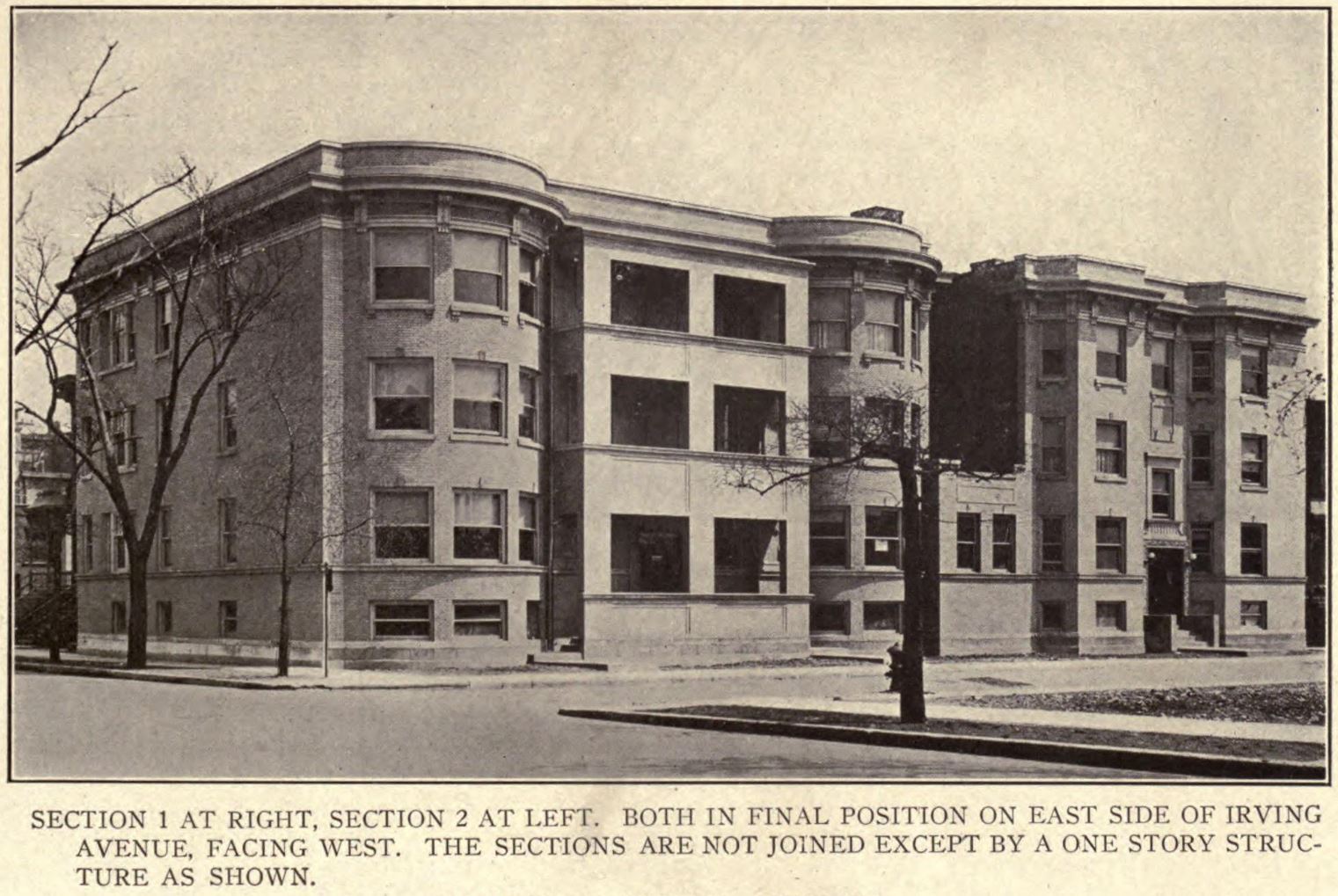
I now know where this building was.  On the first page of the article, 662, it states,  "This building is three stories and basement in height and was located on the southwest corner of Jackson Boulevard and Irving Avenue."

Here's a photograph of the building from the top of page 665 in the article:


The building was moved for the expansion of Crane Technical High School (now Richard T. Crane Medical Prep High School). Here's what the area looked like on the 1917 Sanborn map. The addresses of the buildings that were moved were 2237 and 2239 W. Jackson Boulevard, and 308 and 310 S. Irving Avenue (which is S. Bell Avenue today):


The building's owner bought the lot just across Irving street, on the southeast corner of the intersection.  Problem was, the lot was too narrow to just slide the buildings over as is.  Plus, the back sides of the parts of the buildings would have ended up facing the street with such a simple move.

So the solution was to cut the building roughly in half.   The 308 and 310 S. Irving Avenue part of the building is called Section 1 in the diagram below, and it was rotated 180 degrees before being moved directly across Irving Avenue.  The 2237 and 2239 W. Jackson Boulevard part of the building is called Section 2 in the diagram below, and was rotated 90 degrees before being moved directly across Irving Avenue (so that its front now faced that street rather than Jackson Boulevard).  Here is a diagram from page 663 in the article illustrating this:


A small section of the three stories that connected the buildings was removed, and a new one-story section (to preserve light) was built between the relocated buildings.  The porch originally in front of the Section 2 building had to be removed for the relocation, so it's not in the picture below (from the bottom of page 665 in the article:


Although the moved buildings are now gone (that block is now an athletic field and parking lot for Crane High School), they were still there on the 1950 Sanborn map.  The addresses were 301-303-307-309 S. Irving/Bell Avenue:


I encourage you to read the whole article in American Architect and Architecture.  The process to move the building is fascinating, the cost not as bad as one might think, and one tenant even remained IN the building during the 60+ days it took to move it!


© Amanda Pape - 2021 - e-mail me!

Sunday, May 9, 2021

Sentimental Sunday: Happy Mother's Day to My Mom in Heaven!


My mother, Geraldine Margaret Guokas Pape (1928-2019), pregnant with me, outside hers and Dad's apartment at 2059 W Touhy Avenue in Chicago, Illinois.


© Amanda Pape - 2021 - e-mail me!

Saturday, April 10, 2021

Sibling Saturday: Happy National Siblings Day!


This photo was taken on the driveway of our family home at 8015 Sharpview in Houston, Texas, sometime during or before October 1966.  From the left, Brian, Karen, Mary, me, and Mark.  We girls are wearing short sets sewn for us by Mom.


© Amanda Pape - 2021 - e-mail me!

Sunday, April 4, 2021

Sentimental Sunday: Happy Easter, and Happy Birthday to Me!


This picture is from a birthday party my mother held for me in 1965, when my birthday fell on (what was back then called) Passion Sunday, two weeks before Easter that year (on April 18) - so I'm guessing this party was held the Saturday before, on April 3.  I'm posting the picture today, the third day in my lifetime that my birthday and Easter coincide (the previous two were in 1999 and 2010).

© Amanda Pape - 2021 - click here to e-mail me.