Thursday, September 3, 2020

Those Places Thursday: Dr. David Sayers' Home in Bastrop, Texas


Above:  [R. L. Perkins Home Photograph #1], photograph, December 25, 1962; (https://texashistory.unt.edu/ark:/67531/metapth480175/m1/1/: accessed August 30, 2020), University of North Texas Libraries, The Portal to Texas History, https://texashistory.unt.edu; crediting Texas Historical Commission.


This house - or a part of it - was the home of Dr. David Sayers shortly after he came to Bastrop, Texas, in December 1851.  The Hall-Sayers-Perkins house at 1307 Church was originally a single story "dogtrot" - two rooms separated by an open breezeway hallway in the middle.  In 1961, evidence of wide fireplaces at the ends of each room were uncovered in the foundation, according to the historical marker application and a 1976 newspaper article.  This part of the house may date back to 1830, according to another newspaper article in 1992, and might be associated with early settlers John Jackson Tumlinson Jr. (an early Texas Ranger and Texas Revolution soldier), and Elisha Marshall Pease (an official in the Texas Republic, later a legislator and the 5th and 13th Governor of Texas), who apparently arrived in Bastrop in 1835. 

Tax records showed that Pease owned the property at least 1847-49, followed by John D. Hogan in 1850-58.  Constant K. Hall (buried in the fenced-in area at Fairview Cemetery with David Sayers) was also paying taxes on the property beginning in 1852 and continuing through 1866.

In 1851, two rooms were added with an L-shaped gallery, and it evolved into the Greek Revival style, with a front door with a transom and sidelights.  The work was done by N. B. (Napoleon Bonaparte) Tanner for Hall, who paid him $1400 in full on January 3, 1852.  This was about the time Dr. David Sayers moved into it, apparently renting the home at first and then purchasing it at a sheriff's sale around 1870.  The flooring is apparently hand-pegged and grooved heart of pine with homemade nails.

Below is a segment of an 1887 "bird's-eye view" of Bastrop.  The house is on the right-hand side of the intersection of Diagonal (now Church) Street and an unnamed street (now Buttonwood).  Diagonally across the intersection was the Bastrop Academy (established January 1852, and marked with a 2 below it on the map), which in 1856 became the Bastrop Military Institute, where Dr. Sayers sent his oldest sons (from his first marriage), Joseph (its first graduate) and William.  The Institute closed during the Civil War, but reopened in 1867 as the Texas Military Institute.  In 1869-70, Dr. Sayers served as its surgeon, but the school was moved to Austin in June 1870 and operated there until 1879.


Above: Augustus Koch (1840–?). Bird’s Eye View of Bastrop Bastrop County Texas 1887, 1887. Lithograph, 16.6 x 22.9 in. Lithographer unknown. Bastrop County Historical Society.  From  http://www.birdseyeviews.org/zoom.php?city=Bastrop&year=1887&extra_info= and https://commons.wikimedia.org/wiki/File:Old_map-Bastrop-1887.jpg


Just two-tenths of a mile south, near the corner of Church and Spring streets, is the Calvary Episcopal Church, where David Sayers was a vestryman, and he and wife Inda provided one of the stained glass windows.  One block east and one block south from there, another two-tenths of a mile, at 1003 Main, was Dr. Sayers' medical office.

Tax records show Dr. Sayers lived here until his death in 1886, and his widow Inda in 1887, the year of her death.  The same tax records show their youngest child, Sam Scott Sayers was assessed for the property taxes 1894-6 and 1901 (records for 1888-1893, 1897-1900, and 1902-on are not available online).

Dr. Nathaniel Green Fowler, a dentist, bought the house in 1906.  In 1910, a second story was added and the house was given a Victorian look.  Major Robert L. Perkins Jr. and his wife Catrine bought the house in 1959, and applied for a historical marker in 1964.  It was added to the list of Recorded Texas Historic Landmarks in 1965.  The house is also on the National Register as of December 1978 as part of the Bastrop Historic and Architectural Multiple Resource Area.  Today the house can be rented for guest stays (click that link for interior views).

All of the black-and-white photographs in this post were taken December 1, 1969, and are part of the Texas Historical Commission's Historic Resources Survey Collection.  Check the captions for the dates on the color photographs.


Above:  Texas Historical Commission. [Sayers-Perkins House, (Front elevation)], photograph, December 1, 1969; (https://texashistory.unt.edu/ark:/67531/metapth675102/m1/1/: accessed August 30, 2020), University of North Texas Libraries, The Portal to Texas History, https://texashistory.unt.edu; crediting Texas Historical Commission.

Below:  Texas Historical Commission. [Sayers-Perkins House, (Front elevation)], photograph, December 1, 1969; (https://texashistory.unt.edu/ark:/67531/metapth676476/m1/1/: accessed August 30, 2020), University of North Texas Libraries, The Portal to Texas History, https://texashistory.unt.edu; crediting Texas Historical Commission.


Below:  Texas Historical Commission. [Sayers-Perkins House, (Front elevation)], photograph, December 1, 1969; (https://texashistory.unt.edu/ark:/67531/metapth674636/m1/1/: accessed August 30, 2020), University of North Texas Libraries, The Portal to Texas History, https://texashistory.unt.edu; crediting Texas Historical Commission.


The view above is from the corner of Church and Buttonwood streets, looking southeast, and shows parts of the house added in 1851 (lower level) and 1910 (upper level, entire house).

The view below is looking northeast at the property from the front of the house next door, just south of it.  Note the bay window on the first floor - this was eventually removed (definitely by May 2014, when the color photo further above was taken) and the fireplace originally in this location was restored.


Above:  Texas Historical Commission. [Sayers-Perkins House, (Front oblique)], photograph, December 1, 1969; (https://texashistory.unt.edu/ark:/67531/metapth673237/m1/1/: accessed August 30, 2020), University of North Texas Libraries, The Portal to Texas History, https://texashistory.unt.edu; crediting Texas Historical Commission.

Below:  Texas Historical Commission. [Sayers-Perkins House, (Side elevation)], photograph, December 1, 1969; (https://texashistory.unt.edu/ark:/67531/metapth675287/m1/1/: accessed August 30, 2020), University of North Texas Libraries, The Portal to Texas History, https://texashistory.unt.edu; crediting Texas Historical Commission.


© Amanda Pape - 2020 - e-mail me!

Tuesday, September 1, 2020

Tombstone Tuesday: Dr. David Sayers Family Plot, Fairview Cemetery, Bastrop, Texas

The grandparents and some of the siblings of my great uncle Philip Edgar Sayers Sr. are buried in the historic Fairview Cemetery in Bastrop, Texas, in Section E(B).

Philip's grandfather was Dr. David Scott, 1811-1886, a physician born May 27, 1811, at Reed Island Creek in Wythe County, Virginia.  He graduated from the University of Pennsylvania medical school on March 26, 1835.  Late in 1840, he moved to Grenada, Mississippi, and married Mary Thomas Peete (1821-1847).  They had two sons, Joseph Draper Sayers (1841-1929) and William Branch Sayers (1843-1898) - more on them in future posts.

According to a source published in 1899, David and his two sons moved to Bastrop County, Texas, in December 1851, where he continued his practice of medicine.


Above:  Illustration of Dr. David Sayers, 21 January 1899, for the inauguration of his son Joseph Draper Sayers as Governor of Texas.  Cain, Thomas C. The Bastrop Advertiser (Bastrop, Tex.), Vol. 46, No. 46, Ed. 1 Saturday, January 21, 1899, newspaper, January 21, 1899; Bastrop, Texas. (https://texashistory.unt.edu/ark:/67531/metapth205431/m1/6/: accessed August 26, 2020), University of North Texas Libraries, The Portal to Texas History, https://texashistory.unt.edu; crediting Bastrop Public Library.


Below:  Obituary for Dr. David Sayers, July 10, 1886. Cain, Thomas C. The Bastrop Advertiser (Bastrop, Tex.), Vol. 29, No. 27, Ed. 1 Saturday, July 10, 1886, newspaper, July 10, 1886; Bastrop, Texas. (https://texashistory.unt.edu/ark:/67531/metapth204952/m1/2/: accessed August 26, 2020), University of North Texas Libraries, The Portal to Texas History, https://texashistory.unt.edu; crediting Bastrop Public Library.


Here is his grave marker at Fairview Cemetery - this photo is courtesy Gail Davis from FindAGrave.  The flag in the background is in the plot for his son, Texas Governor Joseph Draper Sayers.


Detail from Dr. Sayers' monument - this and all following cemetery and grave marker photos are by Gerry Beathard from FindAGrave and are used with his permission.


This side (pictured above) reads,

"In memory of Dr. David Sayers, born May 27, 1811 Died July 2, 1886
The afflicted poor never appealed to him. in vain."

The symbol above appears to be the keystone emblem signifying a Mark Master Mason.


This side (pictured above) includes the classic compass symbol of Freemasonry and the words, "His desires were regulated and his passions kept within due bounds with all mankind."  This is a Masonic teaching associated with the compass symbol.


This side (pictured above) has the words, "His conduct was in harmony with the principles of morality and virtue," and the Masonic square at the top, which symbolizes morality.


The final side (pictured above) has the words, "His life exemplified truth, and adorned humanity and his death illustrated the Christian's faith," and what I think is the Masonic 24-inch gauge symbol at the top.


Below is a picture of the David Sayers plot in the Bastrop Fairview Cemetery.  As you can see, there are a number of other graves within the gated, fenced-in area.


The cemetery is now operated by the City of Bastrop, which sent me a guide to the graves in this area of Section E(B) (pictured below, click on the image to make it larger).  The fence for the David Sayers plot is represented by the green box below.  The purple box outlines the fenced area of the Joseph Draper Sayers plot, which I'll discuss in a future post.


Dr. David Sayers' second wife. Indiana "Inda" Scott Sayers, 1828-1877, is buried next to him.  They married on February 8, 1854, in Bastrop County. and had four children who survived into adulthood:  Jessie Alison Sayers (1859–1939), Elizabeth ("Lizzie" or "Lilly") Scott Sayers Sayers (1863–1918; yes, she married a Sayers), Thomas Green Sayers (1865-1910, Phil Sayers' father), and Sam Scott Sayers (1867–1935).  More about Jessie, Elizabeth, and Sam in future posts.


Here is Inda's obituary:

Austin Weekly Statesman. (Austin, Tex.), Vol. 16, No. 27, Ed. 1 Thursday, May 26, 1887, newspaper, May 26, 1887; Austin, Texas. (https://texashistory.unt.edu/ark:/67531/metapth278075/m1/5/?q=sayers: accessed August 26, 2020), University of North Texas Libraries, The Portal to Texas History, https://texashistory.unt.edu.


On the other side of Dr. David Sayers' obelisk are four markers for four Sayers children who died young.  David Sayers, 1861-1865, was likely the doctor's and Inda's firstborn son.


Family stories said Thomas Green Sayers had a twin sister - that must have been Kate, also born in 1865:


It's not clear who the next two Mary Sayers belonged to.  Dr. David Sayers' first wife Mary died in 1847, and he did not marry Inda until 1854.  Perhaps he had another wife between Mary and Inda, with two daughters by her?  Or perhaps these are the children of some other unknown Sayers who came to Texas.


The other graves within the fence include David's and Inda's children Jessie Alison Sayers and Sam Scott Sayers, Sam's wife Dot McLavy Sayers (more on these three in future posts), Inda's sisters Mary Elizabeth Scott (1826-1880) and Martha Scott Fourshee, as well as three apparently unrelated persons:  stagecoach operator Constant K. Hall (1818-1873), his daughter Kate K. Hall (1845-1863), and his father-in-law James Leverich Hedenberg (1790-1862).  There's an empty spot next to Kate that could have the unmarked remains of her mother, Constant's wife, and James's daughter Margaret Matilda Hedenberg Hall (c.1816-26 Feb 1895).  And Dr. Sayers may have purchased his home from Constant (C. K.) Hall.


© Amanda Pape - 2020 - e-mail me!

Sunday, August 23, 2020

Sentimental Sunday: Happy Birthday to Breathless! (tomorrow)


My sweetie Mark on his birthday - probably about 1954.


© Amanda Pape - 2020 - click here to e-mail me.

Tuesday, August 4, 2020

Tombstone Tuesday: Sayers Family Plot, Washington Cemetery, Houston, Texas

The parents and some of the siblings of my great uncle Philip Edgar Sayers Sr. (1901-1972) are buried in the Washington Cemetery in Houston, Texas, in Section A, Lot 108.  Here is the tombstone for his parents, Thomas Green Sayers (May 1865 - 2 February 1910) and Elvira/Almyra "Mina" S. Fawcett Sayers (20 May 1866 - 10 August 1956).  This and all other tombstone photos in this post are courtesy Robert Hague at FindAGrave.


Thomas and Mina were both born and raised in Bastrop County, Texas, where they married on 5 December 1888.  Their oldest son, Thomas Green Sayers Jr. (13 May 1890 - 26 November 1973) was born in Austin, apparently while his father worked in the state comptroller's office, but the next two sons, Albert Fawcett Sayers (27 December 1892 - 25 October 1972) and Joseph David Sayers (24 August 1894 - 1 July 1938), were both born in Smithville, in Bastrop County.

Around 1898, the family moved to Houston.  Thomas Sr. was a traveling auditor with the Southern Pacific Railroad for five years (around 1899-1903).  The family did live in Jacksonville, Texas, in 1904, where son Ralph Segar Sayers (23 September 1904 - 31 January 1994) was born.  Thomas Sr. served as an agent for the Texas and New Orleans Railroad (itself a part of Southern Pacific) and suffered a terrible fall while living there that it was thought he would not survive.


Above:  McFarland, J. E. Cherokee County Banner. (Jacksonville, Tex.), Vol. 18, No. 9, Ed. 1 Friday, September 9, 1904, newspaper, September 9, 1904; (https://texashistory.unt.edu/ark:/67531/metapth507916/m1/5/?q=%22southern+pacific%22+%22+t+g+sayers%22: accessed August 3, 2020), University of North Texas Libraries, The Portal to Texas History, https://texashistory.unt.edu; crediting Jacksonville Public Library.

Below:  The Houston Post. (Houston, Tex.), Vol. 25, Ed. 1 Thursday, February 3, 1910, newspaper, February 3, 1910; Houston, Texas. (https://texashistory.unt.edu/ark:/67531/metapth604650/m1/7/?q=sayers: accessed August 3, 2020), University of North Texas Libraries, The Portal to Texas History, https://texashistory.unt.edu.


Thomas Sayers Sr. went on to work as an auditor for the Kirby Lumber company in Houston when he died after a two-week bout with gastritis (according to the mortuary report, below), at age 44.  His five surviving sons then ranged in age from 5 to 19.  His tombstone, oddly, is incorrect about his year of death, and likely also wrong about the year of birth.


Above:  The Houston Post. (Houston, Tex.), Vol. 25, Ed. 1 Sunday, February 6, 1910, newspaper, February 6, 1910; Houston, Texas. (https://texashistory.unt.edu/ark:/67531/metapth606131/m1/54/?q=sayers: accessed August 3, 2020), University of North Texas Libraries, The Portal to Texas History, https://texashistory.unt.edu.


The Sayers plot (name in tiles above) in the Washington Cemetery also includes markers for three children of Thomas Sr. and Mina who died as children.  Jess A. Sayers (below) was born in 1897 and 1899.  It's not clear if s/he was a boy or girl, but my guess would be a girl, as she had an aunt (subject of a future post) named Jessie Alison.  On the 1900 Census, Mina is shown as having given birth to five children, with four surviving.


There were also two sons who died in their youth.  John F. Sayers (above) was born in July 1896, according to the 1900 Census, which also shows him to be two years old (so 1897 may be correct). The census was taken on June 6 of that year, so he must have died after that.  Sam S. Sayers (below) was born in 1906 and died in 1907.  The 1910 Census shows Mina as having given birth to eight children with five surviving, so all of the children are accounted for.


An article in the February 16, 1900 El Paso Daily Times, written when Thomas Sr. was in that city on railroad auditing business, noted that "T G Sayers is a brother of Governor Sayers, but declares he is one member of the family that is out of politics altogether.  Yet Auditor Sayers' friends say he can nurse a political boom with as much skill and discretion as any old political wheel horse in the state."  Thomas Sr. served as chairman of the Dcmocratic Party Executive Committee for the 13th State Senatorial District in 1890, and was a candidate for district clerk in Bastrop County back in 1892.

More info on Thomas Sr.'s half-brother, Texas Governor Joseph D. Sayers, in a future post.


© Amanda Pape - 2020 - e-mail me!

Thursday, July 2, 2020

Those Places Thursday: St. Margaret Mary Catholic Parish, Rogers Park, Chicago

Here are some photos I took in August 2017 of some of the buildings of St. Margaret Mary Catholic Church in the Rogers Park neighborhood of Chicago - the ones my dad and his siblings would remember.  Click on photos to view them in larger format.


Above: the 1937-38 church, designed by Joseph William McCarthy.
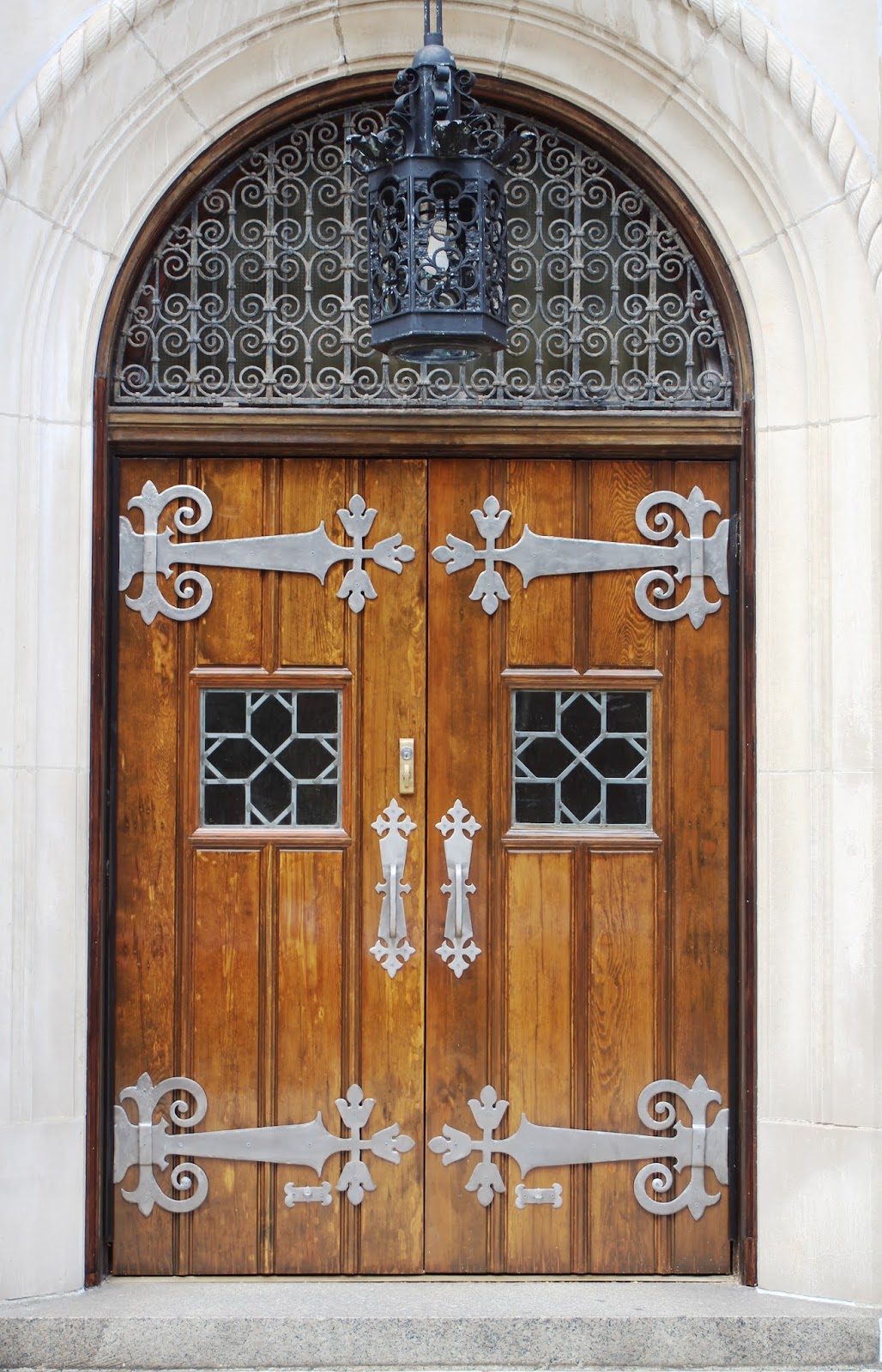
Below: front doors of the church. 


Above: detail of the rose window and the bell tower.
Below:  detail of the main front door.


Above:  detail of the light fixture above and columns around the front doors.
Below: detail of the cross above a side entrance, with a stained glass window behind it.


Above:  altar area of the church - the wood trusses of the roof are visible.
Below:  detail of the main altar.  The words just below the tabernacle are "Sanctus Santus Sanctus," Latin for "Holy Holy Holy."


Above:  detail of the crucifix above the main altar.  It was part of the original church the parish used for worship.  The words above it read "Introibo ad altare Dei," which is Latin for "I will go to the altar of God."

Below:  The rose window above the main entrance, and some of the stained glass windows and Stations of the Cross along the walls.


Above:  Statue of the church namesake, St. Margaret Mary Alacoque, in what was originally the priest's booth in one of the confessionals.

Below:  The 1948 rectory, designed by the architectural firm Barry and Kay.


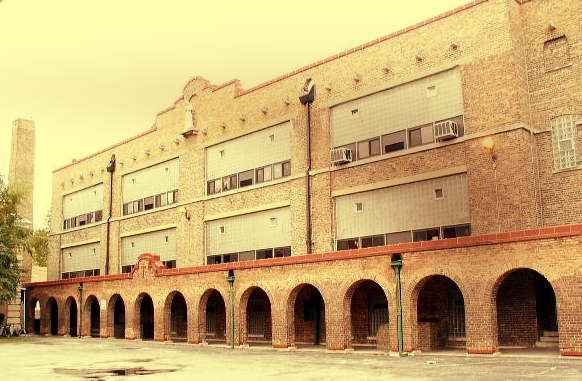
Above:  St. Margaret Mary School, Chicago [2007, cropped] / Kevin Dooley / CC BY 2.0.  Built in 1924 and also designed by Joseph W. McCarthy, it also served as the church until the 1937-38 building was completed.

Below:  Statue of St. Margaret Mary near the top of west side of the building.


Above:  Brickwork cross above a west side entrance to the school.  Note the medallion for Northside Catholic Academy - the school now serves as the middle school (grades 5-8) campus for the merged six parish schools in the area.

Below:  Front entrance to the old St. Margaret Mary Catholic School - now Northside Catholic Academy middle school campus.


Above:  Sign above the entrance door to the 1924 St. Margaret Mary Catholic School - "Sancta Margarita Maria - Georgius Cardinalis Mundelein Fundator," which is Latin for "Saint Margaret Mary - George Cardinal Mundeline Founder."


On February 6, 2020, it was announced that St. Margaret Mary would be consolidated with the nearby St. Henry Parish, St. Timothy Parish, and Blessed Alojzije Stepinac Croatian Catholic Mission (which is located in the 1905 St. Henry building), effective yesterday, July 1, 2020.  While St. Margaret Mary will be the headquarters, the new parish has a new name, Holy Child Jesus Parish.


© Amanda Pape - 2020 - e-mail me!