Thursday, July 2, 2020

Those Places Thursday: St. Margaret Mary Catholic Parish, Rogers Park, Chicago

Here are some photos I took in August 2017 of some of the buildings of St. Margaret Mary Catholic Church in the Rogers Park neighborhood of Chicago - the ones my dad and his siblings would remember.  Click on photos to view them in larger format.


Above: the 1937-38 church, designed by Joseph William McCarthy.
Below: front doors of the church. 


Above: detail of the rose window and the bell tower.
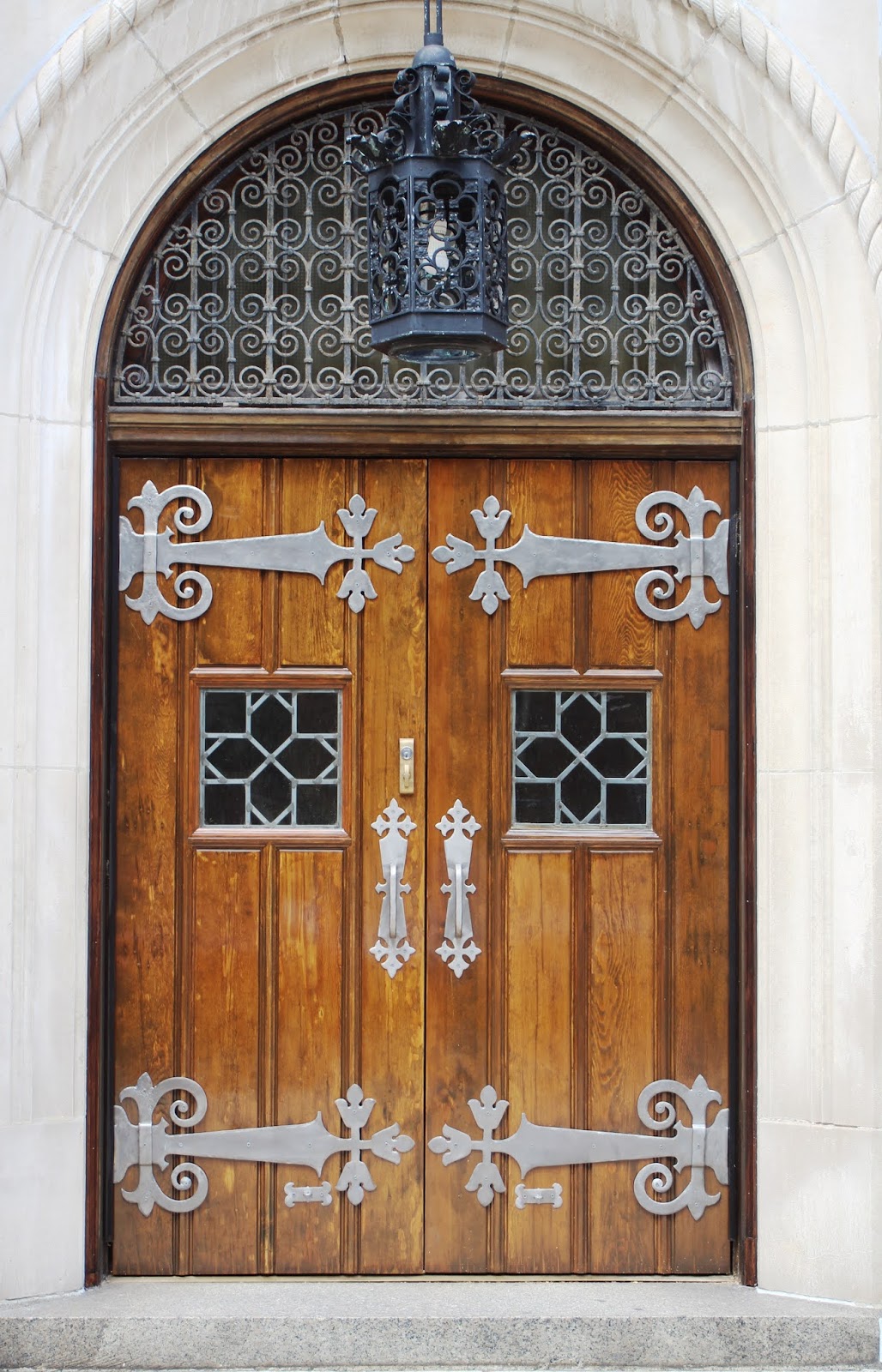
Below:  detail of the main front door.


Above:  detail of the light fixture above and columns around the front doors.
Below: detail of the cross above a side entrance, with a stained glass window behind it.


Above:  altar area of the church - the wood trusses of the roof are visible.
Below:  detail of the main altar.  The words just below the tabernacle are "Sanctus Santus Sanctus," Latin for "Holy Holy Holy."


Above:  detail of the crucifix above the main altar.  It was part of the original church the parish used for worship.  The words above it read "Introibo ad altare Dei," which is Latin for "I will go to the altar of God."

Below:  The rose window above the main entrance, and some of the stained glass windows and Stations of the Cross along the walls.


Above:  Statue of the church namesake, St. Margaret Mary Alacoque, in what was originally the priest's booth in one of the confessionals.

Below:  The 1948 rectory, designed by the architectural firm Barry and Kay.


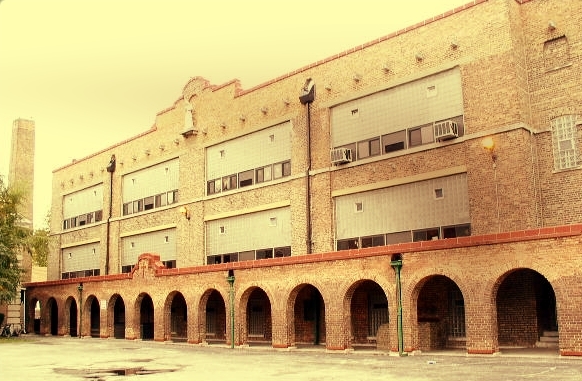
Above:  St. Margaret Mary School, Chicago [2007, cropped] / Kevin Dooley / CC BY 2.0.  Built in 1924 and also designed by Joseph W. McCarthy, it also served as the church until the 1937-38 building was completed.

Below:  Statue of St. Margaret Mary near the top of west side of the building.


Above:  Brickwork cross above a west side entrance to the school.  Note the medallion for Northside Catholic Academy - the school now serves as the middle school (grades 5-8) campus for the merged six parish schools in the area.

Below:  Front entrance to the old St. Margaret Mary Catholic School - now Northside Catholic Academy middle school campus.


Above:  Sign above the entrance door to the 1924 St. Margaret Mary Catholic School - "Sancta Margarita Maria - Georgius Cardinalis Mundelein Fundator," which is Latin for "Saint Margaret Mary - George Cardinal Mundeline Founder."


On February 6, 2020, it was announced that St. Margaret Mary would be consolidated with the nearby St. Henry Parish, St. Timothy Parish, and Blessed Alojzije Stepinac Croatian Catholic Mission (which is located in the 1905 St. Henry building), effective yesterday, July 1, 2020.  While St. Margaret Mary will be the headquarters, the new parish has a new name, Holy Child Jesus Parish.


© Amanda Pape - 2020 - e-mail me!

Sunday, June 28, 2020

Sentimental Sunday: St. Margaret Mary Window, October 1938

Yesterday I was contacted by Paul Murphy, an alumnus of St. Margaret Mary Catholic School in Chicago who'd read my post about the church and school.  He said,

Recently, one of my classmates sent us a copy of the 1938 parish bulletin which was then called "St. Margaret Mary Window." The parish address on page 1 is "7320 Ellwood Avenue."  Today, there is no Ellwood Avenue in Chicago. Also, I could not find it on a list of  Chicago street name changes since the 19th Century. Could [you] help us solve the mystery?

He sent me a copy of the newsletter.  Here's its header on page 1 - note the address, underlined in red.


I decided to first look at "Locations of Chicago Roman Catholic Churches, 1850-1990" by Jack Bochar, second edition (revised to 1997).  This is a GREAT tool to figure out what church your ancestors may have attended, especially if they were immigrants more likely to belong to a national (ethnic) parish, rather than a territorial parish.  Besides helpful maps (the H-1 below refers to the maps grid), this source usually gives a brief history of the locations of the parish.  I thought perhaps the parish office was located elsewhere.  Note that this document is available in a variety of places, but the copy maintained by the Chicago Archdiocese has fairly up-to-date annotations of changes since 1997.

Here is what it said about St. Margaret Mary (underlined in red):

 "--1921: Church at Chase Ave. between Barton (now Claremont) and Ellsood [sic] (now Oakley) Ave."


I went back to check another great tool, the online list of Chicago street name changes compiled in 1948.   In this guide, a hyphen preceding an entry indicates a former street name. Its new name follows it and the coordinates refer to the new name.


So Ellwood Street addresses between 6800N and 7599N became Oakley Street addresses, apparently sometime after October 16, 1938 (the date of the church newsletter) and 1948.

I was curious what exactly was at 7320 N. Oakley Avenue.  From Google Maps Street View, that address falls where the playground is today on the north side of the current school building.   My guess is that at one point the rectory/office was in that location, probably a house similar to the one next door at 7322 (which was built around 1919).  The address 7320 N. Oakley is actually a separate parcel in the assessor's records, not part of the main church-rectory-school parcel.  Here's the assessor's record for 7320 N. Oakley (photo is from August 5, 2008, the playground was built October 3, 2009, the house at 7322 is on the right):


Below is a map highlighting (in blue) the parcel from the CookViewer, a GIS application.  There's also a small skinny parcel just south of it.


Finally, I decided to check Sanborn maps for the area.  First, I used the awesome Sanborn Map locator on the Chicago In Maps website.  I looked at the Sanborn Maps for the Rogers Park area for 1937 (actually published in 1938) and that map updated in April 1951.

First is the 1937-38 Sanborn Map.  Yellow indicates a wood frame structure, red is brick, and green is an unspecified fireproof materials, often detailed in the image (click on it to make it larger).  You can see here that there is in fact a house (D stands for dwelling) at 7320 N. Oakley (formerly Ellwood). The school building (which also served as a church initially) was constructed in 1924 and the church in 1937 (although it was not completed until 1938).  The wood frame building between them may have been an early church hall or perhaps it was the first church, referred to in Bochar's book as existing in 1924.


Below is the Sanborn Map updated to April 1951.  The old rectory at 7320 N. Oakley is gone.  I would need to look at deed records, but my guess is that the church swapped the north 16 feet or so (on the left on this map) of the lot at 7320 N. Oakley for the 16-foot-wide alley between 7320 and the school.  This created an alley right next to 7320, as pictured on the CookViewer earlier in this post.

The wood frame building between the church and the school has been replaced by the present brick rectory, built in 1948.  Also by this point, the church had purchased the flats at 7325-7327 Claremont and turned it into the convent.


Here is the 1924 building permit for the school:


And here is the 1937 building permit for the church.  Note that the 1924 architect is J[oseph] W[illiam] McCarthy (1884-1965, later of McCarthy, Smith, and Eppig, in 1937), who designed 41 Catholic churches in the Chicago area, as well as schools, hospitals, and convents.


Finally, here is the 1948 building permit for the present-day rectory, designed by the firm Barry & Kay, which included architects Gerald Aloysius Barry (1894-1966) and his son Gerald Ward Barry (1924-2005), who also designed a number of Chicago Catholic churches and other facilities.


So far, I haven't been able to find the building permit for the original rectory at 7320 N. Oakley, the convent at 7325 N. Claremont, nor that wood frame building between the church and the school on the 1937-38 Sanborn Map.

I was pleased to find some references to my family in the church newsletter.  Here is an article my Uncle Bob (Paul Robert Pape Jr., 1926-2008) wrote about a Boy Scout trip:


And here is an article that indicates he was an end on the school's football team.  He would have been in seventh grade in the autumn of 1938:


© Amanda Pape - 2020 - e-mail me!

Sunday, June 21, 2020

Sentimental Sunday: Happy Father's Day to My Dad in Heaven!

My dad, Frederick Henry Pape (1929-2017), with four of his five kids - from left, Mary, Karen behind Mark, and me, Amanda.  I think my brother Brian took the picture.  This was at White Sands National Monument in New Mexico in the summer of 1966.


© Amanda Pape - 2020 - e-mail me!

Friday, June 5, 2020

Great Uncle Phil Sayers Sr. - Harris County Commissioner

Philip Edgar Sayers Sr. (1901-1972) is one of my maternal-side great uncles.  He was married to my grandfather's sister, Elizabeth "Lizzie" Wanda Guokas Johnson Sayers (1901-1980).  Uncle Phil served as the Precinct 3 Commissioner for Harris County, Texas, from 1949 through 1968.  Here is his official portrait, which hangs on the ninth floor of the county's administration building at 1001 Preston in Houston.


This image courtesy Janet Hodson Sayers.  Also available at http://archives.hcpl.net/cdm/singleitem/collection/p15978coll9/id/21/rec/1


Philip was born May 25, 1901, in Houston, the sixth of eight sons of Thomas Green Sayers (1866-1910) and Almyra S. "Mina" Fawcett Sayers (1866-1956).  

Philip attended Houston public schools, including the old Central High School for two years before transferring to the San Marcos (Texas) Baptist Academy.  I found Philip in the 1920 yearbook; he was a sophomore that year, assistant secretary of his class and a sergeant of "A" Company in the ROTC.  Here's his yearbook photo:


Philip then attended Texas A&M in College Station, studying agricultural engineering, then worked for an engineering and construction company for a year. During that time, he was seriously injured when a horse fell with him.  He spent a year in hospitals recovering from injuries sustained in this accident.

In 1925 he was employed by the United Fruit Company.  For two years, he was the overseer of over 500 men at a banana plantation of 480 acres and a cattle ranch of over 2000 acres in Guatemala.  He then moved to Columbia and served as division inspector. He traveled extensively in South America and the Caribbean and returned to Houston in 1929.

I wish I knew the story of how Phil and Lizzie met.  They were married June 7, 1929, by a county justice of the peace.  Lizzie was a recent widow (her first husband, Ralph Johnson, died of tuberculosis) with three young sons.  The following year, Phil and Lizzie and the boys are living on Westfield Road in what was then rural north Harris County.  The 1930 Census lists his occupation as poultryman on a chicken farm, destroyed by a flood later that year.  Later that same year, his first son, Thomas Green Sayers (1930-1991) is born, followed by Philip Edgar Sayers Jr. (1932-2013) two years later.

Next, Philip Sr. was employed in the office of City Fire Marshall John Steel. He transferred to the city health department, then directed by Dr. Hutchinson, as a milk inspector. In the spring of 1932 he took a position as a state livestock inspector, working there for two years.  In 1934, he began working with the Gibson Grain Company. 

The 1937 city directory indicates Phil is working at the Hardy Street Feed Store, 5005 Hardy Street.  On the 1940 Census, he's the manager of a feed store.  By 1941, he owns one of his own, Sayers & Son at 6200 Hardy Street on the north side, pictured below (photo courtesy Janet Hodson Sayers).


Politics must run in the Sayers blood - his great-half-uncle, Joseph Draper Sayers, was Governor of Texas 1899-1903.  He was elected to the board of trustees of the Aldine Independent School District in 1941, and was chosen to act as its secretary. Philip first ran for the Harris County Commissioners Court (the governing body for a Texas county) in 1944, and was elected to it in 1948, representing Precinct 3, which was then the north side of the county, where he lived and worked.  Phil was reelected four more times, serving a total of twenty years and retiring at the end of 1968. Here's a campaign card from 1952, courtesy Janet Hodson Sayers.


County commissioners are responsible for overseeing maintenance of county roads, bridges and parks, and other services within their precincts, as well as running the whole county along with the elected chief executive, the county judge.  Probably the most exciting project Uncle Phil was involved with as a county commissioner was the construction of the Astrodome in Houston, the world's first indoor sports stadium.

The groundbreaking for what was originally called the Harris County Domed Stadium--using Colt .45s firing blanks instead of shovels--took place on January 3, 1962.   This was a clever play on the original name of what later became the Houston Astros baseball team - they were first called the Colt .45s.  Below (from the left), County Commissioners W. Kyle Chapman, V. V. "Red" Ramsey, County Judge Bill Elliott, and Commissioners Phil Sayers and E. A. "Squatty" Lyons take their turn at the groundbreaking (photo courtesy Janet Hodson Sayers).


You can see Uncle Phil in these other photos from the groundbreaking, in the same suit and white hat:


Phil and Lizzie lived at 16710 Waycreek Drive, on the far northwest side of Houston, for the rest of their lives.  Here is a picture of them (courtesy Janet Hodson Sayers) in retirement on the front steps of their home.  Phil died of lung cancer the day after his 71st birthday, on May 26, 1972.  He is buried in Section 10 of the Rosewood Cemetery in Humble, Harris County, Texas.


© Amanda Pape - 2020 - click here to e-mail me.

Sunday, May 31, 2020

Sentimental Sunday: Happy Birthday to My Son Eric (tomorrow)!


© Amanda Pape - 2020 - e-mail me!

Monday, May 25, 2020

Military Monday: WWI Honor Roll, University of Washington, Seattle

In honor of Memorial Day and for The Honor Roll Project, I decided to transcribe the World War I Honor Roll plaques at the Memorial Way NE campus entrance of the University of Washington in Seattle.

The plaques are part of the "Memorial Gateway," four pylons made of brick, sandstone, and terra cotta that stand near the entrance.  Construction began in 1928, and two bronze plaques that list the names of the 58 former students who died in World War I were donated in 1930 by Scabbard and Blade, the student military honor society. One was installed on each of the two pylons closest to the road.


Both plaques have a heading reading "Honor Roll World War 1917 1918" with the University of Washington seal.  At the bottom of each plaque. it reads "Presented by Scabbard and Blade 1930."


Here are the names on the first plaque (pictured above):

Lawrence E. Allen | Jeannette V. Barrows | Leo F. Bennett | Cherrill H. Bennett | Alford J. Bradford | Donald R. Broxon | F.E. Buehler | Florian H. Canfield | Arthurt E. Carlson | Lloyd T. Cochran | Dow R. Cope | Edw. C. Cunningham | Wm. R. Cutler | Walter C. Dunbar | James M. Eagleson | Geo. Vernon Evans | Albert M. Farmer | Chas N. Fletcher | Samuel Goodglick | Geo. C. Gorham | Rhodes H. Gustafson | Daniel Hart | Nicholas C. Healy | Clarence J. Hemphill | Alfred C. Hoiby | Everett Hoke | Earl M. Hoisington | Frank H. Hubbard | Howard D. Hughes

And here are the names on the second plaque (pictured below):

Francis D. Johnson | Clair A.R. Kinney | Harry B. Leavitt | Wilfred Lewis | Chas A. Lindbery | John H. Martin| A.D. McCleverty | WM J.A. MacDonald | Frank E. McNett | W.C. Morehouse| Roy Muncaster | Elmer J. Noble | Merle O’Rear| Allen C. Ostrander | Samuel N. Parker | Gerald S. Patton | Frank Peterson | Lester B. Pickering | H.A. Rees | Ralph Beebe Rees | James R. Ristine | Earl W. Shanly | Truman A. Starr | Wm. Sherman Tucker | Homer W. Ward | Leon H. Wheeler | Harold C. White | Chester W.J. Wilson | Lukens P. Young


Memorial Way (pictured below at night) is lined with 58 London Plane (sycamore) trees, one for each of the university's World War I dead.


© Amanda Pape - 2020 - e-mail me!

Sunday, May 10, 2020

Sentimental Sunday: Happy Mother's Day to My Mom in Heaven!

First Mother's Day without my mother, Geraldine Margaret Guokas Pape (1928-2019).  This is a picture of her from early 1957, when she was pregnant with me.


© Amanda Pape - 2020 - e-mail me!

Sunday, May 3, 2020

Finally Found My Great-Grandmother on a Passenger List!

For years I have struggled to find my Lithuanian great-grandmother, Elzbieta (Elizabeth) Banaitis / Banevičius / Boenewitch / Bonewitz Guokas (1875-1929) on a passenger list.  As you can see, part of the problem has been the multiple ways her name has been spelled, in various documents over the years (the ones given above are only a few of them).

Tom Sadauskas in the Lithuanian Global Genealogy Society (LGGS) on Facebook suggested trying some of Steve Morse's One-Step Webpages for searching passenger lists.  I've used Morse's forms for finding an address in various censuses with great success over the years, so this seemed worthwhile to try.

I knew my great-grandmother had to arrive sometime before January 21, 1900, because that is the date she married my great-grandfather, Kazimieras (Charles) Guokas (1863-1939), in Bremond, Texas.  I also felt it was likely she didn't arrive before the death of Charles' first wife, Stefania Jasielonis Guokas, in August 1899.  Because the arrival was definitely between 1892 and 1924, I could use the Ellis Island Gold Form to search Ellis Island arrivals (keeping in mind, of course, that she could have arrived at a different port).


On the advice of Tom and other LGGS members, I entered only her first initial E and last initial B.  I did narrow the years of arrival to 1899-1900, the years of birth to 1874-1876 (other records indicated she was born in December 1875), and the gender to female.  I did enter my e-mail address at the top.


I did narrow the ethnicities to Galician, Polish, Russian, and Lithuanian, as Lithuanians could have been recorded under any of these (although Russian would be most likely for 1899-1900).


Finally, I checked off most all the fields for the results page, except for ship image (which I don't care about), passenger ID (a number assigned by the Ellis Island Foundation), and I wanted the full date of arrival, not just year or month and year, especially since there was a narrow time frame for when she could have arrived in 1900.  To view any of the links in the last column, you'll need a free Ellis Island Foundation account.


I got 34 results, but the 23rd one on the list (click on the image to make it larger) looked quite promising.


Here is the passenger record from the Ellis Island Foundation for an Elsbeta Bonaiguke, arriving January 7, 1900 on the Belgravia out of Hamburg, Germany:


I don't like the viewer for the passenger manifests on the Ellis Island Foundation site, but I now had enough information to find the manifest in both Ancestry and FamilySearch.  Here's a composite image of the left side of the page she is on from FamilySearch, with the headings at the top of the page, followed by some names above hers (she is number 24) to show that her nationality was Russian:


Notice the name just below Elsbeta?  It was transcribed by the Ellis Island Foundation as Palemona Szermuke.  I'll come back to this in a bit.


Here is a composite image of the right half of the passenger list from FamilySearch, again adding the column headings, but this time just showing the rest of the information for Elsbeta and Palemona, as well as the person just above so you can see the two women also have a ticket to their final destination (column 12).  That final destination (column 11) is Houston, Texas, to meet their "cousin" Casimir Guokas (my great-grandfather, column 16).  Further proof that I've got the right people is the address given for Casimir, 1314 R.R. [Railroad] St., where he lived in Houston from 1899 to 1907 and owned until his death in 1939.


The woman who traveled with my great-grandmother was her future sister-in-law, Felicijona or Policina "Pauline" Černas Guokas (1878–1953), who married my great-great-uncle Juozapas "Joseph" Guokas (1869-1933) on January 21, 1900, in Robertson County, Texas, the same day my great-grandparents married.

ETA:  My Lithuanian cousin Osvaldas Guokas has found what we believe is the baptism record for my great-grandmother.  On December 7, 1875, ElÅŸbieta Banaitytė was baptized in Smilgiai.  Her parents were Kazimieras Banaitis and Justina SirevičiÅ«tė Banaitienė of Rozalimas.


© Amanda Pape - 2019 - e-mail me!