Showing posts with label Pape ancestors. Show all posts

Sunday, February 6, 2022

Jack Bleidt's First Communion, May 17, 1936

My regular blog reader Aleksandra commented on my last post, which was a photo of my dad, Frederick Henry Pape (1929-2017), on his First Communion Day.  She asked if there were any traditions regarding First Communion Day presents.  

Well, I don't know for sure what my dad got, but it was probably more or less the same as what his first cousin and classmate, John Charles "Jack" Bleidt (1928-1973), who was only nine days younger than him, got.


Above:  May 17, 1936, First Communion Day for Jack Bleidt (age 7).  He is pictured with his grandfather John Pape (1851-1945), and older sister Mary Jane Bleidt Herring (1924-1965).  Photo courtesy cousin Bill.

Below:  Jack's First Communion certificate, from St. Margaret Mary Catholic Church in Chicago, Illinois.  It is signed by its pastor and founder, Father George McCarthy.  Photo courtesy cousin Bill.


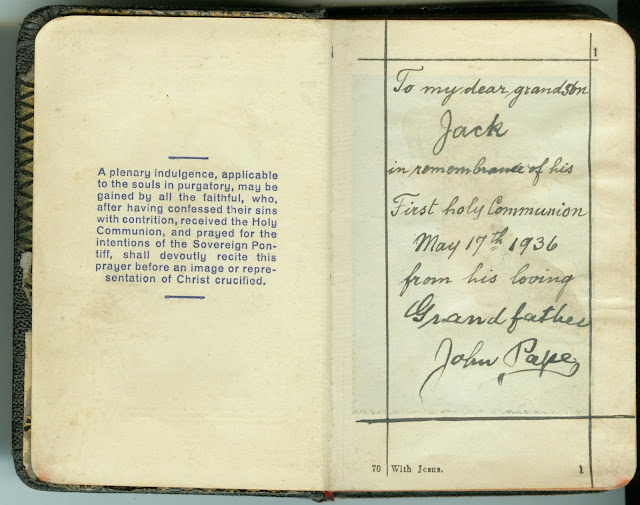
Jack received what appears to be a prayer book (it's too small to be a complete Bible) from his maternal grandfather, John Pape.  It is inscribed near the beginning as follows:  "To my dear grandson Jack in remembrance of his First holy Communion, May 17th 1936, from his loving Grandfather John Pape."  Below are some images of the first few pages of the book.


Above and below:  photos from the interior of the book given to Jack Bleidt by his grandfather John Pape for his First Communion Day, May 17, 1936.  Photos courtesy cousin Bill.


I'm pretty sure my great-grandfather John would have given my father the same thing.  Besides being first cousins, just nine days apart in age, and first-grade classmates at St. Margaret Mary Catholic School, at the time of First Communion, Jack's family was living practically across the street from Dad's in Chicago.  Based on the address Jack wrote in the book, the Bleidt family lived at 2084 [West] Lunt Avenue.  Dad and his family lived at 2093 West Lunt.  And in 1936, John Pape was living at 1949 West Lunt, just a few blocks away.


© Amanda Pape - 2022 - e-mail me!

Sunday, October 24, 2021

John Pape's 1851 Baptism Record from Germany

Back on October 15, 2021, I participated in the 2021 Genealogy Lock-In hosted by
the Genealogy Center of the Waco-McLennan County [Texas] Library, the Texas State Genealogical Society, the Genealogy Network of Texas, and the Central Texas Genealogical Society.  This all-day, one-day-only, all-virtual event featured eight pre-recorded sessions, including some by well-known genealogy speakers.

For me, though, the best session was "So, You’ve Found Your German Town of Origin, Now What?" by Teresa Steinkamp McMillin.  Given that I have birth dates and places for many of my German ancestors, this was of great interest to me.  Just having the indexed information wasn't enough - I really wanted to see the original records.  

Her session walked through using the online Meyer’s Gazetteer to verify the town name and identify religious and governmental jurisdictions that might have vital records.  For example, here is the entry for one of the two Bödefelds (note that you can click on all images in this post to view them in a larger size):


You can also view a historic map of the area. The one I've pictured is for the other Bödefeld, and has the toggle turned on to mark the Catholic parishes (yellow C marker).


Teresa then spoke about, and demonstrated, some of the records available online.  One that she spoke about that I had not heard of before was Matricula Online, which has "church registers (mostly books of birth, marriage and death) from various European countries (currently Austria, Germany, Poland, Serbia and Slovenia)."  And luckily for me, such books from the Archdiocese of Paderborn, where my relatives are from, have recently been added to the site.

You can use the Map or Search for Places functions on Matricula to enter your town of origin, and find the name of (and a link to) the Catholic parish records for it.


This will bring up the available registers.  There are 106 currently available for Sts. Kosmas und Damian parish in Bödefeld, so you can use a slider on the date range column to narrow down the field:


Teresa explained what some of the German words mean.  Taufen are baptisms, Trauungen are marriages, and Sterbefälle are deaths.  A Namenregister is an index.

So I used the Namenregister Taufen that covered 1826-1858 and found the page indexing the baptisms for surnames beginning with P.  Here is the relevant snip from that index page:


The first Johann Pape is an older brother to my John Pape, who was born in 1849 and died the following year.  My John Pape is the second Johann.  The 473 refers to the page number in the baptisms register covering 1826-1858, and the 45 indicates it was the 45th baptism in that year (1851).  Anton is the oldest (born 1854) of John's three younger brothers.

So next I went to the Taufen for 1826-1858 and navigated to page 473.  And there was my great-grandfather!  Here is the left half of the page, and the following image is the right half.


What got me especially excited, though, was the information that I've outline in red boxes.  I could see dates and names of John's first two wives, Elisabeth Dameris and Gertrud Kramer (who is my great-grandmother).  The latter was particularly thrilling, because prior to this, I had no information on when and where John and Gertrud married.  The family story was that John went back to Germany to find a bride after Elisabeth and their two daughters died in Chicago in 1886 and 1887.  All I knew was that John and Gertrud were back in the United States by August 1889, when their first child Clara Pape was born.

I posted these images on Facebook, and asked for translations of information in the red boxes.  Here is the translation for the image above, about Elisabeth Dameris:

"married since 27 Nov 1879 with Elisabeth Dameris from Schmall____ (possibly Schmallenberg: https://www.meyersgaz.org/place/20727066)
addition: Elisabeth Dameris was 'Lehrerin dahier' = teacher here."

Elisabeth was in fact from Schmallenberg, and I have now found her baptism record there.   I also found the marriage record for Elisabeth and John in the Sts. Kosmas und Damian parish registers in Bödefeld.


Here is the image of the right half of John Pape's baptism record:


And here is the translation of the information in the red box, about Gertrud Kramer:

"and has emigrated to America with his second wife, Gertrud Kramer, born in Wennemen (https://www.meyersgaz.org/place/21116023), Catholic church 9 Jan 1859 and married in Düsseldorf 9 Oct 1888 and then emigrated to America 13 Oct 1888.
Addition: Gertrud Kramer was also a 'Lehrerin von hier' = teacher from here."


Can you see why I was so excited?!  I knew Gertrude was baptized in nearby Calle (I've now found her baptism record), but I did not know she was actually born in Wennemen.  I now also have a date and place for John's and Gertrude's marriage.  Although the records for churches in Düsseldorf are not online, the incredibly helpful parish pastor did include a record of John's and Gertrude's marriage in the Sts. Kosmas und Damian parish registers in Bödefeld.

I've spent most of the past week doing additional searches for family members in Matricula Online, and filled more holes in my family tree!


© Amanda Pape - 2021 - e-mail me!


Sunday, March 29, 2020

Sentimental Sunday: 1893 Building Permit for 1043 Sherman Avenue, Evanston, Illinois - Revisited

A little over a month ago, I was contacted by one of the current owners of the house my great-grandfather,  John Pape (1851-1945), lived in from at least 1882 to at least 1925, at 1043 Sherman Avenue in Evanston, Illinois.  She'd discovered my posts in this blog related to the house.  In talking with her, I decided to revisit my earlier post about the building permit for this house.

First, the grantor-grantee index for this plat from the Cook County Recorder of Deeds office indicates John Pape acquired the lot in September 1882 (see the last line) from developer John H. Connor:


According to Connorton's Evanston Directory, 1882-83, the home of John Pape was on the "w[est] s[ide of] Sherman av s[outh of] Greenleaf."  The 1883 directory, which includes a separate listing for the village of South Evanston, says his home was at "Sherman ave se cor[ner] Greenleaf." By the 1889 and 1890 directories, it is "e[ast] s[ide] Sherman av 2d s Greenleaf."  The abbreviation "d" is not explained in the guide, but I think this must mean two doors south of Greenleaf.

In the 1893 directory, the address is "207 Sherman ave s" which was its address in South Evanston, platted in 1868 and incorporated as a village in 1873.  In 1892, South Evanston was annexed into Evanston, which was incorporated as a city. The new city began issuing building permits in October 1892 and renumbered the entire street system in 1893.  The address is given as 1043 Sherman Avenue in the 1894 directory.

I had always wondered if my great-grandfather, who started out as a carpenter, built that house.  I think he may have - but I don't know for sure, given that the house existed before the city started issuing building permits.  It turns out that I missed a detail on the April 1893 building permit I found at the Research Room and Archives at the Evanston History Center in August 2017.  The permit wasn't for a house; it was for "house impvt" - improvements! (Click on documents throughout this post to enlarge them):


The "Application for Building Permit" above and the "Permit Granted" form below were the oldest in the file for this address, and were both dated April 7, 1893.  The two-story with basement improvements (apparently designed as well as built by John Pape) would have nine rooms and be 28 feet wide, 35 or 35.5 feet deep, and 30 feet tall.  It would include a water closet with sink, bathtub, and toilet bowl, be heated by steam, and lighted by gas.   The total cost of building was estimated to be $800, and the mason was James Wigginton.  The legal description of the property at the time referred to the south quarter of Lot 2 of the J. M. Meyers Subdivision (lot 6 according to the tax accessor).  The building permit cost $2.


Apparently there was an additional fee to pay for water service, based on the amount of brick and plaster used in the house, according to a note on the back of the previous document:


The next form is a bit puzzling.  Although the date written on it is April 7, 1893, it is written on a form printed for the 1920s.  It doesn't tell us anything new, and some of the details (depth of house, and subdivision name) are slightly different - perhaps information copied incorrectly from the original permit:  


In retrospect, I think this might have been some sort of card originally filed on its side in a box, based on the data in the left margin, and the fact that there's a card with similar printing for the 1920 addition of a separate frame garage (see the original post for more on that permit).

There was no Sanborn map for this property prior to 1893.  However, I found similar type of map for 1891 at the Historic Map Works website in a set called "Chicago Suburban Maps, Cook County, Ill's. published by the Central Map, Survey and Publishing Co. 148-154 Monroe Street, Chicago. August 1891."  The original maps are available at the Library of Congress.

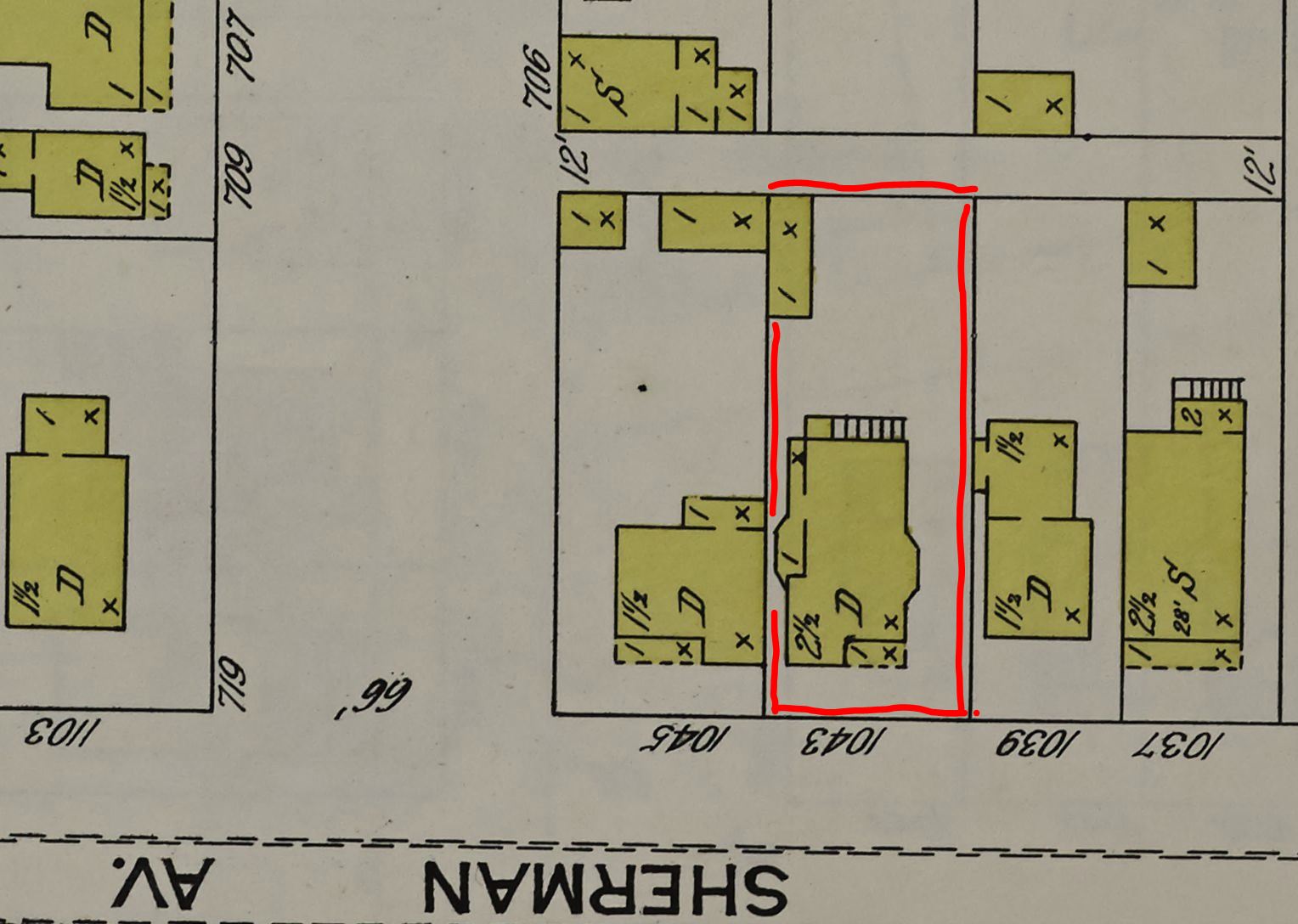
The relevant map is Sheet 22.  Here's an enlargement, below with location outlined in red (click on the image to make it larger).  Note that the address is off, it should be 207; the correct 206 is across the street.  Note also that the house (marked with a D) is only one story.  The smaller building in the back left-hand corner of the lot is identified as a kitchen.


The image below is from the 1899 Sanborn map available from the Library of Congress (rotated to match the orientation of the map above).  The lot at 1043 Sherman is outlined in red.  The house is now mostly 2.5 stories with a bigger footprint.  You can clearly see the bay extension on the right side, visible in the photographs further down in this post.  There's still a one-story building in the back left-hand corner of the lot, but that is gone by 1920.


Below is a photograph of the house, circa 1975, from a real estate listing that was in the file at the Evanston History Center.  Note the garage to the right, near the back of the lot.  The current owner tells me the garage is gone, and that she removed the dormers visible along the roof on the right.  The stairway to the front door has also been reconfigured.


These changes can be seen in my 2017 photo below:


It's not clear to me if John Pape, in 1893, just added on to the existing house at 1043 Sherman Avenue, or if he tore it down and started over.  Hopefully the current owner might find some clues about that.  Watch for future posts about interesting things she found inside the house!


© Amanda Pape - 2019 - e-mail me!

Sunday, July 7, 2019

Church Record Sunday: Baptism and Death Records for John Pape's First Family

My great-grandfather, John Pape (1851-1945), was married before he married my great-grandmother, Gertrude Cramer (1859-1919), in late 1888.  I was aware of John's first wife from the probate for his youngest child, my great uncle Walter Pape, who died intestate in late December, 1975.  The 1910 Census also indicates John had this first marriage, and the 1930 Census indicates he was 28 when it occurred, which would have been about 1879.  Finally, my great aunt Martha Pape Bleidt told a distant cousin in 1969 that "John Pape and his first wife had 2 daughters.  The mother and the two children passed away."

Martha either didn't know or didn't share the name of this first wife or the two daughters, nor when they died.  However, some searching and browsing through early Catholic Church records for the Archdiocese of Chicago that are available on FamilySearch gave me some answers.

A search in the record set for deaths with the surname Pape between 1880 (the earliest date I've found in other records for John's arrival in the United States) and 1889 (when the oldest child from John's and Gertrude's marriage was born) produced the following results:


When I clicked on the first one to view the image, it brought up both of the records, for Martha Pape, age 4, who died October 13, 1887, and Elisabetha Pape, age illegible years and 7 months, whe died less than two weeks later, on October 25, 1887.


Interestingly, these records are from Angel Guardian Orphanage in Chicago.  The orphanage was established in 1865 by the five German Roman Catholic parishes in the city at that time:  St. Peter, St. Joseph, St. Michael, St. Francis ot Assisi, and St. Boniface.  Interestingly, St. Henry Catholic Church, established in 1863 (although the parish dates back to 1851) and adjacent to the orphanage, was not part of this group, because it was originally outside of the Chicago city limits. 

Could these be John's daughters?  It's important to note that almost all “orphans” in nineteenth-century Chicago orphanages had one parent living.  John obviously lived, so this indicated to me that his first wife died before the daughters.  However, I wasn't finding anyone likely to be her in any of the Chicago Archdiocese Catholic Church records indexed at that point.

Since John and Gertrude (and four of their children) are buried at St. Henry's Cemetery (adjacent to the 1904 church building), and since these two girls were at Angel Guardian, I guessed that John was a member of St. Henry's when he first came to Chicago.  St. Nicholas in Evanston, closer to his home, was not established until 1887, and it would be likely that John would have been a member of a nearby German-speaking parish like St. Henry.

Early records (1863-1927, not all inclusive for all sacraments) have been digitized and are available at FamilySearch, but all have not been indexed, so you must browse to find things.  Figuring that John's first wife probably became ill or died before his daughters, I worked backwards in death records starting in 1888, and found this:


Note the 1886 on page 330, on the lower left in the image above.  On the right side, on page 331, death #13 of that year is of an Elisabetha Pape, age 38, who died August 28.


Next I went to the baptisms section, looking for little Martha and Elisabetha.  I found Martha first in the combination book of records beginning in 1883, although she was born not that year (as I thought, with her death record indicating she was age 4 in October 1887), but on page 6, the 16th baptism in 1884:


She was born on February 22, 1884, and the baptism record states that her parents were John Pape and Elisabetha Dameris.  Godparents were Antonius (Anton) Pape, John's brother, and Catharina Wahle (no apparent relation, although she was also the godmother for Walter Pape in August 1900 and lived next door, at 1045 Sherman Avenue, to John Pape for many years).

Finding little Elisabeth took a little longer, since it was hard to read her age on the death record.  The indexer interpreted the smudge as 8 years, but that would put her birth in March 1879 (March is seven months before October).  In this case, a search in all records in FamilySearch for someone with the last name of Pape whose mother had the last name of Dameris produced these results:


And here is Elise [Elisabetha] Theresia Pape's birth record (on Family History Library film number 1287770, image number 368).  Note that the record indicates little Elise was the SECOND child of her mother!  Apparently there was an older child, for whom so far I've been unable to find any record.  Perhaps this child was born and died in Germany before John and Eluse Dameris Pape emigrated.


I now had enough information to find her baptism record at St. Henry's, on page 90, the 21st baptism in 1882.


The birth date matches up, and this record also states Elisabetha Dameris is her mother.  Interestingly, the godparents are listed as Josephus Pape and Anna Kreling.  John had a brother named Joseph, but supposedly he stayed in Germany.  Perhaps he was the godfather in absentia?  Anna Kreling is no apparent relation to us.

There's also a record of little Elisabeth's 1887 death in the Illinois Statewide Death Index:


So the death record at Angel Guardian Orphanage must read age 5 years (not 8) and 7 months.

I don't have a date of birth for Elisabetha/Elise Dameris Pape, although there are three possibilities in the Germany Births and Baptisms index in FamilySearch, all born between 1852 and 1856 in Schmallenberg, Westphalia, which is only 18 kilometers from John Pape's hometown of Bodefeld.  I haven't found a marriage record yet, nor either John nor Elisabetha/Elise on a passenger list - but now I know that both arrived before March 2, 1882.


© Amanda Pape - 2019 - e-mail me!

Sunday, April 14, 2019

Sentimental Sunday: "Indian Boundary Club - Controlled Shooting Area" - November 11, 1951

Last year, while cleaning out the study of my late father, Frederick Henry Pape (1929-2017), I found a number of old black-and-white photos from the early and mid-1950s.  Some of them appear to have been taken by his father, my Grandpa, Paul Robert Pape (1896-1970), and may have been sent to my dad during his time in Korea.  Grandpa put numbers on the front of the images, and also wrote captions on the back.  This one had a very long caption:

Taken at Indian Boundary Club - Controlled Shooting Area 11/11/51.  In case you can't see them, there are 2 Cock Pheasants in my right hand. "Mine Boy" was on duty that day.  I had a hell of a time keeping him from getting out too far ahead of us.


The "us" referred to Grandpa and his friend, Bill Doyle (born 1889), who's in the photo below, also with two pheasants and with "Mine Boy," the family dog, Lucky.  This photo was captioned "Taken 11/11/51 My friendly enemy (Bill Doyle) The guy who always gets in my hair."


I'm not quite sure where the "Indian Boundary Club - Controlled Shooting Area" was.  The Indian Boundary Line itself was an old Native American trail that the 1816 Treaty of St. Louis designated as a boundary dividing the land between the Native Americans and white settlers.  It's the yellow highlighted line on this 1910 map of Chicago (where the city limits are marked in red):


The maps above and below are adapted from the The Rand McNally new standard map of Chicago.  The original maps--and the files--are from the University of Chicago Library's Map Collection.


The map section above shows the West Ridge / Rogers Park neighborhoods of Chicago, where the eastern end of the northern Indian Boundary Line began (click on the map to make it bigger).  Besides the yellow highlighting of the Indian Boundary Line, I also added (the blue square) the location of the future Indian Boundary Park, which was established in 1916, and which was just down Lunt street from where my grandfather was living in 1951 (where the blue star is).

I don't think the controlled shooting area my grandfather refers to is anywhere near this Indian Boundary Park.  It's only about 13 acres in size, and by 1951, was completely surrounded by development.

Instead, I think the shooting area may have been near the Indian Boundary Golf Club, further southwest along the northern Indian Boundary Line.

Here is a map from the Forest Preserve District of Cook County of that area, dating back to the 1930s and 1940s (click on the image to make it larger).  I've taken the original (pictured just below it), rotated it 90 degrees to the right (to more closely match the orientation of the maps above), cropped and color-adjusted it, and highlighted both the Indian Boundary Line (in yellow) and the "tentative alignment of superhighway" (in blue).  The latter may have referred to what is now Interstate 294, which actually went in a little west of this, although there are Metra rail lines roughly in this area.  Hunting was not allowed in the Cook County Forest Preserve itself, but I'm wondering if this "controlled shooting area" might have been in some of the then-unacquired future preserve areas, or perhaps in the area where the superhighway was intended to go, if it was still an undeveloped area in 1951.


Above image adapted from image below: 
Control Plan, scale: 1"=400'FPDCC_06_01_0000_0015_015, Forest Preserve District of Cook County Records, University of Illinois at Chicago Library.  Used with permission of the Forest Preserve District of Cook County, Illinois.


© Amanda Pape - 2019 - e-mail me!

Sunday, April 7, 2019

Sentimental Sunday: "Old 'Droopy Britches' Himself" - Winona, Minnesota, ABT October 1951

Last year, while cleaning out the study of my late father, Frederick Henry Pape (1929-2017), I found a number of old black-and-white photos from the early and mid-1950s.  Some of them appear to have been taken by his father, my Grandpa, Paul Robert Pape (1896-1970), and may have been sent to my dad during his time in Korea.  Grandpa put numbers on the front of the images, and also wrote captions on the back.  The caption on this one said, "Winona Minn Old 'Droopy Britches' himself."


That's Grandpa in the picture.  No idea what kind of car that is, but it's the same one as in a photo of my aunt, Marilyn Pape Hedger, that I posted five weeks ago.  Another photo from the same roll, also taken in Winona, is dated October 1951, so I'm guessing this photo is from the same time.  Marilyn attended the College of Saint Teresa in Winona around this time, so that is probably why they were there.


© Amanda Pape - 2019 - e-mail me!

Sunday, August 26, 2018

Sentimental Church (Record) Sunday: St. Jerome Catholic Church, Rogers Park, Chicago

St. Jerome Catholic Church, at 1709 W. Lunt Avenue in the Rogers Park area of Chicago, is the church where my Pape grandparents, Paul Robert Pape (1896-1970) and Elizabeth Florence Massmann (1902-2000), were married on September 3, 1926.  Here are some photos I took of the church during a visit to Chicago in August 2017 - click on each to make it larger:


St. Jerome was established in 1894, with a wooden church constructed at the nearby intersection of W. Morse Avenue and N. Paulina Street, now the location of the convent building.    The current building was constructed in 1916 at the corner of Lunt and Paulina.


The exterior is described as North Italian Renaissance (or Italianate Romanesque) style, and was designed by noted architect Charles H. Prindeville (who also designed another church important to my family, St. Vincent de Paul).  In 1934, the church was enlarged, with plans by another well-known church architect, Joseph W. McCarthy.  The expansion gave the church the longest central aisle of any Catholic church in Chicago.


Here is how the interior of the church looked from its construction in 1916 until 1931 - this photograph likely taken in the late 1910s.  This is how the church probably looked when my grandparents were married there.

 (Postcard courtesy John Chuckman's Chicago Nostalgia and Memorabilia site.)

This next photo of the interior is by Eric Allix Rogers, who took a number of other photos of the interior of the church for the 2015 and 2016 Open House Chicago tours sponsored by the Chicago Architecture Center.
St. Jerome Roman Catholic Church [8 May 2015] / Eric Allix Rogers / CC BY-NC-ND 2.0

The interior frescoes and other decorations were done by Czech immigrant John A. Mallin in 1931 and 1934.  McCarthy added the colored marble Art Deco inspired altar in his renovation.  My picture below is dark because the lights were out in the church when I took it - I only had the light from the stained glass windows to illuminate it.  I was lucky to get inside the church at all to take the next two photos - a staff member kindly let me in for a few moments.


These stained glass windows are above the altar.


More photographs of the interior are on the parish website, and on a website about John Mallin.

© Amanda Pape - 2018 - click here to e-mail me.

Wednesday, May 23, 2018

(Not-So-) Wordless Wednesday: Dad and Nana, April/May, 1952, Rogers Park, Chicago, Illinois


This photo was taken on the front entry of 2093 W. Lunt Avenue in Chicago in either late April or early May, 1952, when my dad was visiting home after his commissioning as a Second Lieutenant in the Air Force on April 11, after completion of navigator training at Ellington Air Force Base in Houston, en route to reporting on May 14 for B-26 bombardment training at Langley Air Force Base in Virginia.

Standing are my dad, Frederick Henry Pape (1929-2017), and his mother, my grandmother Elizabeth Florence Massmann Pape (1902-2000).

This image is from a recently-found Kodachrome slide.

© Amanda Pape - 2018 - click here to e-mail me.

Wednesday, September 6, 2017

Wordless Wednesday: 2547 Hastings, Evanston, Illinois, 1962 and 2017

I superimposed a photograph from March 1962 of my paternal grandmother, Elizabeth Florence Massmann Pape (1902-2000) on the front steps of hers and my paternal grandfather Paul Robert Pape's home at 2547 Hastings Avenue, Evanston, Illinois, onto a present-day photograph of that triplex home, where they lived from about 1956 until about a year after Paul's death in April 1971:


Here's a more wide-angle view of the home, still with Nana on the front step, showing the second floor:


And finally, here's the view of the home as it looked on August 7, 2017.  Other than being painted red and the storm door removed, the front door appears to be the same, and the house number is the original sailboat design (that also appears in a 1956 photo taken on these same front steps).


© Amanda Pape - 2017 - click here to e-mail me.

Sunday, September 3, 2017

Sentimental Sunday: 1043 Sherman Avenue, Evanston, Illinois, 1918 and 2017

I superimposed a photograph of my great-grandparents, John Pape (1851-1945) and Gertrude Kramer (or Cramer) Pape (1859-1919) along with three of their four sons, probably from December 1918, standing in front of their home at 1043 Sherman Avenue, Evanston, Illinois, onto a present-day photograph of that home, which John built in 1893:


From left to right, the sons, standing in front in uniform, are my grandfather Paul Robert Pape (1896-1970), his younger brother Walter Francis Pape (1900-1975) and his older brother Leo John "Lee" Pape (1893-1979). Walter is recorded as having enlisted in the Army on October 5, 1918, and released November 14 of that year.  Lee served in the Navy from July 19, 1917 to February 15, 1919.  I could not find a record, but it appears that Paul served in the Navy as well.

And here is the "present-day" photo in full, from August 10, 2017, almost 99 years after the black-and-white photo was taken, probably in December 1918.


© Amanda Pape - 2017 - click here to e-mail me.

Friday, September 1, 2017

Friday's Faces From the Past: 1043 Sherman Avenue, Evanston, Illinois: ABT 1905 and 2017

I superimposed a photograph from about 1905 of my great-grandmother, Gertrude Kramer (or Cramer) Pape (1859-1919) with her children and niece, on the front steps of their home at 1043 Sherman Avenue, Evanston, Illinois, onto a present-day photograph of that home, which my great-grandfather John Pape (1859-1945) built in 1893:


I think those in the top row are (from the left) Gertrude's daughter Martha Elisabeth Pape Bleidt (1890-1981, standing), niece Emma Genevieve Pape Childs (ABT 1885-ABT 1937, sitting), Gertrude, and daughter Rhea Maria Pape (1892-1977, standing).

Those in the bottom row are my grandfather Paul Robert Pape (1896-1970, standing), his younger brothers Walter Francis Pape (1900-1975) and Otto Richard "Dick" Pape (1898-1972, both sitting), his oldest sister Clara M. Pape (1889-1975, sitting), and his older brother Leo John "Lee" Pape (1893-1979, standing).  No idea about the dog.

And here is the "present-day" photo in full, from August 10, 2017, about 112-113 years after the sepia-toned photo was taken, probably in 1904 or 1905.


© Amanda Pape - 2017 - click here to e-mail me.