My dad, Frederick Henry Pape (1929-2017), on leave from the Air Force, with his parents Elizabeth Florence Massmann Pape (1902-2000) and Paul Robert Pape Sr. (1896-1970) and the family dog Lucky, outside their home at 2093 W. Lunt Avenue, Chicago, Christmastime 1951.
Showing posts with label Massmann. Show all posts
Sunday, January 3, 2021
Sentimental Sunday: Dad, Nana, Grandpa, and Lucky, Christmastime 1951-52
Labels:
Chicago,
Christmas memories,
Massmann,
Pape,
Rogers Park,
Sentimental Sunday
Wednesday, July 31, 2019
Wedding Wednesday: Nana, June 1953
My grandmother, Elizabeth Florence Massmann Pape (1902-2000), at the double wedding on June 13, 1953, of her two youngest daughters, my aunts Marilyn "Beete" Electa Pape Hedger to James "Jim" Edward Hedger (1933-2010), and Rose Mary "Moe" Pape Dietz (1931-2007) to Ronald Joseph "Das" Dietz (1931-1994). These photos were taken outside the wedding location, St. Margaret Mary Catholic Church in Chicago, Illinois.

© Amanda Pape - 2019 - e-mail me!
The photo above was cropped out of the image below, from a Kodachrome slide found in the study of my late father, Frederick Henry Pape (1929-2017), who probably took the photo.

© Amanda Pape - 2019 - e-mail me!
Labels:
Massmann,
Pape,
Wedding Wednesday
Sunday, July 28, 2019
Sentimental Sunday: Nana, April 1953
My grandmother, Elizabeth Florence Massmann Pape (1902-2000), in April 1953, on the back steps of her home at 2093 West Lunt Avenue in Chicago, Illinois.
Below is the Kodachrome slide the image above was cropped from. It was found in the study of my late father, Frederick Henry Pape (1929-2017), who probably took the photo when he was home on leave from the Air Force, enroute from Korea to Ellington Air Force Base in Houston, Texas.

© Amanda Pape - 2019 - e-mail me!
Labels:
Massmann,
Pape,
Sentimental Sunday
Sunday, March 31, 2019
Sentimental Sunday: "Fishing ? on Miss River" - Winona, Minnesota, October 1951
Last year, while cleaning out the study of my late father, Frederick Henry Pape (1929-2017), I found a number of old black-and-white photos from the early and mid-1950s. Some of them appear to have been taken by his father, my Grandpa, Paul Robert Pape (1896-1970), and may have been sent to my dad during his time in Korea. Grandpa put numbers on the front of the images, and also wrote captions on the back. The caption on this one said, "At Winona Minn fishing ? on Miss River Oct 1951."
The woman on the left is my aunt, Dad's sister Marilyn Electa Pape Hedger. The woman on the right is her mother, my grandmother, Elizabeth Florence Massmann Pape (1902-2000). Marilyn is wearing the same outfit (and the background is the same) as in another undated photo of her and Grandpa, so this photo helped me date that one.
Marilyn attended the College of Saint Teresa in Winona around this time, so that is probably why they were there.
© Amanda Pape - 2019 - e-mail me!
The woman on the left is my aunt, Dad's sister Marilyn Electa Pape Hedger. The woman on the right is her mother, my grandmother, Elizabeth Florence Massmann Pape (1902-2000). Marilyn is wearing the same outfit (and the background is the same) as in another undated photo of her and Grandpa, so this photo helped me date that one.
Marilyn attended the College of Saint Teresa in Winona around this time, so that is probably why they were there.
© Amanda Pape - 2019 - e-mail me!
Labels:
Hedger,
Massmann,
Pape,
Sentimental Sunday
Sunday, March 24, 2019
Sentimental Sunday: "My two Sweetie Pies" - Winona, Minnesota, October 1951
Last year, while cleaning out the study of my late father, Frederick Henry Pape (1929-2017), I found a number of old black-and-white photos from the early and mid-1950s. Some of them appear to have been taken by his father, my Grandpa, Paul Robert Pape (1896-1970), and may have been sent to my dad during his time in Korea. Grandpa put numbers on the front of the images, and also wrote captions on the back. The caption on this one said, "At Winona Minn Oct 1951 My two Sweetie Pies."
The woman on the left is my grandmother, Elizabeth Florence Massmann Pape (1902-2000). The woman on the right is my aunt, Dad's sister Marilyn Electa Pape Hedger. Grandpa referred to her in other pictures as "Sweetie Pie."
Marilyn attended the College of Saint Teresa in Winona around this time, so that is probably why they were there.
I'll be sharing more of the images in the future.
© Amanda Pape - 2019 - e-mail me!
The woman on the left is my grandmother, Elizabeth Florence Massmann Pape (1902-2000). The woman on the right is my aunt, Dad's sister Marilyn Electa Pape Hedger. Grandpa referred to her in other pictures as "Sweetie Pie."
Marilyn attended the College of Saint Teresa in Winona around this time, so that is probably why they were there.
I'll be sharing more of the images in the future.
© Amanda Pape - 2019 - e-mail me!
Labels:
Hedger,
Massmann,
Pape,
Sentimental Sunday
Sunday, January 6, 2019
Sentimental Sunday: Elizabeth Regina Dienes Massmann, ABT 1891
The note on the back says this is Elizabeth Regina Dienes Massmann (1876-1946), one of my paternal great-grandmothers, in about 1891.
This cabinet card is from Hoffman Studio, located at 20 [now 1219] Clybourn Avenue in Chicago. According to the Chicago Historical Society's Chicago photographers, 1847 through 1900: as listed in Chicago city directories, photographer Albert J. Hoffman was at this address from at least 1889 to at least 1895. During this same period, the Dienes family had a hat store at nearby 287 [now 460 W.] Division.
© Amanda Pape - 2019 - click here to e-mail me.
This cabinet card is from Hoffman Studio, located at 20 [now 1219] Clybourn Avenue in Chicago. According to the Chicago Historical Society's Chicago photographers, 1847 through 1900: as listed in Chicago city directories, photographer Albert J. Hoffman was at this address from at least 1889 to at least 1895. During this same period, the Dienes family had a hat store at nearby 287 [now 460 W.] Division.
© Amanda Pape - 2019 - click here to e-mail me.
Labels:
Dienes,
Massmann,
Sentimental Sunday
Thursday, October 25, 2018
Those Places Thursday: Lincoln Park, Chicago, From a 1927-1928 Home Movie
Here is a short clip (1:27 minutes) from the 1927-1928 home movie I found in my late father's belongings earlier this year. In it, Pape and Massmann family members are visiting Chicago's Lincoln Park. I posted still pictures of some of the people in this clip yesterday.
The clip starts with a stop at the Standing Lincoln statue near the south end of the park. I think the man walking in front of it is either my great-uncle Alfred John Massmann (1901-1964), or my grandfather, Paul Robert Pape (1896-1970).
Here's a picture of Standing Lincoln from about 1901 (from the Detroit Publishing Company photograph collection, Library of Congress):
In the still image from the movie below, the building in the background on the right is the Lincoln Park Conservatory. I think the road in the image might be today's N. Stockton Drive. Note the horses crossing the road.
Here's a circa 1905 image of the conservatory (and gardens) taken from close to the same point - a little further north and east than the viewpoint above - this is spring or summer (from the Detroit Publishing Company photograph collection, Library of Congress):
This still image from the movie is of a polar bear in the nearby Lincoln Park Zoo:
This Polar bear image from 1900 is from the Illinois Urban Landscapes Project of The Field Museum Library in Chicago (via Flickr Commons):

This is how the Bear Pit at the Lincoln Park Zoo looked about 1922 (another postcard from 1931 indicates they still looked the same then):

This still image from the movie is probably of an American Black Bear:
Here's another still image from the movie of a dark-colored bear. At this point in the movie, it was snowing lightly.
Further on, there are birds in cages in the movie:
I think the large bird pictured above is a White Pelican, like the one from 1900 pictured below, from the Illinois Urban Landscapes Project of The Field Museum Library in Chicago (via Flickr Commons):
Anther bird that appears in the movie might be a Stork, like the one from 1900 pictured below, from the Illinois Urban Landscapes Project of The Field Museum Library in Chicago (via Flickr Commons):

Here's a still image from the movie with what might be a stork in an enclosure that clearly is inside a building:
That building might be what was called the "Bird Cage" in this postcard from the 1907-1914 (divided back, printed in Germany) era:
© Amanda Pape - 2018 - click here to e-mail me.
The clip starts with a stop at the Standing Lincoln statue near the south end of the park. I think the man walking in front of it is either my great-uncle Alfred John Massmann (1901-1964), or my grandfather, Paul Robert Pape (1896-1970).
Here's a picture of Standing Lincoln from about 1901 (from the Detroit Publishing Company photograph collection, Library of Congress):
In the still image from the movie below, the building in the background on the right is the Lincoln Park Conservatory. I think the road in the image might be today's N. Stockton Drive. Note the horses crossing the road.
Here's a circa 1905 image of the conservatory (and gardens) taken from close to the same point - a little further north and east than the viewpoint above - this is spring or summer (from the Detroit Publishing Company photograph collection, Library of Congress):
This still image from the movie is of a polar bear in the nearby Lincoln Park Zoo:
This Polar bear image from 1900 is from the Illinois Urban Landscapes Project of The Field Museum Library in Chicago (via Flickr Commons):

This is how the Bear Pit at the Lincoln Park Zoo looked about 1922 (another postcard from 1931 indicates they still looked the same then):

(Postcard courtesy John Chuckman's Chicago Nostalgia and Memorabilia site.)
This still image from the movie is probably of an American Black Bear:
This American Black Bear image from 1900 is from the Illinois Urban Landscapes Project of The Field Museum Library in Chicago (via Flickr Commons):
Here's another still image from the movie of a dark-colored bear. At this point in the movie, it was snowing lightly.
Further on, there are birds in cages in the movie:
I think the large bird pictured above is a White Pelican, like the one from 1900 pictured below, from the Illinois Urban Landscapes Project of The Field Museum Library in Chicago (via Flickr Commons):
Anther bird that appears in the movie might be a Stork, like the one from 1900 pictured below, from the Illinois Urban Landscapes Project of The Field Museum Library in Chicago (via Flickr Commons):

Here's a still image from the movie with what might be a stork in an enclosure that clearly is inside a building:
Labels:
Chicago,
Massmann,
Pape,
Those Places Thursday
Wednesday, October 24, 2018
(Almost-) Wordless Wednesday: Stills from a 1927-1928 Home Movie
Here are more still images of family from the digitized 1927-1928 home movie I have written about previously. These images are from a clip of a visit to Lincoln Park in Chicago, which I will post and write more about tomorrow.
Below is my grandmother, Nana, Elizabeth Florence Massmann Pape (1902-2000).
She is holding my uncle Paul Robert "Bob" Pape Jr. (1926-2008), pictured below. Uncle Bob was born in January 1926, so he would have been about two years old when this movie was made.
The next two photos have my great aunt, Agatha Patricia Burke Massmann (1903-1979) is holding her oldest child Alfred John "Jack" Massmann (1926-1999), born just six months after his first cousin, my Uncle Bob.

© Amanda Pape - 2018 - click here to e-mail me.
Below is my grandmother, Nana, Elizabeth Florence Massmann Pape (1902-2000).
She is holding my uncle Paul Robert "Bob" Pape Jr. (1926-2008), pictured below. Uncle Bob was born in January 1926, so he would have been about two years old when this movie was made.
The next two pictures have Uncle Bob and Nana interacting with each other. There appear to be ferns or palms in the background - I think they are in the Lincoln Park Conservatory.
The next two photos have my great aunt, Agatha Patricia Burke Massmann (1903-1979) is holding her oldest child Alfred John "Jack" Massmann (1926-1999), born just six months after his first cousin, my Uncle Bob.

© Amanda Pape - 2018 - click here to e-mail me.
Labels:
Massmann,
Pape,
Wordless Wednesday
Sunday, October 21, 2018
Sentimental Church (Record) Sunday: St. Vincent de Paul, Chicago, Interior: Miscellaneous
Seven weeks ago I wrote about the exterior of St. Vincent de Paul Catholic Church in Chicago, where my Massmann great-grandparents, Frederick Henry Massmann, 1875-1948, and Elizabeth Regina Dienes Massmann, 1876-1946, were married on June 5, 1900. Six weeks ago I started writing about the interior, specifically, the stained glass windows; continuing the next two weeks. Three weeks ago I wrote about the main altar, and two weeks ago I wrote about the side altars and other statues in the church. Last week I wrote about the decorative painting in the church.
This week I'm writing about some miscellaneous items in the interior:
The ambry (below), in an alcove on the east wall near the sanctuary, is a container used for storage of the holy oils used in sacraments: Oil of catechumens, Oil of the Sick, and Sacred Chrism. This ambry was constructed using the base and lid of the former baptismal font.
The baptismal font is now in the center of the church, and was constructed using portions of the former communion rail.
The small altar (below) in front of the main altar has legs also made from portions of the former communion rail. The altar table surface is removable, so the altar can be removed when space in the sanctuary is needed for secular functions.
The baptismal font that is now the ambry used to be in this small room off the narthex - I can tell because the central stained glass window depicts Saint John the Baptist baptizing Jesus Christ:
Finally, the floor of the narthex has this mosaic, also repeated in the exterior signs.
© Amanda Pape - 2018 - click here to e-mail me.
This week I'm writing about some miscellaneous items in the interior:
The ambry (below), in an alcove on the east wall near the sanctuary, is a container used for storage of the holy oils used in sacraments: Oil of catechumens, Oil of the Sick, and Sacred Chrism. This ambry was constructed using the base and lid of the former baptismal font.
The baptismal font is now in the center of the church, and was constructed using portions of the former communion rail.
Above and below - more detail of the baptismal font
The small altar (below) in front of the main altar has legs also made from portions of the former communion rail. The altar table surface is removable, so the altar can be removed when space in the sanctuary is needed for secular functions.
The baptismal font that is now the ambry used to be in this small room off the narthex - I can tell because the central stained glass window depicts Saint John the Baptist baptizing Jesus Christ:
Finally, the floor of the narthex has this mosaic, also repeated in the exterior signs.
© Amanda Pape - 2018 - click here to e-mail me.
Labels:
Chicago,
Church Record Sunday,
churches,
Dienes,
Massmann,
Sentimental Sunday
Sunday, October 14, 2018
Sentimental Church (Record) Sunday: St. Vincent de Paul, Chicago: Interior, Decorative Painting
Six weeks ago I wrote about the exterior of St. Vincent de Paul Catholic Church in Chicago, where my Massmann great-grandparents, Frederick Henry Massmann, 1875-1948, and Elizabeth Regina Dienes Massmann, 1876-1946, were married on June 5, 1900. Five weeks ago I started writing about the interior, specifically, the stained glass windows; continuing the next two weeks. Two weeks ago I wrote about the main altar, and last week I wrote about the side altars and other statues in the church.
This week I am writing about the decorative painting in the church. According to pages 22-23 of Heavenly City: The Architectural Tradition of Catholic Chicago, by Denis Robert McNamara, "An extensive decorative painting program executed by the prolific ecclesiastical painter John A. Mallin [this Czech immigrant also decorated St. Jerome in Rogers Park] once filled the entire interior with patterns and images, the vestiges of which still grace the sanctuary apse ceiling [pictured below]." It's not stated why the rest of the paintings are gone, but the same 1955 fire in the south end of the church that resulted in a new choir loft stained glass window likely destroyed them. An image of how the church looked before the fire is available on a website about John Mallin.
According to that website, Mallin was hired to do these paintings in 1946, and was paid $20,000 for the work. He is also responsible for four murals at the front of the church, two each over the two side altars. I was able to use some clues in the murals to figure out what they depict. Click on each image to make it larger.
Starting from the left as you look toward the altars, this first one is on the west wall above the left side altar to the Blessed Virgin Mary, the Mother of God. Jesus Christ is holding out the Red Scapular of the Passion to a nun who has a distinctive hat. That hat, a cornette, is a mark of the Daughters of Charity of Saint Vincent de Paul, an order founded by this church's namesake and St. Louise de Marillac. The nun pictured though is Sister Louise-Apolline-Aline Andriveau, 1810-1895, of France.
The next mural is immediately to the right of the Red Scapular mural, right above the Mary side altar, and faces south. The clue in this photo were the words around the image of the Blessed Virgin Mary. I could make out the words on her right side, which say, "have recourse to thee." Those are the last few words on the Miraculous Medal, the design of which is based on the 1830 apparitions in France of Mary to St. Catherine Labouré (1806-1876), who was also a Daughter of Charity. The entire sentence on the medal and around the image of Mary pictured below is "O Mary, conceived without sin, pray for us who have recourse to thee." I am guessing that St. Catherine is the nun pictured.
Above the St. Joseph side altar, which is to the right of the main altar as you look at it, is this mural of "The Death of St. Joseph." His foster son, Jesus Christ, is on one side of the dying saint, and the Blessed Virgin Mary, the Mother of God, his wife, is on the other side.
Finally, just to the right of the previous mural, on the east wall, is this mural of Jesus Christ appearing to St. Margaret Mary Alacoque (1647-1690), the French nun who promoted devotion to the Sacred Heart of Jesus.
Next Sunday, I will write about some of the other decorative and functional elements in the interior of this church.
© Amanda Pape - 2018 - click here to e-mail me.
This week I am writing about the decorative painting in the church. According to pages 22-23 of Heavenly City: The Architectural Tradition of Catholic Chicago, by Denis Robert McNamara, "An extensive decorative painting program executed by the prolific ecclesiastical painter John A. Mallin [this Czech immigrant also decorated St. Jerome in Rogers Park] once filled the entire interior with patterns and images, the vestiges of which still grace the sanctuary apse ceiling [pictured below]." It's not stated why the rest of the paintings are gone, but the same 1955 fire in the south end of the church that resulted in a new choir loft stained glass window likely destroyed them. An image of how the church looked before the fire is available on a website about John Mallin.
Above and (detail) below: Decorative painting in sanctuary ceiling of St. Vincent de Paul Catholic Church, Chicago. Click on the images to make them larger.
According to that website, Mallin was hired to do these paintings in 1946, and was paid $20,000 for the work. He is also responsible for four murals at the front of the church, two each over the two side altars. I was able to use some clues in the murals to figure out what they depict. Click on each image to make it larger.
Starting from the left as you look toward the altars, this first one is on the west wall above the left side altar to the Blessed Virgin Mary, the Mother of God. Jesus Christ is holding out the Red Scapular of the Passion to a nun who has a distinctive hat. That hat, a cornette, is a mark of the Daughters of Charity of Saint Vincent de Paul, an order founded by this church's namesake and St. Louise de Marillac. The nun pictured though is Sister Louise-Apolline-Aline Andriveau, 1810-1895, of France.
The next mural is immediately to the right of the Red Scapular mural, right above the Mary side altar, and faces south. The clue in this photo were the words around the image of the Blessed Virgin Mary. I could make out the words on her right side, which say, "have recourse to thee." Those are the last few words on the Miraculous Medal, the design of which is based on the 1830 apparitions in France of Mary to St. Catherine Labouré (1806-1876), who was also a Daughter of Charity. The entire sentence on the medal and around the image of Mary pictured below is "O Mary, conceived without sin, pray for us who have recourse to thee." I am guessing that St. Catherine is the nun pictured.
Above the St. Joseph side altar, which is to the right of the main altar as you look at it, is this mural of "The Death of St. Joseph." His foster son, Jesus Christ, is on one side of the dying saint, and the Blessed Virgin Mary, the Mother of God, his wife, is on the other side.
Finally, just to the right of the previous mural, on the east wall, is this mural of Jesus Christ appearing to St. Margaret Mary Alacoque (1647-1690), the French nun who promoted devotion to the Sacred Heart of Jesus.
Next Sunday, I will write about some of the other decorative and functional elements in the interior of this church.
© Amanda Pape - 2018 - click here to e-mail me.
Labels:
Chicago,
Church Record Sunday,
churches,
Dienes,
Massmann,
Sentimental Sunday
Sunday, October 7, 2018
Sentimental Church (Record) Sunday: St. Vincent de Paul, Chicago: Interior, Side Altars and Statues
Five weeks ago I wrote about the exterior of St. Vincent de Paul Catholic Church in Chicago, where my Massmann great-grandparents, Frederick Henry Massmann, 1875-1948, and Elizabeth Regina Dienes Massmann, 1876-1946, were married on June 5, 1900. Four weeks ago I started writing about the interior, specifically, the stained glass windows; continuing the next two weeks, and last week I wrote about the main altar. This week I am writing about the side altars and other statues in the church.
The altar just below is to the immediate left of the main altar, as you look at them. It honors the Blessed Virgin Mary, the Mother of God. I will write more about the painting above it (and the next altar) next week.

The altar immediately to the right of the main altar, while looking at both, honors St. Joseph, the adoptive father of Jesus.
Here is more detail of the carving under this altar, of Jesus falling while carrying the cross:
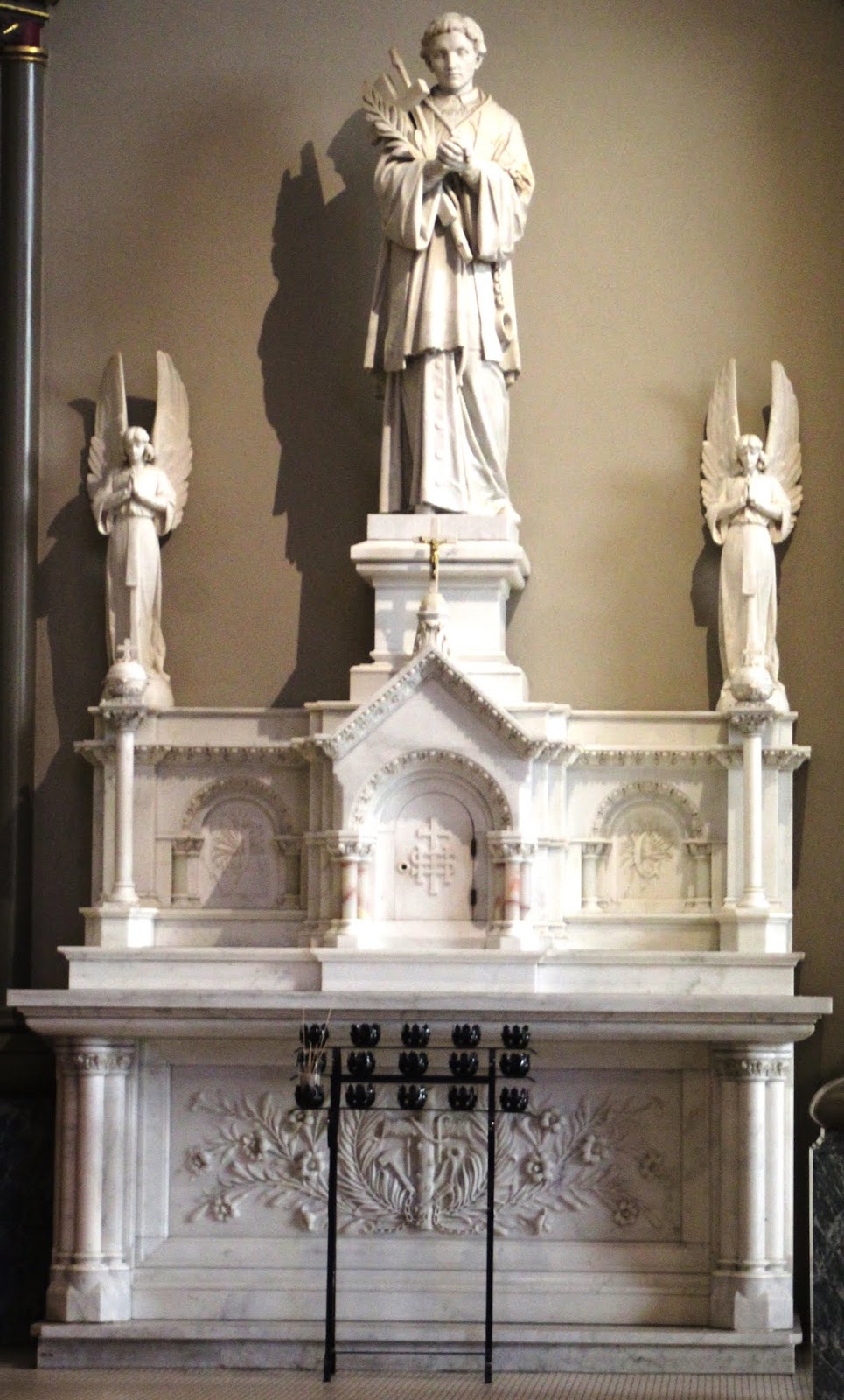
The other altar, to the left of the Mary altar, is the one pictured below, which I believe honors St. Vincent de Paul, the namesake of the church. This saint appears to be in a priest's robes and has a cross, a palm frond, a broken chain with a manacle at the end, and something else (a large unlit candle perhaps), and that symbolism doesn't fit any saint I can find. St. Vincent would be logical for this church, though.
And in the next alcove on the west side, on the south side of the door, is Jesus with the Sacred Heart.
Continuing south along the west side of the church, the next shrine is to St. Elizabeth Ann Seton (on the left), the first native-born citizen of the United States to be canonized, and on the right is another representation of St. Vincent de Paul.
Finally, to the left of this shrine, also on the east wall, is a statue of the Infant Jesus of Prague. I've seen this statue, of the child Jesus with a crown, holding a globus cruciger in the left hand, and the right hand giving a blessing, in many churches, each one with different real clothing.
Next Sunday: more of the interior of the church.
© Amanda Pape - 2018 - click here to e-mail me.
The altar just below is to the immediate left of the main altar, as you look at them. It honors the Blessed Virgin Mary, the Mother of God. I will write more about the painting above it (and the next altar) next week.
The altar immediately to the right of the main altar, while looking at both, honors St. Joseph, the adoptive father of Jesus.
To the right of St. Joseph is the altar pictured below, which depictsJesus in the Garden of Gethsemane, illustrating this passage from the Gospel of Luke, chapter 22:
39Jesus left the city and went, as he usually did, to the Mount of Olives; and the disciples went with him. 40When he arrived at the place, he said to them, “Pray that you will not fall into temptation.” 41Then he went off from them about the distance of a stone's throw and knelt down and prayed. 42“Father,” he said, “if you will, take this cup of suffering away from me. Not my will, however, but your will be done.” 43An angel from heaven appeared to him and strengthened him.
Here is more detail of the carving under this altar, of Jesus falling while carrying the cross:
The other altar, to the left of the Mary altar, is the one pictured below, which I believe honors St. Vincent de Paul, the namesake of the church. This saint appears to be in a priest's robes and has a cross, a palm frond, a broken chain with a manacle at the end, and something else (a large unlit candle perhaps), and that symbolism doesn't fit any saint I can find. St. Vincent would be logical for this church, though.
On the west side of the church, to the left of the altar above and closest to it, is a statue of a Pietà .
And in the next alcove on the west side, on the south side of the door, is Jesus with the Sacred Heart.
Continuing south along the west side of the church, the next shrine is to St. Elizabeth Ann Seton (on the left), the first native-born citizen of the United States to be canonized, and on the right is another representation of St. Vincent de Paul.
Directly across the center aisle, on the east side of the church, is another shrine, with statues of St. ThérÚse of Lisieux and of St. Anthony of Padua, with a painting of Our Lady of Guadalupe between them.
Next Sunday: more of the interior of the church.
© Amanda Pape - 2018 - click here to e-mail me.
Labels:
Chicago,
Church Record Sunday,
churches,
Dienes,
Massmann,
Sentimental Sunday
Subscribe to:
Posts (Atom)