Showing posts with label resources. Show all posts

Monday, August 12, 2013

Mystery ( & Military) Monday, Part 2: H. Jay Hanchette's Father, Capt. Hiram Solon Hanchette

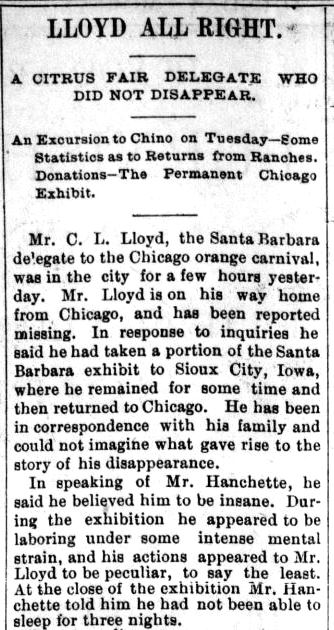
This is part 2 of my series on the mysterious disappearance of H. Jay Hanchette in 1891.  One of the articles I found, from The Chicago Herald, May 19, 1891, page 3, via the Archive of Americana database, had this interesting paragraph at the end (at right):

Harry / Henry Jay Hanchette was the oldest child of Hiram Solon Hanchette / Hanchett and Nancy Jane Griffith, who married in Indiana.   H. Jay was born there in Sullivan County on August 16, 1856.  By 1860, the family was living in Dorr township, McHenry County, Illinois.  Here's a brief biography of Hiram Solon Hanchett, from page 638 of The Life and Times of Samuel Gorton* (Hiram was a descendent of Gorton through his mother):


According to A History of Woodstock 1852 - 2002, Sesquicentennial Edition, page 56, Hiram Hanchett was actually president of the town's Board of Trustees in 1862-63, not mayor. Other records show that he was at Camp Butler in Illinois in June, July, and September, 1863.  There are also a number of different versions of just how Hiram Hanchett died.  Here's one, found in the database Heritage Quest Online – Books, from the 1886 Report of the Adjutant General of the State of Illinois** by J. W. Vance, in the section on page 561 about the Sixteenth Cavalry:


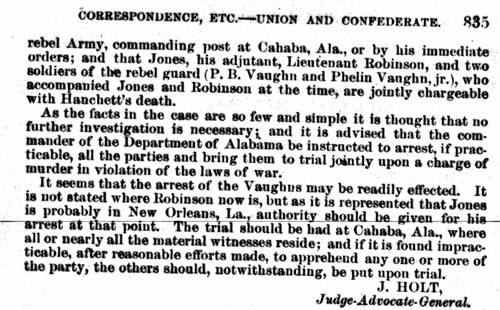
That account appears to have been taken verbatim from page 558 of The Patriotism of Illinois***, written by Thomas Mears Eddy in 1866.  Probably a more accurate account can be found in the 1899 Congressional Serial Set, on pages 117-120, 467, 794-795, 834-835, and 951 of Series 2, Volume 8, Part 1 (Prisoners of War and State, Etc.) in The War of the Rebellion: A Compilation of the Official Records of the Union and Confederate Armies****.

The image at left comes from an interpretive sign about Hiram S. Hanchett at Old Cahawba Archaelogical Park in Alabama.  There is a marker for Hanchett in the Civil War - era cemetery in the park (which has the remains of many of the former prisoners of the Confederate jail once there).  However, Hanchett is not buried there - his grave is unknown and unmarked.

A note on Ancestry.com on Hanchette in the "U.S., Civil War Soldier Records and Profiles, 1861-1865" database raises the possibility that a grave found in the 1970s, quite some distance from the 224 known graves, might be that of  Hiram Hanchett, and that DNA testing was a possibility.

H. Jay Hanchett was not quite nine years old when his father died.  His widow and children had moved to Chicago by 1870 and were living with his maternal grandparents on the Census that year.  His mother Nancy died at age 41, in 1877, when H. Jay was 21.

*Gorton, Adelos,. The life and times of Samuel Gorton : the founders and the founding of the Republic : a section of early United States history and a history of the colony of Providence and Rhode Island plantations in the Narragansett Indian country now the state of Rhode Island, 1592-1636-1677-1687 : with a genealogy of Samuel Gorton's descendants to the present time. Philadelphia: unknown, 1907.  Page 638, found on the Internet Archive.

Note that H. Jay is listed as Harris Joy in this book - most other references say his first name is Henry or Harry, and his middle name is Jay.  It's notable that the above-referenced book has separate entries for H. Jay's brother Charles and sister Minnie Estelle, who lived to adulthood, but there is no separate entry for H. Jay -  probably because of all the scandal that had accrued to his branch of the family by the time of the book's publication in 1907.

**Vance, J. W.  Report of the Adjutant General of the State of Illinois.  Springfield, IL: H.W. Rokker, state printer and binder, 1886.

***Eddy, Thomas Mears.  The Patriotism of Illinois:  A Record of the Civil and Military History of the State in the War for the Union, with a History of the Campaigns in which Illinois Soldiers Have Been Conspicuous, Sketches of Distinguished Officers, the Roll of the Illustrious Dead, Movements of the Sanitary and Christian Commissions, Volume 2Clarke & Company, 1866.

****Scott, Robert N., Lazelle, H. M., Davis, George B., Perry, Leslie J., Kirkley, Joseph W, et al.  The War of the Rebellion: a compilation of the official records of the Union and Confederate armies. 
Washington, DC: Government Printing Office, 1880-1901.

© Amanda Pape - 2013 - click here to e-mail me.

Monday, August 5, 2013

Mystery Monday: What Happened to H. Jay Hanchette?

The Dick Smith Library (where I work) serves as a Regional Historical Resources Depository for original and microfilmed records for a number of Texas counties, including Coleman.  Recently, another library transferred to us a fascinating Coleman County Sheriff's ledger from 1887 to 1892 that contained notices about stolen and stray animals, and wanted and missing persons.  This one caught my eye:
I used a variety of resources to try to find out what happened.  I searched old newspapers for "Hanchette" through subscription services Ancestry.com and GenealogyBank.com, my university's Archive of Americana database, and the free Chronicling America website sponsored by the Library of Congress and the National Endowment of the Humanities.  Most of my links below are to that source, so you can view articles in their entirety.

Henry/Harry Jay Hanchette, secretary of the Los Angeles Chamber of Commerce, left that city and had arrived in Chicago by March 31, 1891, to organize an exhibit of California fruit in the Windy City:
from The Chicago Herald, March 31, 1891, page 10, via Archive of Americana database

The exposition seemed to go well:


from the Los Angeles Herald, May 18, 1891, page 5, via Chronicling America


After the exposition closed in May, Hanchette was supposed to return home via train, but instead disappeared.  About the time the missing person notice went out, articles started appearing in Chicago, Los Angeles, and other newspapers:

from the Los Angeles Herald, May 18, 1891, page 5, via Chronicling America

from The Chicago Herald, May 18, 1891, page 3, via Archive of Americana database
from The Chicago Herald, May 19, 1891, page 3, via Archive of Americana database

from The Anaconda [MT] Standard, May 20, 1891, Page 7,
via Chronicling America


Over the next few months, this was followed by supposed sightings:  as a dead body pulled from Lake Michigan, a debauched man in Kalamazoo, Michigan, a demented man in Janesville, Wisconsin, an organ-seller in Flandreau, South Dakota, and as an insane man in Woodstock, Illinois, where Hanchette grew up.

There was also a lot of speculation:  that he'd sailed for South America, and that he'd been located with another woman - not his wife.  The latter rumor was apparently started by a detective Fred Smith, and rather vehemently denied by Hanchette's mother-in-law, Amelia Griffith.

from The Record-Union, Sacramento, CA, May 21, 1891, page 1, via Chronicling America


from the Los Angeles Herald, May 29, 1891, page 1, via Chronicling America

from The Dalles Weekly Chronicle (The Dalles, OR), June 12, 1891, page 1, via Chronicling America

from The Salt Lake Herald, Salt Lake City, Utah, June 14, 1891, page 14, via Chronicling America

from Riverside [CA] Independent Enterprise, August 15, 1891,
page 3,via GenealogyBank.com


from the Los Angeles Herald, August 20, 1891, Page 8,
via Chronicling America


A couple newspaper stories in the Los Angeles Herald on September 1 and September 2, 1891,  indicated Hanchette may have had a double.  His wife, Emma Griffith Hanchette, and his two sons, Rex and Earl, all thought they saw him in San Francisco while they were staying with Emma's parents, Dr. and Mrs. Edgar M. (Amelia Conant) Griffith.  Two other men who knew him thought they saw him there as well.

Later that month, Robert Farrell, who worked for the Los Angeles Herald when Hanchette was its city editor, claimed to have seen Hanchette, who identified himself variously as Hamilton, H. J. Mitchell, and John Blackman.   Farrell described what he saw in letters to the Herald on September 12 and September 25.

from Los Angeles Herald, September 26, 1891, Page 8,
via Chronicling America


from Arizona Republican (Phoenix), October 03, 1891, page 1, via Chronicling America
After this, things were quiet - for a while.  Come back next week for more of this story!

© Amanda Pape - 2013 - click here to e-mail me.

Tuesday, February 21, 2012

Tuesday's Tech Tip: Archive of Americana database

 [I originally did a variation of this post for my library's blog, but I thought the information might be useful for family history research as well.  Many college and university libraries will let non-students/staff use their library resources, including computers, during certain times of the day or week.  Contact your libraries to find out their policies.]


Archive of Americana is a database to which many academic and some public libraries subscribe, in all or part.  It provides access to primary-source historical materials such as newspapers, government documents, and other publications.  The America's Historical Newspapers collections include issues from newspapers from all 50 states.  Many of the newspapers in this collection go through 1922, but my academic library also subscribes to a module through Readex, the provider of Archive of Americana, that includes the Dallas Morning News through January 1984.  Here's a brief demo on using this database for family history research - click on each image for a larger view:
My great-grandfather immigrated to Texas from Lithuania sometime after 1880, so I did a search (above) on his (unusual) last name and limited it to 1880-2012 (see the red box in the image above).

In the image at left, only five of the 132 results are visible.  Click on the "View all [whatever number] link in the bottom left corner (again, in the red box in the image).

This should (it doesn't always) bring up preview images from the documents that include one or more of your search terms.  If you see something promising, you can click on the preview or on the "View Article" link (see the red boxes in the image below).


When you find an article, you will find a number of tools at the top right of the page.  The "Article Bookmark" link opens a new window containing the OpenURL for the article. You can copy and paste this OpenURL information into another application.  The "Export Citation" link opens a new window containing a simple, text-only format of the citation information for the article. You can also Email the OpenURL link for the document.

You can zoom in or out, reposition the image in the viewing pane, view the full page the article was published on, and reset the image view to the default.  You can also open the article as a PDF, open it in a print-friendly view, and maximize (or minimize) the image view pain.

You can also add the article to "My Collection," a temporary saving space that's held until you log off.

Your search term(s) will be highlighted in yellow. There is a check box at the top left of the screen to toggle that feature on or off. 

The database has a very informative "Help" page that explains all of its features.

Give this database a try for your pre-1922 ancestors, as well as Texas family through 1983.  I was expecting to find my grandfather's cousin who lived in the Dallas area (and I did).  I did not expect to find this article (pictured left) about my grandfather, who never lived in the Dallas-Fort Worth Metroplex, but only in Houston and Austin!

© Amanda Pape - 2012 - click here to e-mail me.