Showing posts with label Black Sheep Sunday. Show all posts

Sunday, November 29, 2020

Historic Preservation?

I was shocked to walk by this historic house at 501 Counts Alley, which is just a few blocks from my home in Granbury, Texas, and see this today:


This is what the house looked like about a year ago:


The stone arches on the front porch are being demolished.  So far, this whimsical flower is still there, but I have to wonder - for how long?


There's also a diamond and a dragonfly (I think) in the stonework on the chimney on the west side of the house.


I decided to do a little research on this house.  The property it is on was purchased by William "Bill" Harrison Kinson, 1889-1966, and his wife Bessie Drucilla Nash Kinson, 1897-1982, on December 27, 1933.  Bill and Bessie had married in Hood County seven years earlier, on December 28, 1926.  On the 1930 Census, she was a public schoolteacher and he was a trucker, and they were renting a house on nearby Pearl Street.  They had no children.

They may have bought the house for more space.  Sometime after March 29, 1932, the Kinsons took in the three children of Grover Cleveland Oxford (1894-1960) and Maude Ann Davis Oxford (1898-1932).  Maude had died from breast and liver cancer, leaving three young children ages 2-5, Grovina, Bonita, and Derl, and the Kinsons took them in and raised them (according to Grovina's 2015 obituary).  They don't seem to be related, and it's not clear why their father did not want to raise them.  The children are listed as "lodgers" in the Kinson home on the 1940 Census.

Tax records for the house indicate it was built in 1935.  That is likely when the mixed stone exterior walls with beaded mortar were built, as the initials in the front gable, "WK," are those of William Kinson.  The Kinsons owned the home through Bessie's death in December 1982.  Earlier that year, she conveyed the house to her former lodger, Derl Crites Oxford (1930-1989), retaining a life estate for herself.  Derl lived there until his death, and the home passed out of Kinson and Oxford ownership when it was sold by Grovina in the settlement of Derl's estate in March 1991.

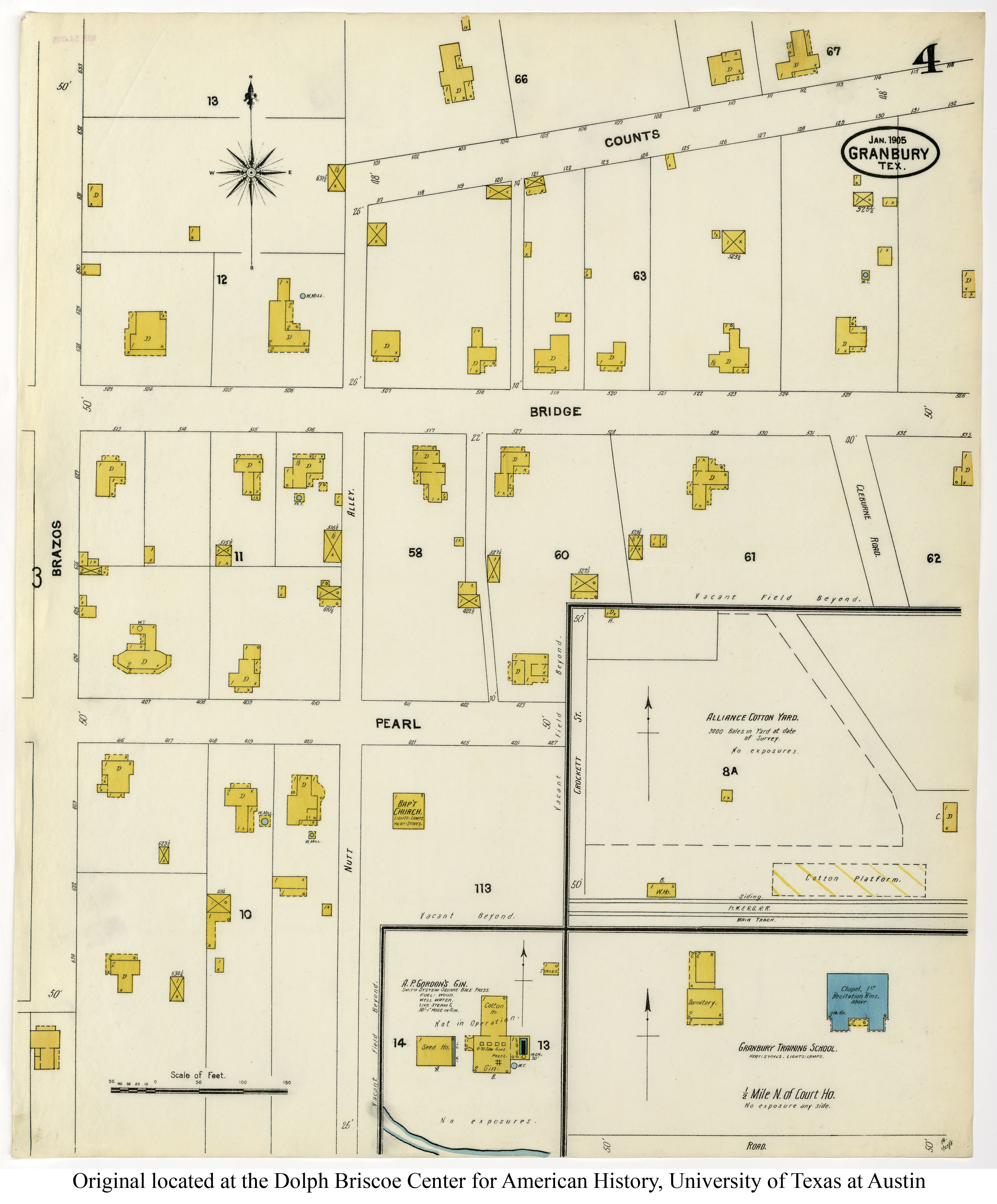
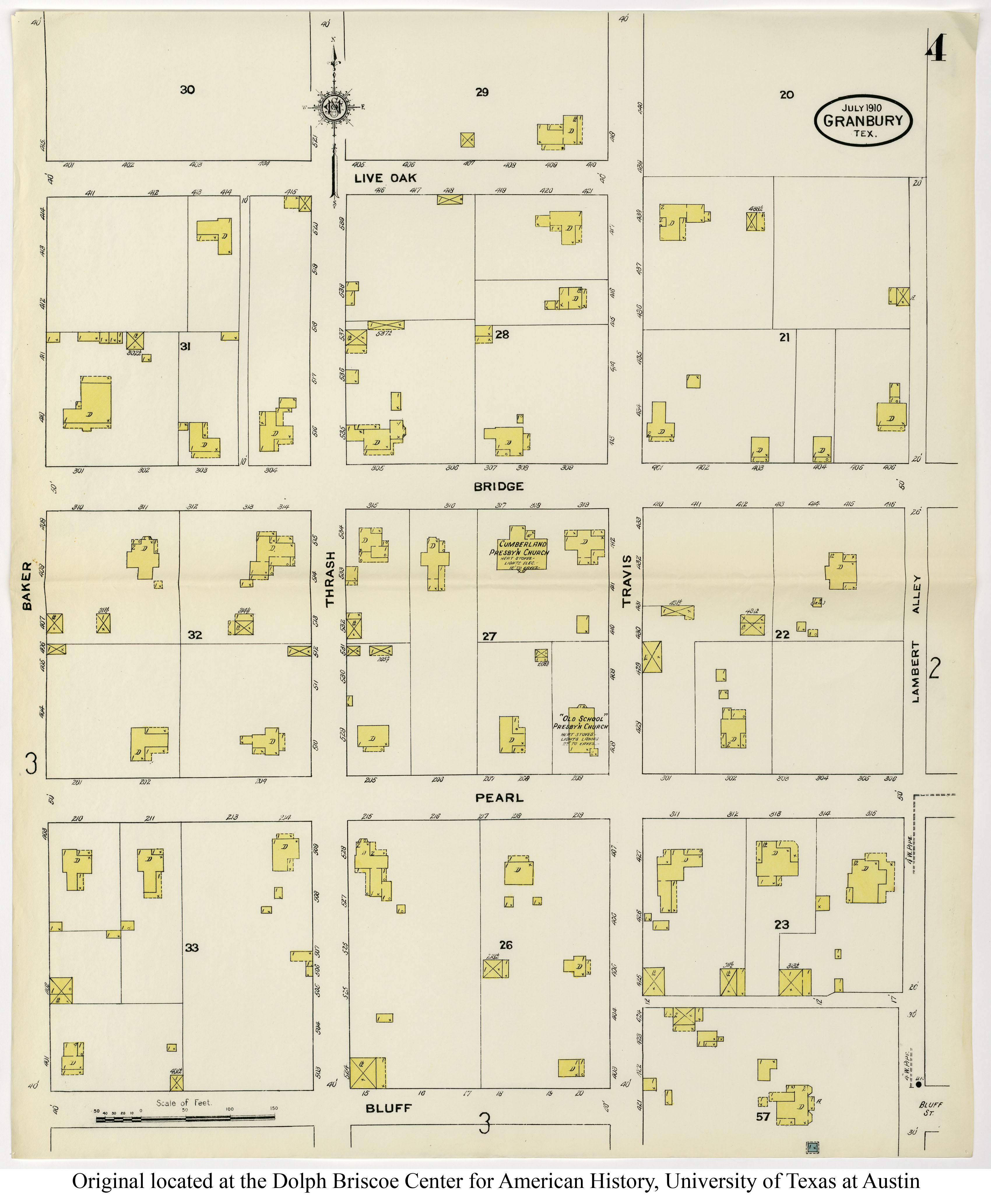
However, it looks like a structure very similar to the existing house has been on the site since at least January 1905, based on Sanborn maps.  In the next two images, from January 1905 and July 1910, it is the smaller house on the left, with a (then-) house number of 110.  The yellow coloring indicates that it is a wood frame structure.


Now look at the next two images, from the February 1932 and March 1945 Sanborn maps.  The 1945 map notes the stone, and you can also see a small outbuilding has been added, probably what now appears to be storage but was likely the original garage.  It's possible the stone outer wall was added over existing wood frame and siding.

Above:  February 1932.  Below:  March 1945.


This house, described as a High Style Tudor Revival, is a high priority for preservation according to a historic properties survey done by the city in 2001.  It "contributes significantly to local history or broader historical patterns; is an outstanding or unique example of architecture, engineering or crafted design; and retains a significant portion of its original character and architectural integrity."

However, a large part of that uniqueness, character, and integrity is being destroyed.  The house is not in the city's historic preservation district (HPO), so the current owners (who bought the house in January of this year) did not have to submit their plans for the exterior to the Historic Preservation Commission (on which I serve, since February 2020) for approval.

ETA 14 January 2021:  The front door that is parallel to the street has been bricked in (with similar stone), and the planter box in front of the window to the left of the porch has also been demolished.


Also, a discussion with a lifetime Granbury resident and some additional research in old newspapers revealed that Bill Kinson was elected alderman (a City Councilperson) in Granbury in April 1939.  Also, his 1966 obituary stated that the Kinsons had owned the Corner Cafe since 1958.  The Corner Cafe was in the building pictured below, at the northwest corner of Pearl and Houston streets on the Hood County Courthouse square.


Based on an early (but undated) photo of this building, it did not always have the crazy-quilt-pattern mixed stone exterior.  I have to wonder if Kinson added this as well.


© Amanda Pape - 2020 - e-mail me!

Sunday, June 10, 2018

Black Sheep Sunday? Ewald Pape's A-File

I was very surprised a few years ago to learn that my architect first cousin twice removed, Ewald Theodore Pape (1894-1976), had an A-File - an Alien Case File - during World War II.  I requested a copy of this file from the National Archives on September 29, 2015, paid $36 for the 45-page copy, and received a PDF via e-mail three days later.

So what is an A-File?  From the National Archives website:
The Immigration and Naturalization Service (INS) began issuing aliens an Alien Registration number in 1940, and on April 1, 1944, began using this number to create individual case files, called Alien Files or A-Files. 
A-Files contain all records of any active case of an alien not yet naturalized as they passed through the United States immigration and inspection process. An A-File might also be created without any action taken by the alien, for example if INS initiated a law enforcement action against or involving the alien.

Despite submitting a declaration of intent to become a citizen in December 1920, and serving in the United States Army from then through July 1922, Ewald did not submit a petition for naturalization within the required seven year time frame.  He later (November 1942) stated that he thought he acquired citizenship through his military service, and only learned he was still an alien when he applied for membership with the American Legion.  He did submit another declaration of intent on October 28, 1936.  He *could* have filed another petition three years later, but for some reason he did not - and then the Alien Registration (Smith) Act took effect on June 28, 1940.


Above:  Ewald T. Pape's fingerprint and photo from his March 14, 1942 Application for Certificate of Identification (Aliens of Enemy Nationalities) Form AR-AE-22
From:  Records scanned at the National Archives at Kansas City
Record Group 566, Records of the U.S. Citizenship and Immigration Services
Department of Justice. Immigration and Naturalization Service.
Alien Case Files, 1944-2003
Alien Case File A2474506 for Ewald Pape
National Archives Identifier: 7147174


Here's what happened to Ewald, based on information in his A-File and other sources:

October 1, 1940:  Ewald completes the required Alien Registration Form AR-2.

August 6, 1941:  Ewald's petition for naturalization is filed.

January 27, 1942:  Warrant of arrest issued by Attorney General of the United States, Francis Biddle - less than two months after the bombing of Pearl Harbor and the United States' entry into World War II in Europe and the Pacific.

January 28, 1942:  Ewald is apprehended by the Federal Bureau of Investigation and received by the Immigration and Naturalization Service (INS, now U.S. Citizenship and Immigration Services, or USCIS) in Portland, Oregon, because "he had in his home certain articles which he was prohibited from having under the regulations pertaining to alien enemies."  Prohibited items included all firearms, short-wave radios, cameras, knives, and “signaling devices” such as flashlights.

According to an April 24, 1944 interview with his wife Alma, she "always felt she was to blame for her husband having been interned because she said he had suggested turning in the short wave radio set in order to comply with the enemy alien regulations, but she believed, being an American citizen herself, she could keep the set in the home, and not realizing the fact that her husband would be blamed."

February 14, 1942:  Appeared before Alien Enemy Hearing Board, which recommended that he be immediately paroled.

February 18, 1942:  Became "desperately ill" and moved from the local immigration detention station to the [Robert C.Coffey Memorial Hospital in Portland, for an operation for a perforating ulcer in his stomach.  (His April 27, 1942, draft registration card indicated that he had an operation on his right side at the waist.)  He spent the next 60 days at home recuperating, and never reopened his [architectural] office in the Sherlock Building (SW 3rd at Oak), according to his April 3, 1943 interview.

March 4, 1942:  Attorney General concurs in the recommendation for parole.

March 14, 1942:  Parole takes effect, at 10:30 a.m., immediately after his release from the hospital.  C. D. Warrington is his sponsor.  He's required to report twice a month to his sponsor, and on the first of each month to his INS parole officer.  He also completes an Application for Certificate of Identification (Aliens of Enemy Nationalities) Form AR-AE-22 on this date, from which the above photograph and fingerprint image are taken.

April 27, 1942:  Registers for the draft.

June 1942:  Employed by the Portland Door Company, 4701 SE 24th Avenue, "in charge of the architectural work and as a supervisor for the company at different places where defense houses are being constructed in this city of material furnished contractors by said company.  At the present time this company is furnishing material to a contractor who is building 360 [housing] units in the Guild's Lake District in Northwest Portland.  Mr. Pape observes the construction of the houses by the contractors and suggests changes and also sees to it that the required material is delivered to the site in proper order."  Guild's Lake Courts was a project of the Housing Authority of Portland, to combat a housing shortage for shipbuilders and other wartime industry workers.

June 24, 1942:  John S. Fisher is named sponsor, as Warrington is now in the Coast Guard.

March 11 through April 3, 1943:  Interviews of three neighbors, sponsor, and Ewald; report of investigations "relating to the conduct and activities of the above-named alien enemy parolee" submitted, recommending continuation of parole "under the terms of the present agreement."

March 18, 1943:  Ewald's petition for naturalization is "continued until end of war."

November 16-17, 1943:  Interviews of four neighbors, sponsor, and Ewald; report submitted recommending continuation of parole.

Ewald states that he "is in charge of the architectural work....in connection with defense housing," and "that if it were not for his present status he could be doing other important work which would pay a great deal more than he is receiving at the present time."  He also "indicated that his parole has been a frequent source of worry to him inasmuch as he and his wife are conscious of the fact that their neighbors and friends are aware of his situation and that at times it has hampered his work."

April 20-27, 1944:  Interviews of sponsor, three neighbors, co-worker, employer, Alma, and Ewald; report submitted recommending continuation of parole.

April 28, 1944:  Zenon C. R. Hansen is named sponsor as Fisher is being called into military service.

August 1944:  Joseph H. Page, a lawyer, becomes Ewald's sponsor.

November 8-29, 1944:  Interviews of three neighbors, his sponsor, his employer, and Ewald; report submitted recommending release from parole.

His employer, Leo Hanley, the owner of the Portland Door Company, says he has known Ewald "over a period of twenty years" and he "is a sedulous individual, an expert in his line and a loyal employee...[who] drew the plans for the Bailey bridge which was recently built by our service in France and is now drawing the plans for seventy five miles of bridge work to be used in Europe by the armed services.....[he] has been the architect for approximately 1500 defense housing units and is at present working on a design for post-war houses which they hope to ship in bundles to Africa, China, and Europe."  Hanley added that if he "had any suspicion that subject [Ewald] was disloyal, he could not affort to employ him in his combustible business."

In his interview, Ewald presented a copy of his honorable discharge from the Army and a June 9, 1922 letter of recommendation from Major C. B. Hazeltine, who said "he has been a draftsman in my office and has done a great deal of inside drafting and outside topographical work.  He is at the present time my chief draftsman and could remain as such, should he so desire....I have found this man at all times and under all circumstances, loyal, competent, and willing.  I consider him a very good draftsman, and extremely neat and painstaking in his work."

The November 14, 1944 recommendation of V. W. Tomlinson, officer in charge, Portland, Oregon, stated "I am familiar with the high type of work he is performing in the furtherance of the war effort and I am convinced that he is not a potential danger to the internal security of the United States.  Quite the contrary, he has contributed far more than the average to our war effort and this record will bear out that he has scarcely received a decent wage for his efforts." (Ewald had noted in his November 1944 interview that he worked 8-9 hours a day, six days a week, for $50 per week.)

The November 18, 1944 recommendation of E. F. Schwandt, Chief, Detention, Deportation & Parole Section, Seattle, Washington, stated that Ewald "has been employed since his parole in an industry which is vitally important to the war efforts of the United States.  During this time he has had every opportunity to damage the war effort had he been so inclined, as even a slight deviation from established practices in preparing architectural plans would have resulted in serious delay in the completion of structures manufactured by his employers.  Apparently nothing of the kind has occurred during his employment and the subject has conducted himself in a manner indicative of his loyalty and good will toward the well-being of this country."

May 2, 1945:  Attorney General Biddle orders release from parole.

May 11, 1945:  Released from parole - three days after V-E Day, the end of World War II in Europe.

December 12, 1947:  Ewald finally takes his oath of allegiance and becomes a United States citizen.

--------

© Amanda Pape - 2018 - click here to e-mail me.

Sunday, January 22, 2017

Black Sheep Sunday: Erath County Sheriff Murdered - 1877

Earlier this week, I was contacted by the director of a public library in Erath County, where the university I work at is located.  She wanted to know if we had any local 1877 newspapers.  Our Stephenville newspapers on microfilm only go back to 1882 (with many gaps in those early years), and the Dublin paper did not start until 1889.

However, I learned a trick from research I did on Francis Edward Garland, the editor of my town of Granbury's early newspaper, the Vidette, from 1872 to 1883.  No copies of that newspaper survive, but I found plenty of references to Garland and the Vidette in other Texas newspapers (available at the Portal to Texas History) from that era.

I thought the same technique might work in this case - especially since the story involved the murder of the Erath County Sheriff, William James Mastin, and the researcher had an exact date for his death:  June 25, 1877.

Sure enough, I found two references to the murder on the same page (two)1 of the July 5, 1877, issue of the Weekly Democratic Statesman, published in Austin, Texas, via the Portal to Texas History.  I had searched for "mastin erath" (without the quotes) and limited the results to 1877.  The first reference started at the bottom of column six and continued at the top of column 7.  Sheriff Maston [sic] was killed by a cattle thief he intended to arrest:


Further on in column seven was a little more detail.  This time Mastin's name was spelled correctly, and it gave the date of the murder, June 25.  The name and a detailed description of the murderer, Bone Wilson, was also given, as well as the fact that a reward was being offered for his capture.  This story also noted Mastin was going to arrest Wilson for stealing a horse (not cattle theft):


I found a follow-up story2 in the Galveston Daily News of September 27, 1877, on page 4.  In a section with news from Erath County, the Stephenville Empire newspaper was quoted. (In the image below, I have blanked out a number of lines of news not relevant to this case.)  Bone Wilson, alias Napoleon B. Wilson, was killed by Texas Rangers under the command of T. M. Sparks about 20 miles from Fort Chadbourne on September 15, 1877:


A little more detailabout the murderer’s death comes from the Lampasas Dispatch of September 27, 1877, via the Brownwood Banner.  This one was found by searching the Portal to Texas History for “sheriff erath” (no quotes in the search), as Mastin was sometimes spelled incorrectly.  This article does not even refer to the sheriff by name, and some of the details of Wilson's killing are different.  Both articles note that Wilson's body was taken to Coleman City (just established in 1876). which is about 60 miles east of the fort.


There’s more about Mastin on pages 15-16 of James Pylant’s 2009 book, Sins of the Pioneers4.  He was elected sheriff on February 15, 1876, and had survived an earlier attempt on his life in November of that year "when Rufus C. Howie fired a six-shooter at him."

One of Pylant’s sources5 is an account of the killing of Mastin’s murderer, Bone Wilson, by one of the Texas Rangers participating, Noah Armstrong.  Armstrong was interviewed sometime between 1936 and 1939, as part of the Folklore Project of the Federal Writers’ Project, a New Deal jobs program that was part of the U.S. Works Progress (later Work Projects) Administration (WPA).  His account of the killing of Bone Wilson starts on the fourth page.


Sources:

1Weekly Democratic Statesman. (Austin, Tex.), Vol. 6, No. 39, Ed. 1 Thursday, July 5, 1877, newspaper, July 5, 1877; Austin, Texas. (texashistory.unt.edu/ark:/67531/metapth277635/m1/2/?q=mastin+erath: accessed January 21, 2017), University of North Texas Libraries, The Portal to Texas History, texashistory.unt.edu; .                                                          

2The Galveston Daily News. (Galveston, Tex.), Vol. 36, No. 161, Ed. 1 Thursday, September 27, 1877, newspaper, September 27, 1877; (texashistory.unt.edu/ark:/67531/metapth464966/m1/4/?q=mastin%20erath: accessed January 21, 2017), University of North Texas Libraries, The Portal to Texas History, texashistory.unt.edu; crediting Abilene Library Consortium.

3Beall, W. P. The Lampasas Dispatch (Lampasas, Tex.), Vol. 7, No. 18, Ed. 1 Thursday, September 27, 1877, newspaper, September 27, 1877; (texashistory.unt.edu/ark:/67531/metapth179077/m1/3/?q=sheriff%20erath: accessed January 21, 2017), University of North Texas Libraries, The Portal to Texas History, texashistory.unt.edu; crediting The Dolph Briscoe Center for American History.

4Pylant, James. Sins of the pioneers: crimes & scandals in a small Texas town. Stephenville, TX: Jacobus Books, 2009.                                                  

5Doyle, Elizabeth, and Noah Armstrong. [Noah Armstrong]. Texas. Manuscript/Mixed Material. Retrieved from the Library of Congress, https://www.loc.gov/item/wpalh002308/. (Accessed January 21, 2017.)


© Amanda Pape - 2017- click here to e-mail me.

Sunday, July 13, 2014

Black Sheep Sunday: Jacob Shelton's Murderer, John Dove, in Prison

A few months back, I wrote a couple blog posts about one of my family's black sheep, my great-great-great-grandfather Jacob Shelton (1822 - ABT 1874).  Jacob was killed by John Dove, the brother of Jacob's third wife.  John Dove went to prison and, according to Dove family stories, was killed trying to escape to visit a dying daughter.

I was exploring a little at FamilySearch.org the other day, and decided to browse through the "Index of Official Register of Inmates Vol. 1, no. 1-9073, 1866-1889."  I jumped over to the last names beginning with D and pretty quickly found these two pages (which I've very roughly stitched together to create this image, with the headings for each column at the bottom of the image:


Below are enlargements for the relevant information. The column headings for these sections are Reg[istration number], Name, Year Received, Crime, and Yrs/mo [length of sentence].  John Dove was received into the Louisiana State Penitentiary in 1877 for murder with a life sentence.


The page on the right-hand side had column headings for Expiration of Sentence, Where Sentenced, and Remarks (if any).  John Dove's sentence did not expire (since it was life), and he was sentenced in Winn Parish (where the crime of murdering my great-great-great-grandfather Jacob Shelton occurred).


Under Remarks, it says he "Died  Sept. 3rd 1878."  The circumstances of his death are not described.  It may very well be that he was in fact shot while trying to go see his dying daughter Julia, as a Dove family story contends.

Sources:
"Louisiana, State Penitentiary Records, 1866-1963," images, FamilySearch (https://familysearch.org/pal:/MM9.3.1/TH-1951-24842-38169-35?cc=1931391&wc=M6PZ-NWL:227357201,227511501 : accessed 11 Jul 2014), Correctional institution records > Index of official register of inmates vol 1 no 1-9073 1866-1889 > image 104 of 577; citing State Archives, Baton Rouge.
AND
"Louisiana, State Penitentiary Records, 1866-1963," images, FamilySearch (https://familysearch.org/pal:/MM9.3.1/TH-1942-24843-335-16?cc=1931391&wc=M6PZ-NWL:227357201,227511501 : accessed 11 Jul 2014), Correctional institution records > Index of official register of inmates vol 1 no 1-9073 1866-1889 > image 105 of 577; citing State Archives, Baton Rouge.

© Amanda Pape - 2014 - click here to e-mail me.

Sunday, February 9, 2014

Black Sheep? Sunday: Jacob Shelton, 1822 - ABT 1874


Jacob Shelton, my great- great-great-grandfather on my mother's side, was born in Alabama in 1822, the ninth of ten children of Mark Shelton and Susannah Luttrell.  On September 18, 1842, he married an Elizabeth Stone in Lauderdale County, Alabama (per Alabama Marriages, 1809-1920, and Alabama, Marriage Collection, 1800-1969).  However, this Elizabeth apparently died, as there are also records in three Mississippi Marriages collections showing Jacob marrying Elizabeth A. Bridges on December 28, 1845, in Marshall County in that state.

Jacob and Elizabeth appear on the 1850 Census on September 12 in Southern Division, Marshall County, Mississippi, with sons Joseph L., age 3 (born in 1847), and John E., age 1 (born about 1849).  Four more children were born somewhere in Mississippi, probably in Marshall County:  Bennett A. (named for Elizabeth's father, Matthew Bennett Bridges) about 1852, Sarah J. about 1854, Jacob H. about 1856, and James William about 1859.


Jacob purchased 317.92 acres of land near Sardis in Winn Parish, Louisiana, for $158.96 on December 16, 1859, according to an Affadavit for Actual Settlement and Cultivation.  A land patent was issued on July 2, 1860:
A declaration dated November 28, 1860, states that Jacob had been residing on the land since Christmas Day, 1859, had a house with a kitchen, and had 25 acres under cultivation.

The 1860 Census, taken on June 21, shows the family in Winnfield in Winn Parish with one additional person - a Samantha K. (or R.), age 21, married within the year.  Her last name is not shown as being different, so either she was a Shelton (perhaps a niece of Jacob’s), or the enumerator assumed she was.  I have not figured out who she is.  However, there is a Samuel Newman, age 23 and married within the year, just above Jacob’s name on the 1860 Census.  On the 1870 Census for Winn Parish, I found an S. B. and S. K. Newman of the right ages.  Perhaps this Samantha was simply listed in the wrong household on the 1860 Census.

The 1860 Census Slave Schedule shows that Jacob owned one slave, an unnamed 14-year-old black female.

My great-great-grandfather, Levi Marion Shelton, the youngest child of Jacob and Elizabeth Bridges Shelton, was born on January 28, 1863, in Winn Parish. 

Jacob apparently served in the Confederate Army in the Civil War.  He was a private in Company B of the 6th Regiment, Louisiana Cavalry.  This unit was assembled in January, 1864,
and saw light action in Louisiana. Later it operated a courier-line between Camden, Arkansas and Alexandria, Louisiana.  According to Civil War Prisoner of War records, Jacob surrendered to the Union in New Orleans on May 26, 1865.  He was paroled in Natchitoches, Louisiana, on June 13, 1865.  This is the only record of his service; he is not on any muster roll, and an application for a pension was never made.

Now this is where the "black sheep" portion of Jacob's life begins.

Jacob's wife Elizabeth apparently died sometime in 1865.   Jacob fathered a black son out of wedlock, Van, born in February 1868.  Supposedly his mother was Jacob's housekeeper.  I would not be surprised if she was his former slave.  In fact, I found a record in the 1870 Census in Winn Parish of a Susan Jane Shelton, black, age 24, living with a black boy named Van McLain, age 4, and another mulatto boy, William Shelton, born in June 1870.  Supposedly Van had a brother named William Shelton and a sister named Anna Shelton, born about 1874 (She shows up on the 1880 Census in Winn Parish with a Susanna Shelton, age 33).  Whether or not they were also Jacob's children or just took that surname is unknown.

According to one Shelton family story, Elizabeth contracted tuberculosis.  Catherine Dove Chitwood, a Civil War widow with three children and four younger siblings living in Winn Parish
 (sister Elizabeth, and brothers John, James and William), came to live with the Shelton family to help take care of Elizabeth and the Shelton children. After Elizabeth died in 1865, Catherine continued to live in the Shelton home.  However, this story is unlikely, because Catherine and her three children (and her sister Elizabeth, also a widow at that time, and her three children) are listed in the August 4, 1866, issue of the Bienville Messenger - a parish northwest of Winn, indicating that Catherine and her offspring did not move to Winn Parish until after this time.

Jacob and Catherine had a daughter, Susan, out of wedlock, around June 1870. (She's two months old and "infant not named Chitwood" on the August 9, 1870, Census in Winn Parish, but is on the 1880 census in Catherine's home in Sabine, Texas, as a ten-year-old named Susan Shelton.) 

Apparently the census enumerator talked.  Just a few days later, on August 13, 1870, the minutes of the Sardis Baptist Church in Winn Parish indicate that Catherine was charged with adultery and excluded from the church. Catherine had joined the church in May 1867, and asked for and was granted a letter of dismission on October 9, 1869 (about the time she would have have realized she was pregnant). 
Eventually Jacob and Catherine apparently were married, since an August 1873 entry in the church minutes states that "Catherine Shelton" was received by restoration and Jacob Shelton "on confession of faith." 

Jacob Shelton was killed by Catherine's brother John Dove.  There are many variations in the stories on just when and why this occurred.  I think he died in 1874.  But that will be another post.

© Amanda Pape - 2014 - click here to e-mail me.

Sunday, February 24, 2013

Black Sheep Sunday: Odom Family, ABT 1919

When my my mother's first cousin Edith Carole contacted me a few weeks ago about a photo of what turned out to be her grandparents/my great-grandparents, Louis Henry Wolfe and Addilee Tennessee Shelton Wolfe Odom Harris, she said she'd send me another photograph that is supposed to be of Addilee and her second husband, Hughes Calhoun Odom, with his family.  The story goes that during World War I, Addilee volunteered to roll bandages for the Red Cross, met a military man, and had abandoned her family to run off with him.  Her first marriage, to my great-grandfather, Louis Wolfe, occurred in 1905 when she was 15 and he was 33, and she had her first of four children at age 16.

The photo below was likely taken between July 1917 and April 1919, when Hughes was in the military, as he is wearing a uniform in the picture below.  I'm guessing 1919, since the youngest child in the picture (the little girl at the left), was born about 1916, and she looks to be about three in this picture.
Back row, from left:  Samuel Mosely Barnes (1891-1966), Maggie May Odom Barnes (1894-1965), Hughes Calhoun Odom (1894-1962), Addilee Tennessee Shelton Wolfe Odom Harris (1890-1977), Jesse Calhoun Odom (1866-1945), Leonora "Nora" Carroll Odom (1871-1928), Albert Carroll Odom (1900-1970), and William Thomas Odom (1897-1966).
Front row:  May L. Barnes (born  ABT 1916), William Lafayette Barnes (1913-2000), John S. Odom (born  ABT 1906), and Luther Edward Odom (1910-1967)

Edith Carole got this photo from her first cousin once removed, Lemora Thompson Stroud, in Louisiana.  She said it was in Addilee's things (when she passed away in Louisiana in 1977) and that Addilee had told her this was Hughes Odom's family.  Addilee is the woman in the light-colored dress in the center and the man in uniform next to her is supposed to be Hughes Odom.  Based on records found in Ancestry.com, Edith Carole made guesses as to who the other people are, and I agree with her. 

The 1920 Census shows Addilee and Hughes living in Fort Worth.  The marriage (if there ever was one) didn't last too much longer, as Addilee married Charles Harris on January 7, 1922.  She is listed as Addie Odom on that marriage license.  Charlie Harris (1887-1959) was the love of her life, and she insisted on moving back to Louisiana (from Texas, where she'd been living near her children) shortly before her death in 1977, so she could be buried next to him.

© Amanda Pape - 2013 - click here to e-mail me.

Sunday, June 24, 2012

Black Sheep Sunday: Wife-Killer is Bigamist

Odessa American, December 29, 1959, p. 19
Back in April, I got to attend the Texas Library Association annual conference in Houston.  I spent some extra time in town after the conference and visited the Clayton Library Center for Genealogical Research of the Houston Public LibraryOne of the databases they have, that I can't access (for free) outside of a Houston Public Library branch, is the Access NewspaperARCHIVE (to which I'm considering a subscription).  I spent a lot of my day at the Clayton searching this database, particularly the name of Guokas, as my great-grandfather and his kin settled in the area in the late 1890s and early 1900s.

Earlier I wrote about Gail Lee Guokas Gross (1940-1959), my second cousin once removed,  who was murdered by her husband, Harold Ray Gross, on December 26, 1959.  Imagine my surprise when I turned up the article at the left.

Turns out Mr. Gross was a bigamist - AND Gail had a son I did not know about!


Based on some of the information in this article - Gross' age, the name of his other wife, and the fact that they had two sons, plus a little research, I was able to figure out that Harold Ray Gross was born February 15, 1935, in Bell County, Texas, and died November 12, 2006, in Joshua, Johnson County, Texas.  He also apparently remarried in April, 1972 - which seems to indicate to me that he was released from prison, despite his life sentence.  Because he served in the Navy (March 1955 to July 1957), he was apparently eligible to be buried in the Dallas-Fort Worth National Cemetery.

I have to admit, this bothers me a little.  I mean, the man shot Gail FIVE times, and admitted to the murder, pleaded guilty, and agreed to a life sentence - yet he's buried in a national cemetery for our honored veterans?

The other surprise was learning Harold and Gail had a son, David Henry Gross.  I wasn't able to find any information about him, however, other than the article to the right.

Note at the very end of the article, it says, "The dead woman left her 17-month-old son with her mother while she went to the theater."  This told me that David was born about July, 1958.  That hasn't helped (so far) in finding out anything about him.  I have to wonder if he was adopted by one of Gail's parents (who were divorced by that time) or by her sister Jackie and her husband.  Perhaps he has the last name of Guokas, or Payne (his grandmother's maiden name), or Allumbaugh (his uncle's name), but I have not turned up any possibilities under those names (yet) either.

© Amanda Pape - 2012 - click here to e-mail me.

Sunday, March 18, 2012

Black Sheep Sunday: My Grandmother in an Orphanage

I recently returned from a visit with my 83-year-old parents. Mom has been into genealogy for years and has created notebooks with photos and documents pertaining to hers and my father's lines. I was aware of the document at left, but learned something else about my great-grandmother Addilee Tennessee Shelton Wolfe Harris (1890-1977) that I did not know.

The document at left shows that my grandmother, Sara Melzina Wolfe (1908-1997; she would have been 104 today), and her three siblings, the four of them then ranging in age from 3 to 9, were placed in the DePelchin Faith Home (now the DePelchin Children's Center, and in a different location) for about a year and a half, from mid-April, 1916, to late September, 1917.

The "Mrs. Annie Wolfe" who placed them there was their aunt, the wife of the brother, James Shannon Wolfe (1870-1949), of their father, Louis Henry Wolfe (1872-1929).  The children's home address given, 1409 Alston, may just be an error in transcription from Shannon and Annie's address of 1405 Alston.  This is also Louis' address from the 1917 Houston city directory through his January, 1921, passport application - including the 1920 US census, when the children are living with him - and Addilee is conspicuously absent.

Mom told me that Addilee volunteered to roll bandages for the Red Cross, met a military man, and had abandoned her family to run off with him. The children were put in an orphanage temporarily because of Louis' work as a bricklayer, which had him moving around. (He died in an automobile accident in 1929 near Devers in Liberty County, Texas, in transit with a job; and the passport application was to work with a bricklaying company in Tampico, Mexico.)

The 1920 US Census shows 30-year old "Addie Lee," born in Louisiana of parents born in Louisiana, as the wife of Hughes Odem, age 30, a Texan with a South Carolinian father and Texan mother, living in Fort Worth.  I did some searches in Ancestry.com, and I believe this is Hughes Calhoun Odom (1894-1962).
One of the photos my mother had in the files was the one at left.  A distant cousin said this was my great-grandmother, but Mom said the man in the picture was not her first husband, Louis Wolfe, nor her last husband, Charles Burroughs Harris (1887-1959).  The face has been partly torn, but I think this man could be Hughes Calhoun Odom, at least comparing it with the picture I found of him (above) on Ancestry.com.


When Addilee married Charles Harris on January 7, 1922, she gave her name as Addie Odom (FamilySearch.org, Texas Marriages, 1837-1973).  I haven't been able to find a record of a marriage to (or a divorce from) Hughes Odom; nor, for that matter, a divorce from Louis Wolfe.

The picture at right is of Addilee Tennessee Shelton Wolfe Odom Harris in 1922, the year she married Charlie Harris, when she was 32 years old. Her first marriage, to my great-grandfather, Louis Wolfe, occurred in 1905 when she was 15 and he was 33, and she had her first of four children at age 16. Apparently Charlie Harris was the love of her life, as shortly before her death, she insisted on moving back to Louisiana so she could be buried near him.

© Amanda Pape - 2012 - click here to e-mail me.

Sunday, October 10, 2010

Black Sheep Sunday: Murder

I was doing a little research on the Guokas line last night (my mother's maiden name), as my mom had sent me some notes she'd written about family lore. I was checking for the last name in FamilySearch (pilot and beta) as well as in Ancestry.com, concentrating on Texas.

While in FamilySearch's collection of Texas Death [certificate]s, 1890-1976, I came across Henry Lee Guokas (1910-1984) listed as a parent for Gail Lee Gross, who died December 26, 1959, at age 19.  Henry was my grandfather Charles Guokas Jr.'s first cousin, the oldest son of his dad's brother Anton, and I'd already located him in the 1910, 1920, and 1930 censuses as well as the Social Security Death Index and the Texas Death Index, 1903-2000.  The information about this daughter and her mother (maiden name Floy Payne) was new. (Gail is pictured at right, from the 1955 North Dallas High School yearbook).

I took a closer look at the actual death certificate, and found this:
Wow! Decided to check the Dallas Morning News historical archives, and I found three articles, the most thorough of which is the following:
from the Dallas Morning News, March 23, 1960, page 5
I wonder if Harold Ray Gross is still in prison, or died there, or was paroled at some point?

© Amanda Pape - 2010